
By Claudia Terreros
From the basements of Sarajevo where electronic music echoes, to the Ottoman bridges of the Drina and the primeval forests of Sutjeska, the mosques, churches and old bridges of Bosnia and Herzegovina are not simply separate monuments; they are pieces of a single social system that holds together history, community and territory. The argument is clear: the tourism sector, still developing, must fit coherently into that system rather than treating its parts as isolated attractions.
While some countries manage to close chapters of their history, the heart of the Balkans is learning to live with them open. The land reveals layer upon layer of eras: the medieval kingdom, the Ottoman centuries, the Austro-Hungarian period, socialist Yugoslavia and the war of the 1990s all coexist in the same spaces. Yet the central idea lies not in commemorations but in the fact that a basement in Sarajevo, a bridge over the Drina and a forest in Sutjeska work today as parts of one and the same system.
Under the orders of a transparent country
For decades Sarajevo was one of the great multicultural meeting points of the Balkans, with Orthodox Christians, Catholics, Muslims and Sephardic Jews living side by side in the same neighbourhood, and that condition, damaged but not erased by almost four years of siege, still operates beneath layers of reconstruction. At night the city becomes easier to read. The local clubbing scene doesn’t have the scale of Berlin or Belgrade, but something smaller with a similar energy: cramped spaces with no exportable aesthetic, where different generations mix. Techno and Balkan-tinged electronic music are not an industry here but a “silent” extension of social life. Students, workers and people of different ethnic or religious backgrounds may end up at the same table. This is no aspirational idyll, as the country’s political conflicts are still real, but it is a healthy, respectful coexistence. This diversity deserves a closer look; it has not been considered or admired nearly enough.
A gentrification that rearranges without expelling
On top of that everyday fabric, the outside gaze is beginning to act, cautiously but already noticeably. Emotional gentrification, in which the real pain of residents is displaced by sweetened narratives for outside consumption, presents itself as a change of direction after the longest siege of a capital city in modern history. Some places that for years were informal meeting points are starting to fix their menus, their look and their messaging now that they appear in international recommendations. The city, rebuilt from within, is starting to explain itself to the outside world. And explaining yourself to outsiders, however carefully you do it, changes the thing being explained from within. The risk is not losing authenticity in the classic tourist sense, but upsetting the balance of everyday life: when free time is perceived as an experience and social life as content, the dynamic changes.
And explaining yourself to outsiders, however carefully you do it, changes the thing being explained from within.
Beyond the capital, heritage as a system
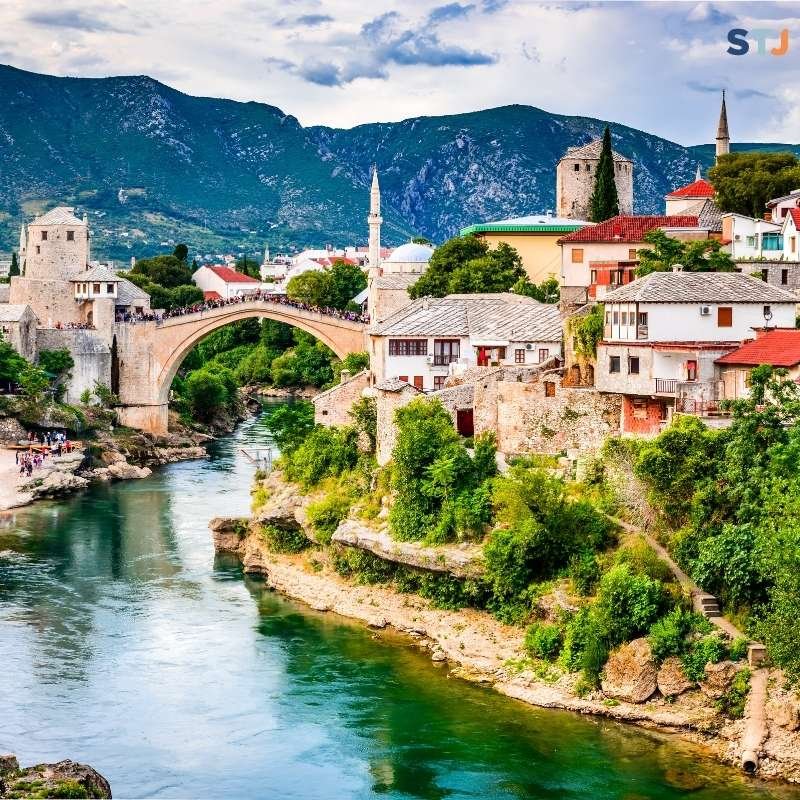
The same happens, on a different scale, outside the capital. The Ottoman bridges, Stari Most in Mostar, rebuilt in 2004 eleven years after its destruction, and the Mehmed Paša Sokolović Bridge over the Drina at Višegrad, which Andrić turned into a novel, are the Bosnian monument par excellence. But their value comes from the logic that explains them, not from being isolated objects: the river narrowing the valley, the caravan route that linked Sarajevo with Istanbul, the medieval fortress on the opposite slope. That same logic explains the towns tourism has yet to put on the map: Jajce, former capital of the medieval Bosnian kingdom, with an urban waterfall where the Pliva plunges into the Vrbas; Travnik, the Ottoman seat of the vizier, its mosques lined up opposite Austro-Hungarian buildings; Počitelj, carved into the slope above the Neretva, partly abandoned during the war and now slowly being restored; Blagaj, where a sixteenth-century dervish tekke literally rests on the spring of the river Buna. And it also explains the natural counterpoint: Sutjeska, in the south-east, is home to Perućica, one of Europe’s last primeval forests, whose only effective protection for centuries has been the lack of road access.
What links everyday life in Sarajevo with its cultural heritage is a refusal to crumble into dust. A six-hour session in a basement, where what matters is the rising curve of the small hours, doesn’t export well. Nor does a historical route between three medieval towns, where what matters is the relationship between them rather than each one on its own. Bosnia and Herzegovina’s tourism grew at annual rates close to 10% before the pandemic and has already returned to those levels. So the practical question is not whether to expand, since that is already happening, but according to what logic. The monument-by-monument consumption common in established destinations translates this country badly: flattening it into a list of disconnected places removes precisely what makes it special.
Bosnia is one of the few places in Europe where history remains visible both in the landscape and in daily life. Sarajevo’s basements, the Ottoman bridges, the medieval towns and the primeval forests are not mere relics for visitors; they are part of a system that has started working again. Recognising that system as a whole, rather than isolating its parts, is probably the only way to understand what makes the country worth visiting. It is also the only way to travel through it without contributing to the decline of the very things you came to discover. So the relevant question is not whether Bosnia deserves more tourists, but what kind of tourism is right for the benefit of Bosnian communities and heritage. The answer will largely determine which parts of the country remain intact in the decades to come.
Claudia Terreros wrote this piece as part of their training at the School of Travel Journalism. If it inspired you, take a look at our Master in Travel Journalism and our Master in Gastronomic Journalism and Communication, watch our students’ travel documentaries on YouTube and listen to their stories on our podcast on Spotify.
Interested in writing about travel that explores the extraordinary? Discover the Master in Travel Journalism and the Master in Gastronomic Journalism and Communication at the School of Travel Journalism.