
By Salomé Carreira
Salema
Where tourism regenerates nature.
We spent the night in Sagres and were supposed to arrive in Salema by noon, according to the instructions from the front desk clerk who had assisted us the day before. He told us, “You don’t need to make a reservation; with RVs, you can just show up, but if you arrive by noon, you’ll have a better chance of getting a good spot.” We woke up with limited time, yet we first took a brief detour through the clearings near the Arade Dam. I wanted to show André the sanctuary where thirty Iberian lynxes (Lynx pardinus) live and flourish, safeguarding the survival of their species.
Upon arrival, the descent revealed the first challenge: a steep cobblestone path. After taking a deep breath and shifting into first gear, we made our way down without incident. The receptionist, with an understanding smile, suggested we park the van in front of the reception area to check in. Then, another staff member, in a small electric vehicle resembling a golf cart, guided us to our spot located at the top of a small hill overlooking a wooded clearing. The site was spacious and well-defined, with access to electricity and water. As we parked, we exchanged greetings with our neighbors. A striking feature of motorhome travel and camping is the camaraderie among travelers: there’s a custom of greeting one another, sharing food, and enjoying the sense of lightheartedness that hangs in the air; however, this closeness never becomes intrusive, as everyone maintains their own refuge on wheels.
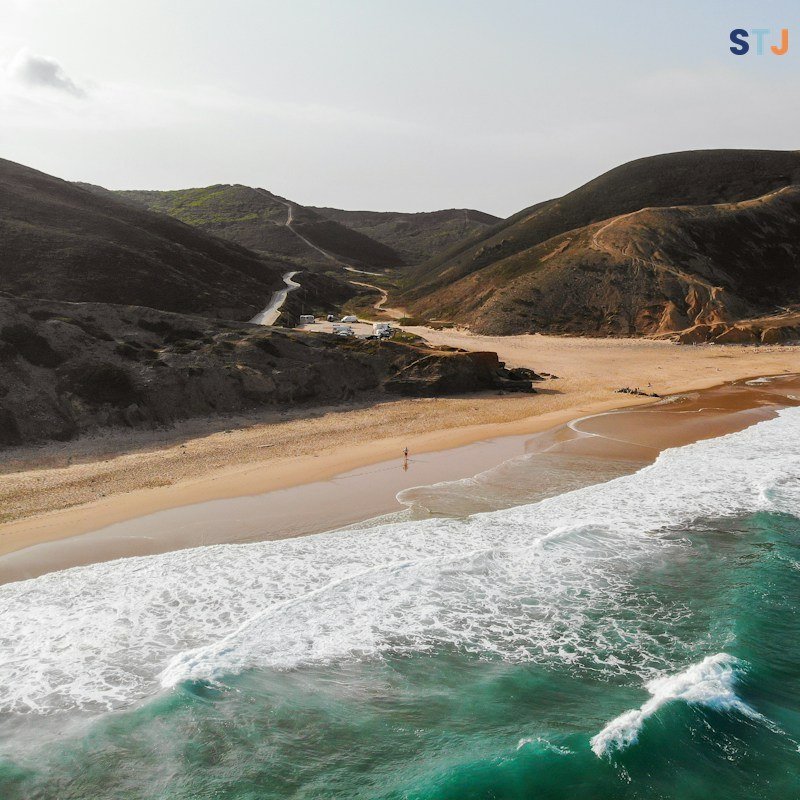
Salema Eco Camp is located in the Algarve, within the Costa Vicentina and Southwest Alentejo Natural Park. It is certified by Green Key, the Verified Carbon Standard, and Zero Waste.
The entire camp embodies Regenerative Tourism: the energy used is mostly solar; recycling stations and a composting system are available to visitors; cleaning products are natural or eco-certified; and the water used on the premises is treated by the camp and returned to the environment. At Nazari, the park’s restaurant, each dish is labeled with its carbon footprint so that travelers can make more conscious and sustainable choices. Small gestures, taken together, make a big difference.
The park offers various lodging options: RV camping, teepees, and glamping for a few days of simplicity and nature; yurts (circular dwellings reminiscent of the nomadic peoples of Central Asia) are an excellent choice for those who prefer greater privacy and a unique experience; and for those who don’t want to sacrifice comfort, there are small studios.
When it comes to sustainable tourism, the glamping area called INLAND is particularly noteworthy, as each stay helps support AGRICOF— the Corvo and Formiguinhas Farmers’ Association— in Santo Antão, Cape Verde. This collaboration is part of international ecological and regeneration initiatives, serving as a clear example of how environmentally conscious choices translate into benefits for the community.
Since 2023, Salema Eco Camp has been developing the SER team, which stands for the pillars of sustainability, ecology, and regeneration. This initiative operates in close collaboration with the local community, universities, and international organizations. In 2025, the camp invested in a decarbonization project at the Chubut wind farm in Argentina.
In addition to ecosystem restoration practices, the park also promotes activities that restore the well-being of its visitors. Casa Alma Mater is a welcoming space dedicated to yoga classes and meditation sessions, demonstrating that the health of the land is closely linked to the health of people.
Salema Eco Camp is not just a place to sleep. It is an immersive experience in nature where natural and social diversity are celebrated and where the local ecosystem is renewed, bringing hope for a more sustainable and harmonious world.
Island of Tavira
Where traveling means protecting an ecosystem.
We left Salema around nine in the morning and took the A22 highway toward Tavira. At one in the afternoon, we bought round-trip tickets to the island for €2.75 each. The ferry crossed the Ria Formosa for thirty minutes until we reached the island, where we were greeted by a landscape of dunes and a calm sea.
As you walk along the golden sand trails, you’ll find information about invasive plant species and endemic animal species, such as the common chameleon (Chamaeleo chamaeleon) and the white stork (Ciconia ciconia). If you’re interested in volunteering with wildlife, RIAS—the wildlife rehabilitation center—takes in these and other species. Due to its natural importance, the island’s ecosystem is protected by the Natura 2000 network and the Ramsar Convention.
You can feel the peace of a place where cars don’t drive. The surrounding vegetation, with its large trees, combined with the constant sea breeze, creates an atmosphere of tranquility that makes you lose track of time.
On the island, the only tourist accommodation available is ORLA—an ecoglamping site that preserves the landscape with its shades of sand and the dark green of the maritime pines along the seashore. The resort describes its facilities as responsible and eco-conscious: it uses 100% green energy, the faucets have a coin slot to regulate water consumption, and the water is heated by heat pumps. The resort features a supermarket and a restaurant named Come na Gaveta. The restaurant’s name comes from a Portuguese proverb that tells of how the people of Tavira used to eat in secret from a drawer.
One of the most famous delicacies is the oysters from the Ria Formosa— however, high consumption of these bivalves can jeopardize the ecosystem’s sustainability. Their consumption should only be considered sustainable when it comes from legal production or harvesting.
The sun sets, and we travel to a distant land where the sunset paints the sky in shades of orange and pink, and the golden light envelops the landscape, creating a serene and almost magical atmosphere.
In ORLA, the lights illuminate a path that seems endless, and the night makes itself heard. This is not the silence of isolation, but rather the awakening of another way of life. Inside the tent, we watch the leaves brush against the canvas, sounding like drops of heavy rain; birds fly low overhead, and from outside, we sense the footsteps of the other guests, though they do not disturb our rest. The experience truly awakens the senses.
The next day, I woke up to ambient music—birds, the rustling of leaves, and the wooden walkway that gently gives way beneath my feet. I got up slowly, as if any sudden movement might shatter the tranquility of that morning. When I gently unzipped the tent, I became part of that ecosystem.
After a final swim in the island’s crystal-clear waters, we returned to the city and enjoyed lunch at Marés Bistro Bar, where the sweet potato purée with fried baby squid was exceptional. We then drove for 45 minutes toward Odeleite.
Castro Marim
Where luxury means having time, good food, and a few flamingos in the landscape.
The wind was dry and heavy, conducive to wildfires; however, the mountainous landscape seemed to escape that threat, assuring us that the land is accustomed to such conditions. We arrived at Natur Amendoa, the lodging where the hours are dictated by the rhythm of nature. The scent of almond trees wafts to the hotel’s entrance. There are plenty of almonds and plenty of time for you to pick them from the tree and peel them yourself. The pool, surrounded by a landscape stretching as far as the eye can see, invited us to take a late-afternoon swim, but first we needed to unpack our bags.
The property has just five rooms, a living room, and a kitchen open to guests. The commitment to sustainability is evident in the property’s design, which uses reclaimed materials—such as wooden pallets for benches. Furthermore, Natur Amêndoa has signed an environmental policy statement, committing to the careful use of natural resources, the prevention of pollution, and contributing to environmental protection.
Our room was named “Casulo”: it stood out for its wooden porch that stretched all the way to the edge of the mountains, greeting the valley from morning until night. I must admit that the air conditioning saved us that afternoon. The heat was relentless, and the buzzing of the cicadas seemed to intensify the sensation of the high temperature. The room was decorated in shades of lime white and earthy brown, blending seamlessly with the landscape. I couldn’t resist flipping through the book under the bed: Food, Nature, and Landscape. The pages spoke of sustainability and connection to the land, of innovative recipes using local ingredients, and of stories that celebrated the simplicity of rural life. One of the phrases that inspired me most was a quote from Albert Einstein: “Observe nature closely, and you will understand everything better.”
After a break, it was time for some fun! The refreshing citrus-flavored drinks cut through the afternoon heat, and the sweet scent of sugarcane mingled with the gentle breeze. A dip in the pool left us feeling light, and for a few brief moments we forgot our surroundings and became one with the landscape.
The afternoon light reflected the last rays of the sun on the water. A woman— the only one we’d seen so far—told us, “The sunset here is spectacular; you can see it really well from up here. It must be almost time.”
The sunset was set to take place around nine o’clock at night, which gave us a few more minutes to arrange our towels and choose the best vantage point. We dried off and looked for the stack of pallets that offered the best view. With our refreshments still in hand, we watched one of nature’s most beautiful spectacles.
While in Tavira, the end of the day transports us to an arid landscape; here, the sun sets over the almond trees lined up along the mountains, as if on a chessboard. The contrast between the golden light and the dark green of the trees created a unique visual harmony; the absence of people stands in contrast to the Algarve coastline and teaches us that the world we inhabit is filled with much more than just people. There, far from the hustle and bustle of tourism, we disconnected from the outside world and found peace.
The silence of the mountains enveloped us in a serene and moving embrace. We gazed at the brilliant sky, feeling the immensity of the universe pulsating above us. The low light pollution allowed the natural darkness of the night to prevail, revealing thousands of stars that, in urban areas, remain hidden by the artificial glow reflected in the atmosphere.
The next morning, we set out to explore the Sapal de Castro Marim and Vila Real de Santo António Nature Reserve. Spanning nearly two thousand hectares, this area features a landscape where water, salt, and wildlife come together to create a scene that seems to change with every step. Here, birdwatching reigns supreme.
At lunchtime, we left the marsh behind and headed to Taberna Medieval – O Velho Cavalinho. Carlos, the owner, welcomed us with the ease of someone who knows well the art of turning a meal into an experience. Up front, the fire blazed as Afonso cooked the⒈enchidos. Appetizers, craft beer, and hidromel—a drink that’s part of the establishment’s identity—arrived at the table. But it was the seasoned tuna that ultimately stole the show. Amid laughter, conversation, and the crackling of the fire, for a moment it seemed as though we had stepped through an invisible door and entered the 15th century.
Back in the salt marshes, salt reclaimed its rightful place. Traditional salt production remains an integral part of this region’s identity. And when a landscape ceases to be merely admired and begins to sustain those who live there, tourism can become a tool for preserving traditions. Here, salt also becomes an experience: body treatments featuring coarse-grain salt scrubs and clay applications are one of the ways found to make the most of this resource and create new sources of income. The millennia-old salt production has received high-quality certification from the International Federation Nature et Progrès and Sativa.
I left the crowd behind for half an hour, and it was during that brief moment that the salt marsh revealed itself— a gull, three flamingos, a great egret, a black-winged stilt, a spoonbill, and a common tern. Six species gathered in a silence that seemed to belong only to them.
The glasswort kissed my feet. The Guadiana River flowed beside me, slowly setting the rhythm of the landscape. On the other side of the riverbank lay Ayamonte, Spain. There, I realized that perhaps this is what we seek when we travel into nature: not more things to see, but time to observe.
⒈Enchidos: a traditional food product made from minced or chopped meat, usually seasoned with salt, spices, and other ingredients, and stuffed into a natural or artificial casing.
Mértola
Where conservation, tourism, and hunting coexist.
The heat we felt in Castro Marim became our traveling companion, clinging to our skin and the car windows. At the entrance to Mértola, the castle greeted us, and immediately afterward, a landscape of a thousand horizons opened up before us.
The lodging we chose was Casa do Monte, a country estate converted for rural tourism, fifteen minutes from the center of the village. As soon as we entered, I counted no more than eight guests. The space seemed designed to accommodate many more: spacious, quiet, surrounded by a lush garden and a swimming pool with simple lines that seemed to be waiting patiently for travelers.
A gentleman, seated in one of the few shaded spots, showed us the way to the rooms. The path led through the main hall, and that’s where I began to notice the details. Above the fireplace, a deer’s head stood motionless, watchful, as if observing every arrival. Fox pelts lay beneath a varnished wooden chest. Next to the glass cabinet stood a ceramic crocodile. I continued down the hallway, and unexpectedly, I saw a sign advertising the sale of farm-fresh eggs on the estate.
We finally reached the bedroom. Ours was themed around the Iberian lynx. Each room represented an animal—a choice that, at first glance, seemed intended to celebrate the wildlife that inhabits these landscapes. But there was a contradiction that was hard to ignore. In the bedroom, the lynx was honored. In the lounge, the animals were hunting trophies. And I was left with a question I couldn’t shake: is it possible to admire wildlife and, at the same time, harbor the desire to kill it?
And at that moment, the lynx in our room seemed to me to be more than just a decorative choice. It became a question.
As dusk fell, we heard them: dozens of dogs barking, anxious, restless— emotions that ripple through the air and reach us. Around the same time, the promised eggs were being collected; they would be our breakfast the next day. We started the morning with Laura, the estate manager. Laura had left Lisbon for Mértola, driven by a desire for a calmer life. In the capital, she told us, she used to dream of vacations. In the Alentejo, that desire seemed to have evaporated—perhaps carried away by the heat, perhaps by the tranquility of the days in the hills.
In the middle of our conversation, I told Laura that I’m a veterinarian and that I’ve worked on the conservation of the Iberian lynx. She knew exactly what I was talking about. Mértola is one of the areas in Portugal where this species has once again found a place to live, and around here, encounters with the lynx are part of the community’s stories. Laura told me one such story. A few years ago, at the end of the day, she was driving home with her two daughters when a huge animal leaped in front of her van. The shock came first. Admiration followed soon after. When it finished its leap, the animal stopped next to the van and stood there, calm, as if nothing extraordinary had happened.
It was an Iberian lynx. Her daughters, curious, asked her what that animal was. And Laura, probably still trying to believe what had just happened, had the rare opportunity to observe up close one of the most endangered and iconic symbols of this landscape.
The conversation led us to the topic of hunting. Laura shared with us that, during hunting season, occupancy at Casa do Monte increases. And it was also in this context that another topic arose: sustainability. The manager confessed to us that it isn’t always easy to explain to guests that natural resources have limits. In the summer, water becomes particularly scarce in the Alentejo. Droughts are recurrent, and in a region where every drop counts, the conscious use of this resource is no longer just a recommendation—it’s a necessity. That’s why they ask guests to use towels responsibly. One guest’s response stuck with Laura: “I’m paying. I have the right to use whatever I want.”
I found myself thinking about that statement. Perhaps this is one of the greatest challenges of sustainable tourism: making people understand that paying for a stay does not mean buying the right to consume a region without limits.
Efforts by those who manage these spaces do exist, but they don’t always reach the visitors. The estate adopts low-impact practices, such as energyefficient lighting, offering homemade and local products, and encouraging guests to explore the region through hiking and cycling.
On our last day in Mértola, we embarked on an almost relentless search for suitable glasses to view the total eclipse that would cross the skies over Portugal that night—a rare event that hadn’t occurred in the country for 114 years.
We knew we would be watching the eclipse at our next destination, but we still had time for one last stop: Terra Sintrópica—a nongovernmental organization dedicated to agroecological transition, ecosystem regeneration, food sovereignty, and the promotion of the local economy. Terra Sintrópica operates within the Ongoing Regenerative Process (PREC), a space where visitors can learn about these practices up close, sample local cuisine, and purchase seasonal products.
At the PREC, we sampled Bolo da Vera, a sweet bread topped with a generous layer of shredded coconut and condensed milk. But the story behind it was even sweeter. As the name suggests, it was created by Vera, the friendly Cape Verdean woman who served us lunch. The recipe stems from her roots and the inspiration of her mother, who passed down the traditions of Cape Verdean pastry-making to her. When we tasted Vera’s Cake, we weren’t just trying a dessert—we were also contributing to Vera’s dream of building a business with its own unique identity.
It’s this kind of encounter that adds another dimension to a trip. When food ceases to be just food and begins to tell the story of who prepares it, where it came from, and where it’s headed.
Perhaps it is because of all these qualities that Mértola was the first municipality in the Alentejo to obtain Biosphere Sustainable certification—a recognition of a region that seeks to harmonize tourism, community, culture, and sustainability.
Pedrogão do Alentejo
Where a destination ceases to be merely a place and becomes a connection. We arrived at our final destination: Pedrógão do Alentejo. It is a village located 1 hour and 30 minutes from Mértola, with 937 residents, where the weather dictates the daily rhythm. As we walked into a local café, the heat was the main topic of conversation. Feeling quickly at home thanks to the warm welcome, I remarked, “I don’t know how you stand this heat.” The owner replied firmly, “For us, it’s normal—we were born and raised here. We only stop working when it goes over 46°C.” In Pedrógão’s summer, time is felt, not counted, just as in Salvador Dalí’s painting, The Persistence of Memory.
The lodging we chose was Casa de Pedrógão, located in the center of the village. When I close my eyes, I recall the cool air circulating between the white walls and the light-colored wooden doors, the pool area with its six lounge chairs, and the fig tree in the neighboring yard, where a small plastic chair had been strategically placed for one of the most typical pastimes of a true Portuguese: picking figs!
Meanwhile, national television was fueling anticipation for the solar eclipse, a phenomenon that has been interpreted in various ways over the millennia. In ancient China, it was believed that a dragon devoured the Sun, prompting noisy rituals to drive it away. For the Incas, the event signaled the discontent of the god Inti, requiring fasting and offerings. In ancient Greece, it was seen as a sign of divine wrath.
Since the eclipse glasses were sold out, we improvised a device using a piece of cardboard with a hole punched in it and a white sheet of paper: by aligning the sunlight through the hole, the paper revealed the projection of the moon passing in front of the sun. It didn’t take long before the village children began to gather around us, asking, “What’s that? What are you doing?” “We’re watching the eclipse—come on over,” I’d reply. And they’d cup their hands over their eyes, visibly amazed.
Their enthusiasm was so great that, in the blink of an eye, six children had joined us to watch the eclipse through the small piece of cardboard. Those children brought me back to myself. In them, I recognized my inner child, and in those moments, I didn’t need to be anything else. In this context, the word “authenticity” sheds the cliché that so often accompanies it in tourism discourse and regains its purity and elegance.
However, Pedrógão isn’t defined solely by the daytime and the heat. The village is located in the Alqueva region, where Dark Sky tourism takes center stage. Experiences such as canoeing under the stars, night photography workshops, and nocturnal birdwatching await discovery.
The night offers us a true open-air cinema—the night of the Perseids. According to NASA, the Perseids are particles left behind by Comet 109P/Swift-Tuttle that, upon entering Earth’s atmosphere, produce the luminous, colorful trails we see in the sky. To identify what our eyes were seeing, we used the ⒉Stellarium app, which showed us the constellation Perseus: the point in the sky from which the Perseids appear to radiate.
At dawn, we left the Alentejo. It was time to go. My 2010 Suzuki needed a break from the heat. As I drove home, clouds had already taken over the sky, bringing with them a welcome shade after days of intense sunshine.
⒉Stellarium: an app that transforms the real sky into an interactive map, allowing users to identify stars, planets, constellations, and other celestial objects in real time.
Note on Sources: This chronicle is the result of documentary research conducted before and during the trip, supplemented by direct observation, field experience, and informal conversations with people encountered along the way. The factual information was crosschecked against institutional and other public sources.
This article is part of Salomé Carreira’s Final Master’s Project for the Master in Travel Journalism at the School of Travel Journalism.
Salomé Carreira wrote this piece as part of the Final Master’s Project for the School of Travel Journalism. If it inspired you, explore the Master’s Degree in Travel Journalism and the Master in Gastronomic Journalism and Communication, watch our students’ travel documentaries on YouTube, and listen to their stories on our Spotify podcast.
This article is part of Salomé Carreira’s final Master’s project for the Master in Travel Journalism at the School of Travel Journalism (class of 2026).