
By Marianna Campigotto
Golden ceilings, turquoise domes and intricate mosaics adorn the cities of the ancient Silk Road, where centuries of history have been preserved in astonishing architectural splendour. Samarkand, Bukhara and Khiva evoke images of caravans crossing deserts, merchants trading precious fabrics and spices along the centuries, and scholars studying the mysteries of the universe. Behind the beauty and grandiosity of it all, darker stories linger.
Sanjar Azizov speaks of his homeland, Uzbekistan, as a place of extraordinary cultural richness, shaped by the passage of Persian, Greek, Turkic, Arab and Mongol civilisations, and the ambitions of the empires that rose and fell in their wake. In between tales of magnificent monuments and ancient cities, it is the darker stories that linger in the imagination. An astronomer betrayed by his own son. A minaret and the legend of a condemned architect. A sea slowly sacrificed in the name of progress.
Beneath the splendour of the Silk Road lies another Uzbekistan, whose beauty is intertwined with tragedy, mystery and loss, like fragments of the past. Speckles of gold.
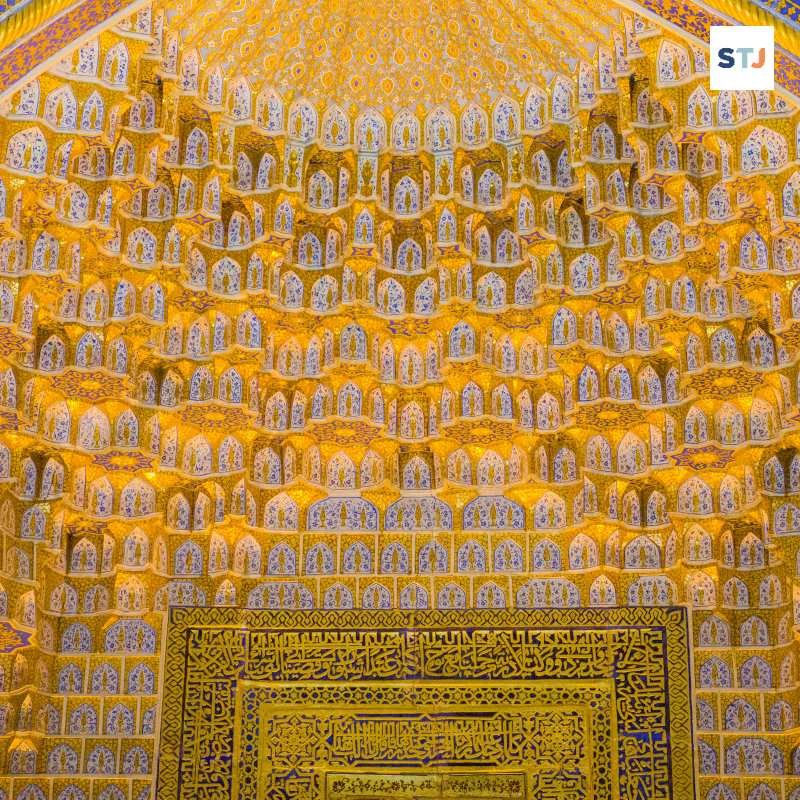
The astronomer who could not foresee his fate
In Samarkand, a city revealing the splendour of the Timurid Empire, one of history’s most fascinating tragedies unfolded beneath the stars. Ulugh Beg, grandson of the conqueror Timur, was an unusual ruler. While others sought glory through territorial expansion, he found his passion in mathematics and astronomy. During the fifteenth century, he transformed Samarkand into an important centre of scientific learning, commissioning an observatory where scholars mapped the skies with remarkable precision.
Ironically, the man who could calculate the movements of celestial bodies could not predict the betrayal awaiting him on Earth. In 1449, following a struggle for power, Ulugh Beg was murdered on the orders of his own son, Abd al-Latif. His observatory eventually fell into ruin, its remains buried and forgotten until their rediscovery in the early twentieth century. There is something profoundly haunting about this story. A man who dedicated his life to understanding the universe was destroyed by the earthly ambitions of his own family. A destiny written in the stars.
The unfinished tower of Khiva
Further west, the walled city of Khiva appears. Its labyrinth of narrow streets, mud-brick walls and blue-tiled monuments preserves the atmosphere of an ancient trading city. Among its architectural treasures stands Kalta Minor, a magnificent turquoise minaret whose unusual proportions reveal an ambition never fulfilled. Its construction began under Muhammad Amin Khan in the 1850s, with plans for a tower that would dominate the surrounding landscape, almost like a lighthouse in the vast desert plains.
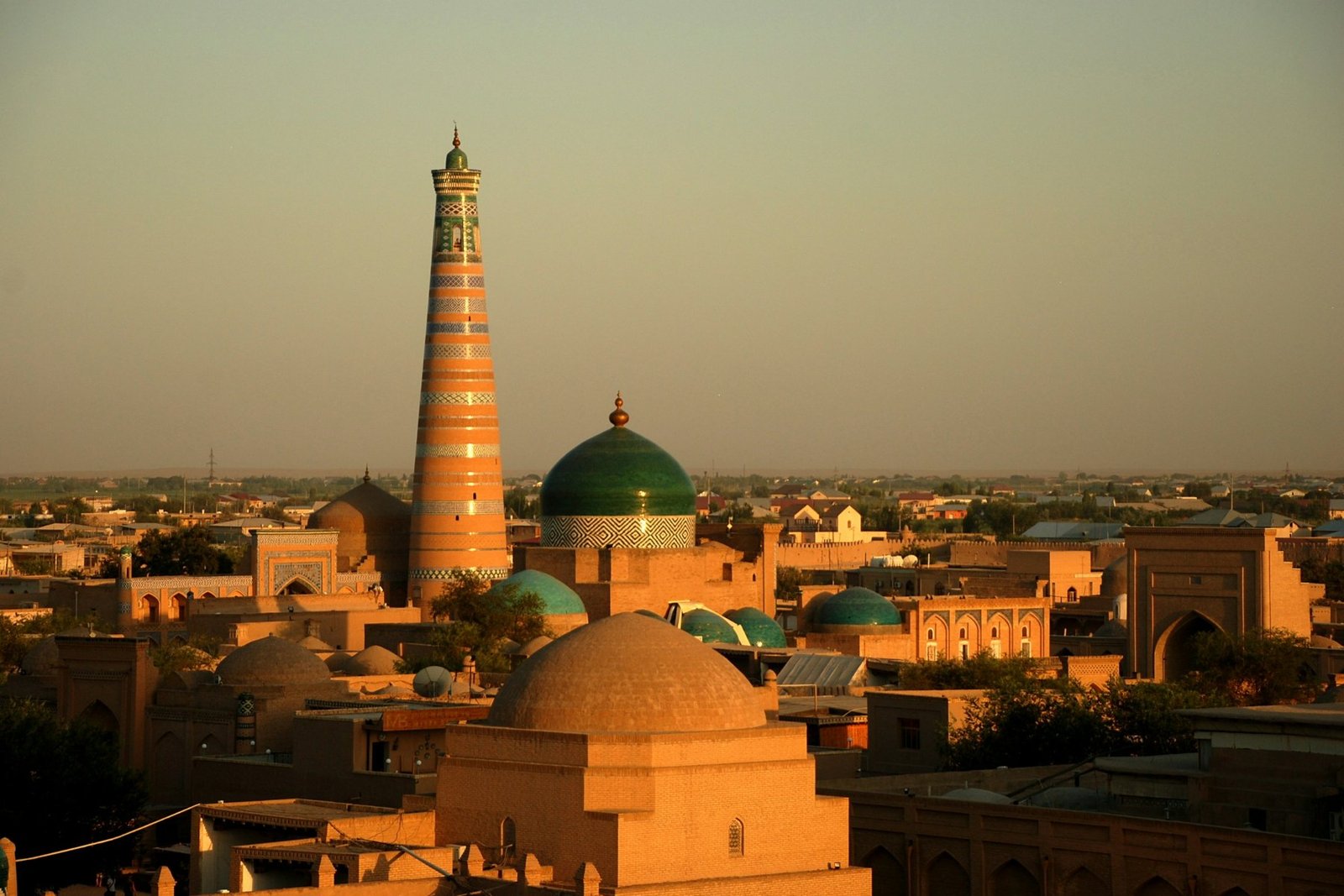
Yet the minaret was never completed. History offers a straightforward explanation: work stopped after the Khan’s death in 1855. Folklore, however, prefers a more sinister ending. According to one version of the legend, the Emir of Bukhara secretly approached the architect, hoping to commission an even bigger tower. When the Khan of Khiva discovered the arrangement, he ordered the architect’s execution.
Whether the story contains any historical truth or not, it is fascinating how legends inhabit unfinished places. Kalta Minor remains beautiful because it is incomplete. Its missing part invites the imagination to complete what history abandoned. Both the building and the story behind it.
The sea that became a ghost
Uzbekistan’s most unsettling ghost lies in the northwest of the country, where rusting fishing boats now rest on dry ground, surrounded by a landscape that was once underwater.
The Aral Sea used to be one of the world’s largest inland bodies of water. Its shores supported fishing communities and thriving ecosystems. Then came the Soviet Union’s ambition to transform the arid landscapes of Central Asia into vast agricultural fields. Beginning in the mid-twentieth century, enormous quantities of water were diverted from the rivers feeding the Aral Sea to irrigate cotton plantations. Cotton became the region’s white gold, a symbol of economic power and ambition. But its price was devastating. As the water retreated, fishing communities lost their supplies, ecosystems collapsed and exposed seabeds became sources of contaminated dust. Around the former port of Muynak, abandoned boats now stand as monuments to a vanished past.
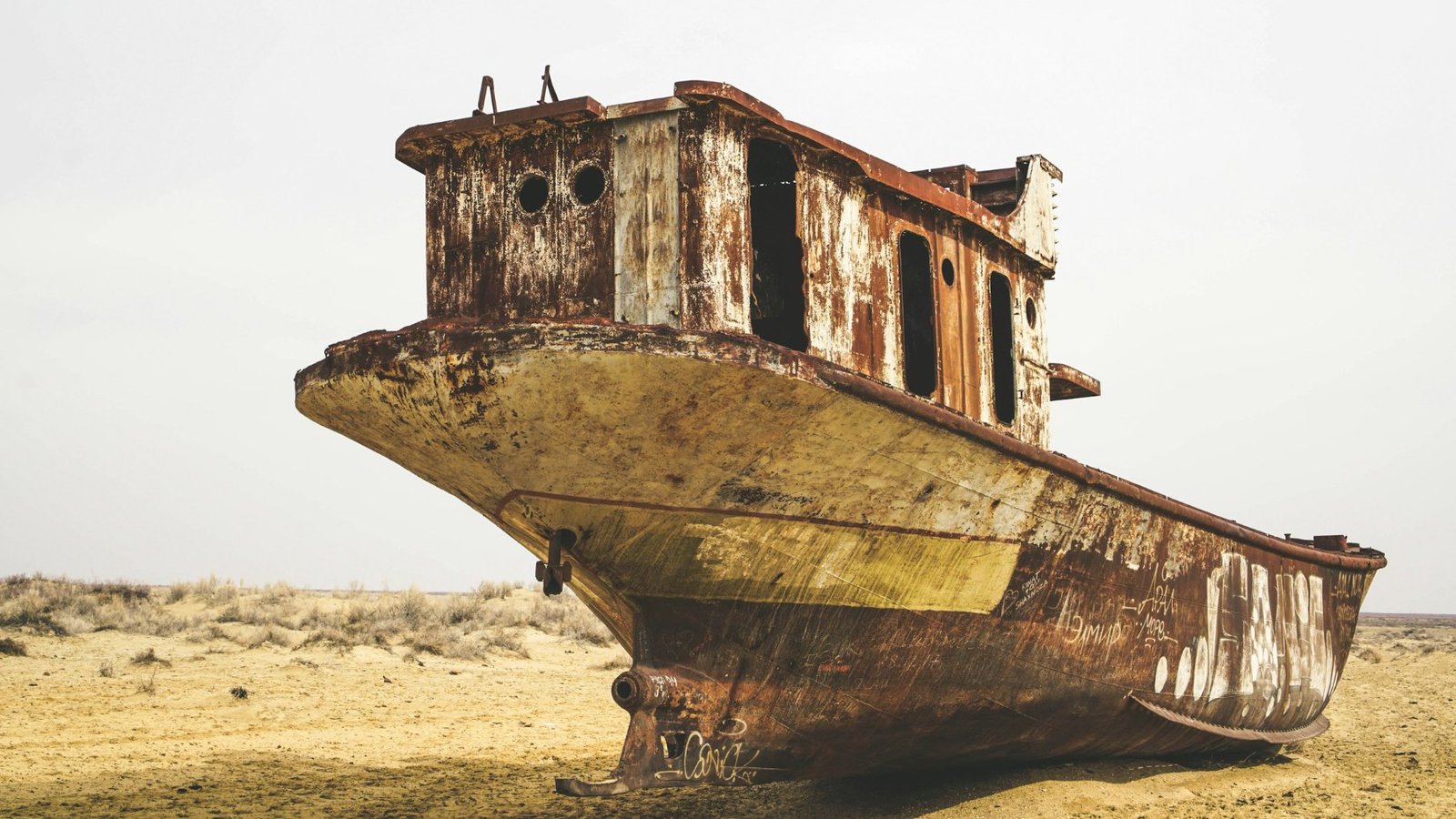
Although restoration efforts have helped parts of the northern Aral Sea recover, much of the southern basin remains severely damaged. Unlike the legends of Khiva, here the ghosts are real: the fishing boats, the abandoned shoreline, an ecosystem forever lost to eternal dust. The loss is rarely sudden: nature is gradually sacrificed, and the consequences of it may outlive mankind.
What remains beneath the gold
A ruler’s desire for power destroyed an astronomer. Another ruler’s pursuit of grandeur left a tower unfinished. Centuries later, the ambition to reshape nature contributed to the disappearance of a sea. Reducing Uzbekistan to its tragedies would be as misleading as seeing only its golden monuments. Its history is also one of extraordinary creativity, scientific achievement and cultural resilience.
Sanjar Azizov’s masterclass awakened a desire to look beyond the beauty that first attracts travellers, and to consider the stories that give it depth. As Uzbekistan slowly emerges from the fog of its past, opening its doors to the world, perhaps its greatest beauty lies in the stories it has preserved, as much as in the new ones it is ready to tell.
Marianna Campigotto wrote this piece as part of her training in the Master in Travel Journalism at the School of Travel Journalism, after the masterclass on Uzbekistan given by Sanjar Azizov.
Want to turn your travels into stories that get published? Discover the Master in Travel Journalism and the Master in Gastronomic Journalism and Communication at the School of Travel Journalism.