
By Mónica Romero
“Costa da Morte” series · Part 2 of 10. A series by Mónica Romero, written as part of her final project for the Master in Travel Journalism at the School of Travel Journalism (2026).
Costa da Morte cannot be crossed in a hurry. And it would be a shame to try.
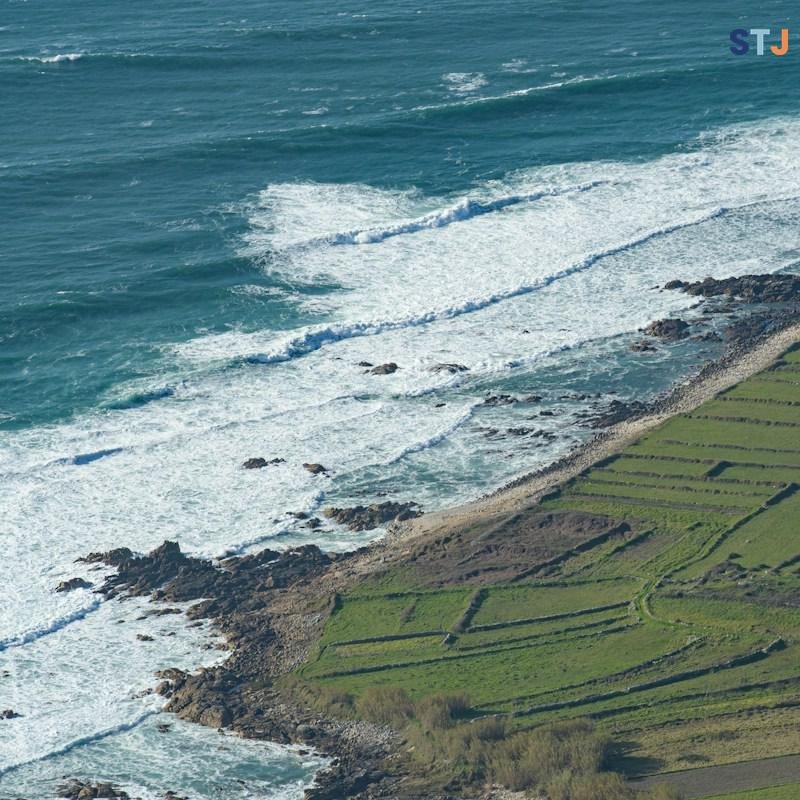
The roads along this stretch of the Galician coast seem designed to make us change pace: bends, small harbours, tracks leading to capes where there seems to be nothing, and detours that end up revealing beaches, cliffs or fishing villages.
That is why a lighthouse route works much better when we stop counting kilometres and start counting stops.
There is also a reference hiking trail, O Camiño dos Faros (the Lighthouse Way), which links Malpica and Fisterra over roughly 200 kilometres divided into eight stages. This itinerary, however, is designed mainly to be done by car over three days, and stretched to four or five if you want to walk, take photographs and linger without constantly checking the clock.
Day 1. Malpica, Punta Nariga, O Roncudo and Laxe
Malpica works perfectly as a starting point. Before setting off, head down to the harbour and look out towards the Sisargas Islands, home to the first lighthouse on our route.
From there we continue to Punta Nariga.
The change is spectacular. The lighthouse, designed by César Portela and in service since 1998, looks like the bow of a granite ship pointing towards the Atlantic.
Next we head for Corme and Punta do Roncudo. Here the lighthouse is no longer the only protagonist. The rocks, the crosses dedicated to barnacle gatherers who died at sea and the sound of the waves say a great deal about the relationship between this coast and the people who make a living from it.
Before reaching Laxe, it is worth taking a detour to the Monte Branco viewpoint. From here you can see the Anllóns estuary, Barra beach and much of the Corme e Laxe estuary.
Spending the night in Laxe lets you end the day with a walk to its lighthouse.
Day 2. Camelle, the English Cemetery, Cabo Vilán and Camariñas
This is the day of the shipwrecks.
The road first takes us to Camelle and Arou. In Camelle, the church of Divino Espírito Santo still holds a small bell that belonged to the City of Agra, wrecked in 1897.
From here, continue to the Trece inlet and the Cementerio de los Ingleses, the English Cemetery.
The site is closely linked to HMS Serpent, which sank off Punta do Boi on the night of 10 November 1890. Only three of her crew survived.
Arriving at Cabo Vilán afterwards helps you understand the next chapter of the story. The Serpent tragedy helped speed up improvements to maritime signalling in the area, and in 1896 the current electric lighthouse came into service.
You can spend the night in Camariñas, with time to stroll around the harbour and discover another of the town’s identities: bobbin lace.
Day 3. Muxía, Touriñán, Nemiña and Fisterra
The morning begins in Muxía, next to the sanctuary of A Virxe da Barca.
Here the Camino de Santiago, seafaring tradition and legends linked to the great stones surrounding the sanctuary all come together.
From Muxía we continue to Cabo Touriñán. There are two lighthouses: the old one, from the late 19th century, and the current one. But what is truly impressive is the space. Touriñán is the westernmost point of mainland Spain and one of those places where the horizon seems to take up half of the photograph.
Afterwards you can stop at Nemiña and continue to O Rostro beach before reaching Fisterra.
Save the final stretch for sunset.
What if you have four or five days?
Then the real luxury appears: travelling slowly.
You can devote the fourth day to Corcubión, Cee, the O Ézaro waterfall and its viewpoint, from which you can take in the Xallas river, Monte Pindo, the Atlantic and, in the distance, Fisterra.
The fifth day can be used to revisit places in a different light, walk short trails or simply stay put.
Because that may well be the best way to travel along Costa da Morte.
Arrive with a carefully planned route, and let the Atlantic rearrange it for you.
This article is part of Mónica Romero’s final project for the Master in Travel Journalism at the School of Travel Journalism.
Mónica Romero wrote this piece as the final project of her training at the School of Travel Journalism. If it inspired you, take a look at our Master in Travel Journalism and our Master in Gastronomic Journalism and Communication, watch our students’ travel documentaries on YouTube and listen to their stories on our podcast on Spotify.
← Previous instalment: The “End of the World” Lighthouses of Costa da Morte: Where the Map Ends and the Atlantic Begins
Next instalment (7 November): The Shipwrecks That Named Costa da Morte: 8 True Stories and What Remains of Them Today →
All parts of the “Costa da Morte” series
- 1. The “End of the World” Lighthouses of Costa da Morte: Where the Map Ends and the Atlantic Begins
- 2. A 3–5 Day Lighthouse Route Along Costa da Morte: Scenic Itinerary, Stops and Experiences (you are here)
- 3. The Shipwrecks That Named Costa da Morte: 8 True Stories and What Remains of Them Today
- 4. Cabo Vilán: The Light Born of Fear and Storms
- 5. Fisterra: The Lighthouse at the End… and the Beginning of Many Lives
- 6. Touriñán at Sunset: The Ritual of the Last Light
- 7. The Lighthouse Keeper’s Life: From Isolation to Automation
- 8. Coastal Legends: Raqueiros, Stones with Memory and Other Tales Still Told
- 9. 12 Costa da Morte Viewpoints for Breathtaking Sunsets
- 10. Photographing Lighthouses and Storms on Costa da Morte: Gear, Safety, Framing and Golden Hours