
By Laia Ávila
As you approach the entrance to Simud Hitam cave, the air fills with a powerful stench: a pungent mix of damp and guano typical of this peculiar ecosystem. Far above, at the top of the 90-metre-high cave, human silhouettes climb nimbly up hanging wooden ladders, while swiftlets dart past at high speed, sharing the air with bats beginning to leave at dusk. On the ground, a carpet of invertebrates stirs underfoot.
The Gomantong Caves, in Sabah, Borneo, are not only a natural refuge for wildlife but also one of the harvesting centres for a luxury delicacy: edible swiftlet nests. Made mainly of hardened swiftlet saliva, these nests are prized in gastronomy, especially in China, where they are used to make the famous bird’s nest soup.
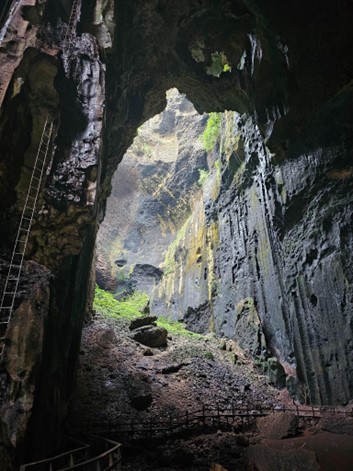
But the process is neither simple nor risk-free. Harvesters climb up and down the ladders, braving extreme heights and dangerous working conditions. Lower-quality nests, made of saliva, feathers and other materials, are found in Simud Hitam, while the most valuable ones, made only of saliva, are in Simud Putih cave, which remains closed to the public. These nests can fetch more than €2,000 a kilo, making the harvest a crucial economic activity for local communities.
According to an article published in The Star (2024), Malaysia’s Ministry of Science, Technology and Innovation has highlighted the country’s key role as one of the world’s leading producers of edible bird’s nests. Looking ahead, Malaysia is expected to export around 350,000 kilos of swiftlet nests by 2030, worth 2.8 billion ringgit (about €560 million). According to minister Chang Lih Kang, the industry has become an invaluable resource in a global market estimated at
100 billion US dollars (around 470 billion ringgit) in 2023 (The Star, 2024).
The high value of the nests puts heavy pressure on swiftlet populations. To address this, the aim is to ensure that local communities with traditional harvesting rights don’t lose income to illegal harvesting, which is why the harvesters live close to the caves. As early as 2004, the study Problems in the harvest of edible birds’ nests in Sarawak and Sabah, Malaysian Borneo stressed the importance of more research and education on swiftlet behaviour and ecology. It also highlighted the need to move value-added processing closer to the caves where the nests originate, and to the people who harvest them, to make the practice more sustainable and ensure resources are properly managed.
The swiftlet nest trade reflects the tensions between tradition and the modern economy. Conservation policies must not only protect the birds but also balance the economic interests of local communities that depend on this resource.
Gomantong is also being promoted as a tourist destination, which could increase pressure on the local ecosystem, affecting both natural resources and the nest harvest. Yet, if managed sustainably, tourism can bring significant benefits: raising awareness of conservation, generating income for local communities and supporting wildlife protection.
In the end, the Gomantong Caves teach us that conservation isn’t about isolating nature from people but about finding ways to coexist. In the half-light of Simud Hitam, as a harvester silently climbs a wooden structure to reach a nest high above, with extreme care, skill and knowledge, that delicate balance becomes visible: tradition, economy and conservation in a single gesture. The wealth of this place lies not only in the ancestral practice that sustains it or the market that drives it, but in its ability to keep alive the bond between people and nature.
Laia Ávila wrote this piece as part of their training at the School of Travel Journalism. If it inspired you, take a look at our Master in Travel Journalism and our Master in Gastronomic Journalism and Communication, watch our students’ travel documentaries on YouTube and listen to their stories on our podcast on Spotify.
Interested in writing about travel that explores the extraordinary? Discover the Master in Travel Journalism and the Master in Gastronomic Journalism and Communication at the School of Travel Journalism.