
By Verónica Francia
I arrived in Faial with a suitcase that was too heavy and a mind even more cluttered. July 2025. The plane descended through torn clouds like wet wool, and the ocean appeared suddenly beneath us — a dark, rippled surface without tourist reflections. The island made no effort to impress me. No special effects. Just deep green and serious blue. A landscape that did not ask to be photographed; it asked to be looked at.
I had chosen the Azores out of exhaustion more than desire. After months of compressed days, quick replies and relationships handled like files to be processed, I felt a subtle irritation toward everything. Travel, once an opening, had become consumption. Movement without absorption. Places reduced to proof. I was looking for a place that would not entertain me, that would not cooperate with my distraction. Faial seemed to have no intention of performing. I was not there to discover a place; I was there to verify myself.
At the airport, I reread a line by Raul Brandão, the Portuguese writer who sailed these islands and wrote about them with rough respect: the sea does not console, it reveals. It comes from his book The Unknown Islands, a hybrid of travel observation and existential geography. For years I had treated it as a literary sentence — something to underline, not to apply. I would discover it was an operational warning.
Horta: a town that does not perform
Outside, the air pressed against the face with a wet, mineral softness. My skin registered the island before my thoughts did. Salt first, then vegetation, then something metallic underneath, like cooled iron. Horta, the main town, appeared compact, without stage sets: low houses, pastel colours faded by the wind, streets that climbed without hurry. No skyline gestures. Doors close to sidewalks. Windows at conversational height.
The harbour was unlike any other I had seen, its walls and docks covered with paintings left by passing sailors. Symbols, dates, boat names, promises to return. Layers of pigment as layered intention. Here the seafaring tradition is documented in paint — a superstitious gesture, a request for protection for the next crossing. Not street art. Ritual. Petition on concrete.
I walked that first afternoon, not out of discipline but because of the atmospheric density. The air was thick with humidity and salt; breathing required attention, and each inhale felt textured. Under my shoes, volcanic stone — irregular, porous, alive, like a cooled scar. Surfaces absorbed light instead of reflecting it. The town sounded different, too: less engine noise, more wind friction, rope tension, mast vibration. Metal against metal in small, controlled complaints. Hydrangeas bordered roads and fields in continuous bands — blue, violet, white, sometimes fading into green. I had always filed them under decoration. Here they were infrastructure: windbreak, boundary marker, visual rhythm. Introduced in the nineteenth century, they became identity through repetition. Not native, but now culturally rooted. Authenticity sometimes comes from duration, not origin.
Solitude as a method
I was travelling alone. Not out of heroism but internal necessity. I did not want to be interpreted in real time, to negotiate preferences or summarise impressions while still forming them. I wanted perception without commentary. On the first morning I set a rule: no tight schedule, only direction. Direction allows correction without failure; a programme creates guilt when broken. I left with a notebook, a pen and water. No headphones. Raw signal only. The discomfort was immediate. Without a checklist, perception widens but control shrinks. I noticed how strongly I associated control with safety, even in harmless settings.
I entered a bar with wooden tables marked by time — not decorative scratches but operational traces: cups dragged, coins counted, elbows pressed, conversations anchored. I ordered coffee and warm bolo lêvedo, a typical Azorean sweet bread cooked on a griddle. The woman sliced it and added butter automatically. When I held it between my fingers, the heat transferred into the skin and stayed. Milky, caramelised, slightly fermented. I realised I was eating without looking at a screen. That alone felt like a behavioural anomaly. The woman asked where I came from. I answered. She nodded as one registers the wind.
“If you like walking, go toward the high path. There is a man who works with stone. Lives alone. Says he listens to rock.”
She used the word devagar while describing the path — slowly, steadily — not as tempo but as instruction. She said it the way you point out a reliable mechanic, not a mystic. I wrote it on paper, not on my phone. Outside, the clouds moved low and fast, dragging shadows across the fields like passing thoughts. Every hour, the palette changed. I understood why painters struggle with islands: nothing holds still long enough to simplify.
The man who listens to rock
Two days later I took that path, to test whether curiosity would persist after delay. It did — which meant it was not impulse but pull. No signage, no arrows. Just packed earth between ferns and tall grass, elastic and damp underfoot. Wind arrived in bursts from the Atlantic, carrying micro-droplets of salt that settled on lips and eyelids. I tasted water without seeing it. Climbing reorganised thinking; incline edits distraction. After nearly an hour, I saw the house: dark stone, low roof, resting on the land instead of imposed on it. No road access, only foot entry. Laundry moved slowly on a line. A metal bucket collected rainwater from a carved channel. Systems visible. Function readable.
The man worked at an outdoor bench, striking metal with a regular rhythm. Each strike placed, not released. “May I come closer?” — “If the path brought you here, yes.” Permission based on effort, not identity. Dark hair streaked with grey, sun-hardened skin, large marked hands. On the table: rings, pendants, lava stone, copper, raw silver. No forced symmetry; variation followed the material grain. “You make them.” — “I remove what is not needed.” — “Technical or spiritual answer?” — “Experience.”
He told his story without drama: born in Argentina, raised in shamanic communities — not the postcard version. Then Italy, five children, a separation, and finally the island. No arc, only sequence. “When a house collapses, you can rebuild it the same, or change the ground.” He spoke without emphasis markers. “Here we live devagar — not slow, right.” I asked what right meant. “Aligned with material, weather, fatigue. With limits.” He smoothed a stone while speaking; the tool’s sound changed with pressure. “If you force it, it cracks. True for rock. True for people.” The statement landed with mechanical clarity. I had forced timing and relationships and called it efficiency. It was the fear of losing position, relevance, momentum. “You run even when you are still?” No accusation. Diagnosis. I did not defend myself. Accuracy removes defence.
Devagar: the right pace, not the slow one
I returned repeatedly. Sometimes we talked; sometimes he worked and I observed. He let me smooth a stone, and after a few seconds I accelerated unconsciously. “Your hand runs before your intention.” I reduced speed; the friction became a whisper. He handed me three lava fragments of different density and told me to strike them lightly. One dull, one sharp, one hollow. “The hollow one has a hidden fracture. It will fail later. Not now. Later is worse.” Delayed failure as higher risk than immediate failure — applicable well beyond stone. He showed me how copper changes colour when heated slowly versus fast. “Speed creates appearance. Slowness creates strength.” He used devagar again and again, but also com jeito — with care, with the right touch. Technique plus sensitivity. Not just how, but how appropriately.
The sea that reveals
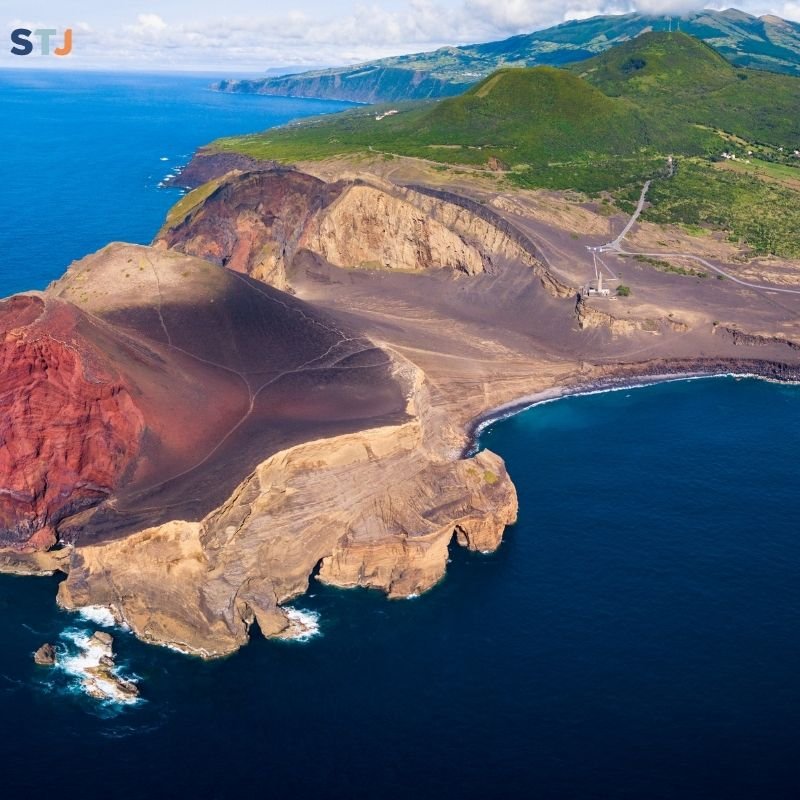
One day I took a bus inland — sparse schedules; you adapt, or you wait. The driver greeted passengers by name and cargo: fish crates, a tool bag, bread boxes. Transport as social network. “You are not from here.” — “No.” — “Good. That way you look.” The man beside me had worked on whaling boats and described the transition from hunting to observation after the regulation changes of the nineteen-eighties. “If you forget the hard part, memory becomes advertising.” At Capelinhos — the volcanic zone formed by the 1957 eruption — the land still looked provisional: pale ash sand, constant wind, a half-buried lighthouse. Geological youth, visible. Instability, readable. Stability, I thought, is often just time long enough not to be permanent.
Another afternoon I joined a whale-watching boat, not for spectacle but for context. Regulations now structure the practice strictly: distance limits, engine behaviour, observation time. “Respect is measurable here,” the guide said. “Distance is respect.” We saw sperm whales surface briefly, breath plumes vertical and clean. Sound first, then sight. Everyone went silent without instruction; awe requires quiet bandwidth. One evening at the harbour, a small festival formed without announcement — guitar, voices, children running, no phones raised. A fisherman taught me the word saudade: nostalgia with the presence of absence. Orange light hit the wet ropes; sardine smoke entered clothes and hair. Smell as memory anchor.
Leaving lighter
Final visit to the stone worker. “Do not write me as a sage.” — “As a man.” — “Better. Sages are not verifiable.” — “What will you take away?” — “A subtraction.” A minimal nod of approval. I bought a green-veined lava pendant, heavier than expected. Not souvenir weight. In the days after, I slowed deliberately: walks without destination, handwritten notes, sound maps, smell records. Fewer phones in sight, longer stays at the table, uninterrupted conversations. A measurable difference. Brandão was right — the sea reveals. It removes narrative cosmetics. It shows pace errors, forced misuse, attention deficit. I had arrived carrying unnecessary weight. I left carrying the necessary weight. The difference is attention.
On the plane’s ascent, the island receded into cloud again. No dramatic farewell. No performance ending. Appropriate. Travel did not give me more; it removed enough to let me see what remained. Travel gave me fewer things and better measures. Correct speed for truth. Devagar.
Verónica Francia wrote this piece as part of her training at the School of Travel Journalism. If it inspired you, explore the Master’s Degree in Travel Journalism and the Master in Gastronomic Journalism and Communication, watch our students’ travel documentaries on YouTube, and listen to their stories on our Spotify podcast.
Read more on Travel & Create: Clouds and Volcanoes adventures · Walls that Speak: A Journey Through Rome’s Street Art.
This article is part of the practical work carried out by students on the Master’s Degree in Travel Journalism at the School of Travel Journalism.