
By Chloe Nguyen
“Often overlooked when Western travelers plan their first visit to Vietnam, Hoi An and Hue offer relatively quieter experiences than Hanoi or Saigon, though each is a vital city in its own right, with regional food specialties and plenty of cultural and historical interest.” This saying by Anthony Bourdain in Parts Unknown left me with an urge to dedicate a few words to my country and bring this city to a wider audience. Hue stole a piece of my heart from the day I first set foot there. It is a place where we can either discover the deep history or simply relax. Some might find Hue boring because the city moves at a “super slow” pace, where things seem to pause every second. On the other hand, I find Hue possesses a unique “playful but shy beauty” representing the grace of Vietnamese women. Hue has its own soul, a feeling you will never find anywhere else in Vietnam. From a cultural and historical lens, visitors are easily captivated. Along my journey, I have met many people who visited Hue, they all still carry the “echo” of this place, and yes, they all left a part of their heart there. Hue is overlooked, yet this place knows exactly how to catch a visitor’s attention.
The Soul of the Garden House
Writing about Hue can’t be completed without mentioning the Garden House, which is the soul and symbol of this city. I believe this is how the city was originally built when it comes to sustainability. This icon brings visitors back to the old days of Vietnam, specifically to an era where palace-style living spaces met nature. Back in the 17th century, when the monarchy was alive, these spaces were common for the elite. It was considered a sophisticated living space where emperors could connect with nature throughout the day. It is a combination of wooden architecture and a vast garden. Over time, these spaces still stay alive, carrying that “green soul” and the Vietnamese spirit into the modern day despite the fact that now they exist mainly for tourists. Each garden house reflects the soft vibe of Hue and a philosophy of living among nature. However, from a critical perspective, many have transitioned into purely tourist spots. Isn’t a house without people just a museum? The soul of the Garden House was once completed by the people living there, human presence makes a place. Therefore, I find that some of the original vibe and the feeling of a family residence has been lost. Additionally, because these wooden houses were built so long ago, they are often over-budget for proper renovation, creating a challenge for their longterm legacy.
Local Identity and the Cost of Sticking to Tradition
Many people speak to me about Hue’s local identity, defined by a slow pace that results from a mix of imperial rigor and deep culture. Hue is known for its royal spirit, a city of history and ancient traditions. This is shown in small details, the way a Hue woman ties her Ao Dai, her gentle gestures, her extremely polite attitude, and her soft-spoken voice. Even in the local dishes, you don’t simply eat, you enjoy the appearance and appreciate the person who made it. Even a small, cheap dessert is shaped like flowers or leaves. When you enter Hue, you feel like you are entering the past, even in 2026. However, there is also a drawback. When a city always sticks to the “old,” the door for innovation often remains closed. In reality, Hue is developing slowly, and there are very few technological companies. Consequently, local youngsters often choose to move away to larger cities to find better opportunities.
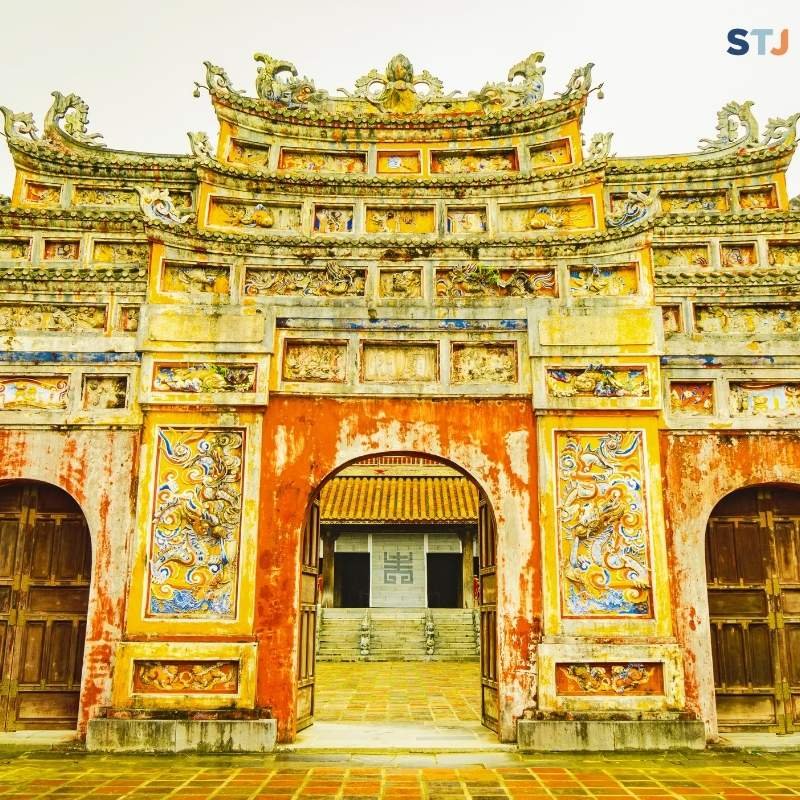
Purpose-Driven Travel and the
“Museumification” of Poverty Hue is also a city for practicing mindfulness and purpose-driven travel. Because it is the Buddhist heart of Vietnam, the city teaches you about mindful living, not only through meditation but through enjoying authentic food and the tiny details of life. Travelers have the chance to join local workshops to truly understand the culture. On the other hand, there is currently a phenomenon, the “museumification” of poverty. From a visitor’s lens, people want to capture the “old Hue” and the perceived poverty of the place. From a local’s lens, some earn a living by recreating a version of poverty that might be over. This romanticization happens in many developing countries, and it is a critical issue Hue must face lately.
Technology and the Future
Along with the development of technology, the city has taken advantage of some tools to create a more immersive experience. At certain attractions, we now use AI and VR to help guests walk into the past. While this is an essential technique in modern tourism, I believe there is much more potential to be unlocked. From my perspective, Hue is still a conventional spot, and the lack of local tech companies limits the job opportunities for the youth who want to modernize their hometown. In a nutshell, I believe every destination has its own advantages and uniqueness to leverage, but the main ingredient is the human element. Humans make a place, from the meaning they create to the way they deliver it to guests. To me, Hue is still on a growing path. I believe that in the future, we will find a balance between modernity and tradition, maintaining the core values of this destination while evolving to meet the needs of the modern traveler.
Chloe Nguyen wrote this piece as part of their training at the School of Travel Journalism. If it inspired you, explore the Master’s Degree in Travel Journalism and the Master in Gastronomic Journalism and Communication, watch our students’ travel documentaries on YouTube, and listen to their stories on our Spotify podcast.
Read more on Travel & Create: I Threw a Dart at a Map… and Ended up in Kyrgyzstan · Walls that Speak: A Journey Through Rome’s Street Art.
This article is part of the practical work carried out by students on the Master’s Degree in Travel Journalism at the School of Travel Journalism.