
By Lorenzo Olivieri
Lorenzo Olivieri At the light of trembling candles, we start to eat our dinner. We pour wine slowly into the glasses, searching for the right amount by dipping the tip of a finger inside, measuring by touch rather than sight. We still reach instinctively to the light switch even knowing the magic of instant light this time will not work. Our phones are also useless: since the power went off, they are nothing more than heavy boxes without connection, and soon, without battery. After days of storms and relentless rain, two things became clear: it would not let up anytime soon, and the ancient Greeks were right to imagine their gods ruling through thunder and lightning. I overheard the phone calls before I grasped the scale of it, the same words repeated again and again: biblical catastrophe, villages cut off, no water. Then the power went out across the entire valley. Dimitri, Triphonas, and Agapios sit around the soba, tending the fire, feeding the hungry stove with wood. In a language I only half understand, Dimitri hands me chestnuts roasted directly over the flames. Trifonas pulls out a small plastic radio. We turn the knobs, stretch the antenna, aim it in every direction, trying to catch a glimpse of voices in the darkness surrounding us. Nothing. Just static in every direction. It is around eight in the evening, but the blackout messed up our circadian rhythm, so aided by the fire rumbling in the stove, I fell asleep on one bench in the taverna of Kalloni, the beating heart of a village of fourteen people in northern Greece, tucked in the middle of the Pindus mountains chain. The Spanish writer Sergio Molina speaks of an Urban Spain, dense and alive, mirrored in every Western European city, and an Empty Spain, made of countryside and shrinking villages left to erode quietly. Greece, like Spain, was also shaped by a long imbalance. Also Greece, like Spain, is born out of two empires – the Roman empire and the Ottoman empire who favored cities over the countryside. Epirus remained Roman, and Greek, long after the fall of Rome, yet it would not become part of the modern Greek state until 1912, when the Ottoman Empire finally dissolved. History reached this land late and reluctantly. Progress arrived slowed down, uneven, imposed. This is a story of forced slowness, of places that learned to survive by waiting, clinging to the sediment of centuries rather than moving forward with them. Rural Greece is supposed to be dead. That is what the statistics say, what the policies assume, what the newspapers repeat.
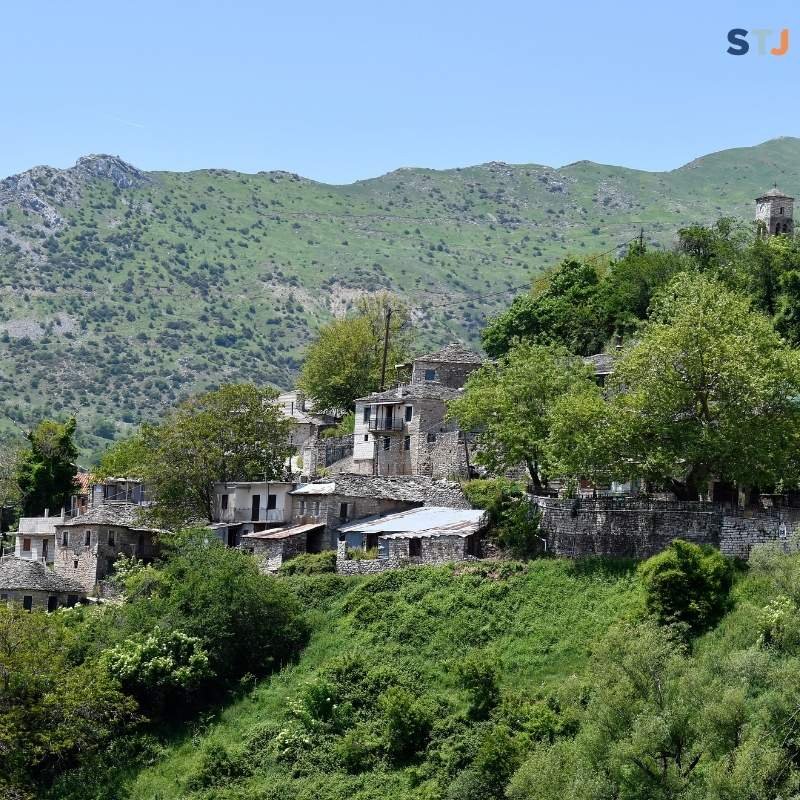
As of early 2025, the country numbered just over 10.37 million people, a slight drop from the year before, driven by far more deaths than births. In the countryside, the picture is even starker: agricultural villages that once made up nearly half the nation now account for less than one in five Greeks. To see what this decline looks like beyond the numbers, I travelled to Epirus, one of the regions of northwestern Greece most heavily marked by emigration. If you happen to take a flight from Greece, about an hour after takeoff you will see it from above: the jagged peaks of Tzoumerka, a mountain chain cutting through Epirus, looking sharp as the teeth of a cheese grater. Tzoumerka is not just a rugged mountain range. It is, above all, a constellation of 47 villages scattered across steep slopes and narrow valleys. Some are home to only a handful of residents, sometimes aging; the biggers reach around a few hundred permanent inhabitants.
“If one morning I don’t see smoke coming out of a chimney, I think we’ve lost another one,”
Panos tells me. He moved from the sunny Peloponnese first to Demati, then to Kalarrites, arriving with Ta Psila Vouna, an organization working to strengthen social cohesion and mutual support in remote mountain communities. Today Panos works at the Akanthos taverna in Kalarrites, a place frozen in time. Its owner, Napoleon Zaglis, left Athens thirty years ago, where he worked as a programmer and returned to the village of his parents to take over the family business. We meet Napoleon in the church of Agios Nikolaos, a fifteenth-century building of wood and stone. He steps out of the darkness and greets us as if this were the most ordinary thing in the world. It is impossible to not recognize him immediately, the long grey moustache and the quiet smile. Napoleon is a Vlach – or Aromanian – part of a small ethnic group known for their resourcefulness and love for the land, now close to disappearing. He still speaks Vlach, a language he describes as “half Italian, half Greek.” We are at an altitude of 1,200 meters, welcomed by fog that cannot quite hide the stunning view over the Chrousia Gorge, once the Turkish–Greek border. In the main square stands the platanos, the plane tree found in every rural Epirote village, alongside a row of stone fountains. Each, they say, has different properties: one to drink if your stomach hurts, another to draw water for cooking beans, each suited to a specific need. The village was once home to around four thousand people. Today, the permanent population is closer to thirty. In summer, especially during the week of the Dormition of the Virgin, on 15 August, it fills again, as families return for the annual festival. Not far from here stands the Monastery of Kipinas, a 13th-century church carved into the mountainside, ninety meters above the ground. The monastery, and the view from it, are breathtaking. As you step inside the taverna Akanthos the air is heavy with the smell of spices, coffee and tsipouro. The room fills quickly, locals and visitors packed together. There are around thirty tourists from Germany, hikers who walked on to the next stone village, Syrrako, like Kallarites also Unesco-listed. At one table sit two old men with their wives. The men are brothers and married two sisters. The older used to run the donkey company responsible for transporting goods, back when cars could not—and still cannot—enter the village.
On a Saturday morning, taking advantage of another break from the rain, I drive south toward Elatos, closer to the urban center of Arta. Here I meet Pavlos, who at twenty-nine built a livelihood as a beekeeper from nothing. He started young, without land, without equipment, and without a family tradition to inherit. Everything had to be learned alone. Last summer, he tells me, was especially hard.
“When it’s too hot, bees are more vulnerable to disease and pests,” he says. “And last summer was too hot.” Pavlos shows me his three varieties of honey with pride. The most distinctive comes from the strawberry tree, a protected local delicacy, bitter and intense. Everything is done according to the bees’ needs. Strawberry tree honey, the only bitter honey in the world, and the reason I am here, is harvested last each year, its flowers blooming in November, when the cold has already set in. A few days later Pavlos calls me. The strawberry tree honey is ready. It tastes unlike any honey I have tried before: intense, bitter and deep with flavour.
“One spoon when you have the flu and it will heal you,” they tell me in the village. A few days later, I head toward Filippiada, a small town in southern Epirus, sandwiched between the Peloponnese coast and the Tzoumerka mountains. Last summer it was scarred by a major wildfire and only recently emerged from flooding. Filippiada is a quiet town of fewer than ten thousand inhabitants, a metropolis, compared to the mountain villages I’ve grown used to. It is also known as the town of storks, for the scattered nests of migratory birds that spend the summer here. One nest sits on a light pole just outside my hotel balcony. That evening, I go out to search for a place to eat as a light rain begins to fall. The grillhouse I found has only three customers, myself included, and the cook is smoking beside the grill. This must be the place.
“Apo pou eisai, xenos?” Where are you from, foreigner? In uncertain Greek, I explain where I’m from and what I’m doing here, answering a question I’ve heard a thousand times. A foreigner in winter, in these lands, never fails to spark curiosity. The souvlaki is tender and well charred, served with the unmissable fried potatoes. There are plenty of them, enough to appear on every plate. When I ask for the bill, the cook tells me my beer has been paid for by the two locals. Outside, the rain has stopped. The next day, I am back in Tzoumerka. It is cold in Kipseli, and when I arrive in the late afternoon, the only light on comes from the church. They are celebrating Saint Nicholas, one of the first feasts leading into Christmas.
“Apo pou eisai, pallikari?”, an old woman asks me. In these villages it’s hard to blend in and not be noticed. People need to place you, to give you a name and a story.. Pallikari does not mean only “young man,” but also the young
fighters who waged the war of independence against the Ottomans, many of them from these very lands. It is a positive judgement. After my brief explanation, she hands me blessed bread and a full glass of kolliva: boiled wheat mixed with sugar, nuts, raisins, and pomegranate seeds. When I mention the village I am from, a man standing nearby asks me to wait. He disappears, then returns with bread and mail for my village, pressing them into my hands and asking me to take them back. In Kalloní, the mountain village where I am living, there is always more to do than there are people to do it. According to official statistics, just fourteen residents remain—most of them over eighty years old. In 1951, more than three hundred people lived here. Seventy years later, Kalloní has lost roughly 96 percent of its population, leaving behind empty houses, long winters, and a stubborn handful of lives holding the village together. The houses stand close to one another, packed like nuts in a pine cone. It would be easy to miss the village if you were passing through. A small square, a church, a cemetery, and a single taverna—built in the 1930s—survive after decades of emigration and abandonment. Today Dimitri comes to help us clear one of the future workshops for honey production. When I arrive, he is listening to Ipirotiko on a local radio station that broadcasts only traditional music.
“Do you like Ipirotiko?” I ask.
“Not when I was young. But after thirty, you start to appreciate it.”
Dimitri lives in Athens and works in import–export. He is here to collect his parents, who split the year between their mountain home and his apartment in the capital.
“The house isn’t equipped for winter,” he says. “And winter here can be harsh.”
The radio switches to the news. I catch fragments, war, crisis, Russia, Israel. Dimitri shakes his head. “The minister of defense says we should get used to seeing flags on coffins, like the Americans.” Out here, those winds of war feel distant, almost unreal, absorbed by the mountains. We stop to breathe and dry our sweating forehead. We talk about the lack of jobs in the region. In much of rural Greece, life still follows the seasons: when agriculture and tourism slow down, work disappears with them. Long stretches of unemployment leave local economies exposed.
“If I made a million a year, I’d come back to live here,” Dimitri tells me. He suggests I visit the Malokedros forest (Juniperus foetidissima), carefully tended by Triphonas. Malokedros is an evergreen conifer that can grow up to twenty meters tall. Its scientific name comes from the strong, pungent smell released when its twigs are crushed. In Tzoumerka, where the mountains are prone to erosion, Malokedros plays a crucial role: its dense root system helps stabilize the soil and prevent landslides. Botanists describe it as a
“relict” species: one that has survived dramatic climatic shifts by clinging to specific
ecological niches. This part of the Balkans is one of its natural habitats, but the tree requires constant care. Triphonas—strong and sharp like the Malokedros he protects—is another institution here. He is the main partner in a mountain cooperative that produces honey, grows blueberries, and presses them into juice. He also runs a taverna that on Sundays serves venison and wild boar, cooked by his wife Aleka. Barely a meter and a half tall, he is nonetheless magnetic: he hops from table to table, greeting and talking to everyone like old friends. Within minutes, guests are hypnotized by his stories. Passing through these mountains, this is not a place you should skip. Along with Aleka, Triphonas runs the cooperative with Roula and Giannis, both musicians from Epirus. Giannis is a Renaissance man: a beekeeper, the cantor in the local church, and a musician who plays the clarinet and the bagpipes. Roula plays the accordion and makes it cry with the intensity of a violin, an instrument rarely heard with such force, and rarely encountered at all, in Greece. They last played for the village’s patron saint festival, Agios Mina, on October 11, in front of about fifty people. Fifty is a crowd, given the population. Plates of grilled pork chops, lamb ribs, and fried potatoes arrive without pause, alongside wild boar slow-cooked for hours over pilaf – rice soaked in meat juices. The musicians play for hours, carrying a mournful, piercing melody that feels inseparable from the hard mountains of Epirus. Tables fill with empty bottles of tsipouro, also produced locally by Triphonas. Tsipouro goes down like fuel in a diesel engine: first with resistance, then with warmth, and soon you want nothing else. The local unit is a small 0.4-liter bottle, and before long the table is carpeted with empties.
“At first you ask yourself, what am I doing here?” Larissa, a swiss volunteer, tells me. She is visiting Tzoumerka for the fourth time. “Then the place steals your heart, and you always come back.” She and her partner Lou were among the first volunteers to arrive in Kalloní two years ago. Together they reopened an old mountain path, and the entire village turned out to help. Since then, they return whenever they are in Greece, part of Triphonas’s extended family now. One night we celebrate together, eating baked pie cooked by Aleka near the stove and sipping tsipouro late into the evening. Statistics say rural Greece is dead. Policies assume the same, quietly abandoning the countryside to itself. Yet here, life does not disappear—it reorganizes, slows down, and waits. It survives through gestures rather than plans, through people who leave and return, through paths reopened and tables set again. When I wake the night of the blackout, the room is quieter than I expected. Everyone else has gone. Only Dimitri – the village lumberjack and handyman – remains, and beside the stove, the greatest drinker of tsipouro I have ever met, is still sipping and smoking, smoke curling lazily from his cigarette, the firelight dancing on his face. Outside, for the first time in days, complete and serene darkness surrounds the valley.
The sky is dense with stars, the constellations unchanged from what they were four thousand years ago. The Pleiades – the Seven Sisters, freed after the anger of their father Zeus – look down at me. The peak of Tzoumerka rises white with snow, a pale mass against the night. Dimitris calls me over. He unfolds an old, wrinkled map. Earlier that day I told him I wanted to visit the ancient oracle of Dodona, a few kilometers from Ioannina. By candlelight, he points first to Dodona, then to Delphi in the south. Then to the Acheron, the river that led to the ancient Greek underworld, and finally to Mount Olympus in the east. The points form a perfect cross, intersecting at the center.
“Do you know what’s in the middle?” he asks. Outside, the valley remains black, silent and full of stars.. He takes a pen and slowly circles the spot.
“Tzoumerka.”
Lorenzo Olivieri wrote this piece as part of their training at the School of Travel Journalism. If it inspired you, explore the Master’s Degree in Travel Journalism and the Master in Gastronomic Journalism and Communication, watch our students’ travel documentaries on YouTube, and listen to their stories on our Spotify podcast.
Read more on Travel & Create: I Threw a Dart at a Map… and Ended up in Kyrgyzstan · Walls that Speak: A Journey Through Rome’s Street Art.
This article is part of the practical work carried out by students on the Master’s Degree in Travel Journalism at the School of Travel Journalism.