
By Julia Koopmans
A big, white, soft cloud of smoke arises from the rocks in front of me and towers itself into the sky. Shaped by the gusts of wind, I could see stories unfolding in the clouds. Horses galloping through the fields, and children play while farmers work on their lands. It feels so peaceful, but at the same time it is so immense that I could feel the energy from the big fire underneath my feet. It’s my first time on an active volcano, and despite it being very peaceful and quiet, it could also be treacherous. It’s last big eruption happened in 1772 with a big lava stream to Laguna Masaya. However, the story of this volcano goes back at least 9000 years ago and knows a range of extensive eruptions creating the caldera that includes the Laguan Masaya and two small mountains with 5 craters in the middle. It’s the Santiago crater that has been attracting people to this place since the beginning of human life.
During my childhood, I was encouraged to read and borrowed book after book from the library. I really loved to escape into the world of others, to explore the world, and to learn about different realities. And despite the excessive number of stories, one has always stood by me. Written by a Dutch writer, Ellen Tijsinger, it was called ‘De Zwarte Vulkaan’ (the black volcano) and tells a story about a boy with a dream to become the best shoe shiner of Nicaragua. People would line up for him until the big cathedral of León. However, his life is designed by helping his family and when his brothers are called for the army, he has to leave school and help his father in the tannery. Knowing his destiny could also be looking for food on the dumpsite like many other kids, he never complains. When on one day the Cerro Negro erupts and León is covered in black ashes, his life changes. He starts to take care of chicks and change them into really fighting chocks. The money he wins with the famous street battles is used to make his dream come true.
Two decades later, I finally find myself surrounded by the beauty of Nicaragua this book has persuaded me. I felt compelled to learn about it’s culture and the relation with its excessive landscape. Already occupied by a master thesis on Indigenous and peasant struggle against the current dictatorship, I was even more drawn by people’s resilience and finding meaning in life with little that they sometimes have. After having overthrown the last dictatorship of Somoza in 1972 with the so-called Sandinista Revolution, Nicaragua tried to rebuild itself towards a democratic constitution. But without the realization of many, their revolutionary brother had other plans and made himself the next authoritarian leader of this nation. Traveling to Nicaragua as a researcher and journalist is therefore not without risk. It asks a cautious mind and a very secure firewall on all devices.
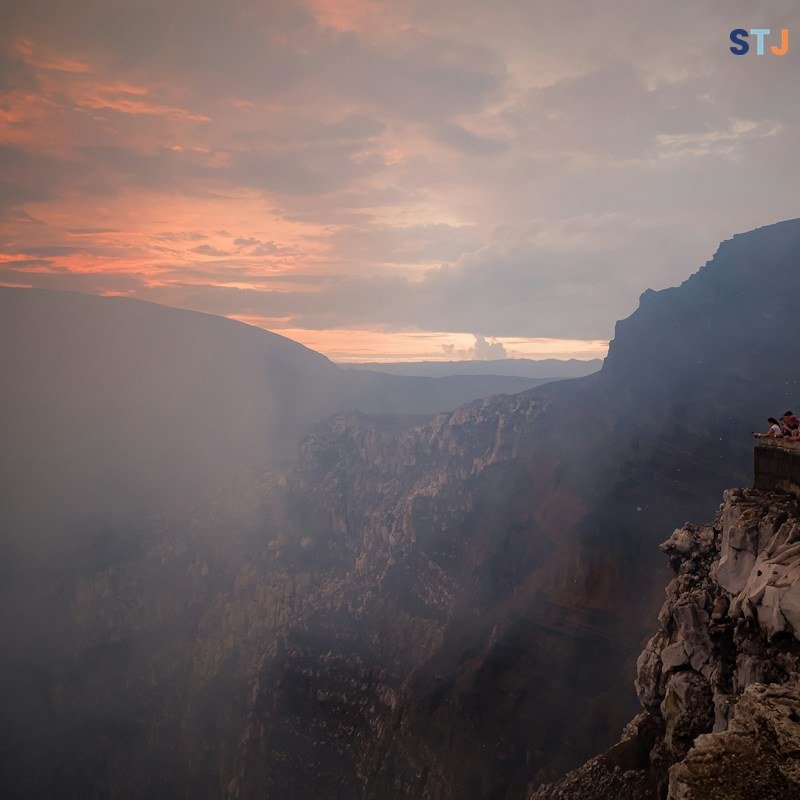
Therefore, I mingled with other tourists and joined them on tourist excursions to historical sites and national parks. In this way, I ended up in one of the many busses driving up the Masaya volcano on this late afternoon in June. Being warned by the very unpredictable weather, I led myself surprise by a threatening rain cloud that slowly passed and blessed us with a fortunate beautiful sunset. In the middle of this nature event, people continued their ways around. Busses come and go, groups of tourists step out of the buses with curiosity, silence and a little nervousness, but soon as they arrive at the crater, little talks start to fill the silence and phones are taken out of the pockets. One by one, visitors try to capture the smoke coming out of the crater as far as they can or dare to reach their phones over the edge. When nothing spectacular is yet to see, they switch to a selfie or ask a travel companion to be their personal photographer.
The sun is still setting, and smoke fills up the air in front of us, forming different shapes. I have always been fascinated by the endless movement of fire and smoke and am captured by its performance here. The darker the sky, the warmer the glow appears from inside the mountain. I envision the breath of the earth keeping us warm at night. It has something magic and ancient too. A place where thousands upon thousands of people have stood before throughout time. All being attracted to this living mountain.
Colonial ghosts and indigenous memory
Curious about the local meaning of this place, I listen carefully to what our guide Carlos, has to say. When I asked him about the ancient name Popogateppe (meaning Smoking Mountain) that the first people gave to the active volcano, he sounds a little confused. He explains how the Indigenous people saw the mountain as a living spirit but then refers more predominantly to the current name Masaya. Both names come from the Nahuatl language, but somehow the one has overcome the other. It seems this ancient name is has gradually faded into oblivion over time, just as the lava flow from the last major eruption is gradually fading into the increasingly green landscape. Not that is has lost its name right as people still describe call it the ‘smoking mountain’. What I did notice is that the complex of volcanoes is gradually called Masaya, whereas actually one of the mountains is officially called by that name. The other volcano is named after its main crater, Nindirí, formed by historic collapses and eruptions. It also includes two dormant craters, San Pedro and San Juan. During the tour through the park and museum, and even online, these names are often interchanged. I get the impression that the guides try to honor the original Indigenous names before the Spanish renamed the craters after Catholic saints, yet confusion remains because the official terminology still follows the Spanish versions.
Just like Popogateppe, the nearby town of Masaya was once called Mazalt-Yan, but when the Spaniards arrived, the name was changed into its current form, Masaya. Carlos explains that Masaya comes from Nahuatl and can mean “place where deer are,” “life of deer,” or, in the language of the Chorotega peoples, “life of fire.” To this day, the Indigenous neighborhood of Monimbó symbolizes these ancient roots and the resilience of Indigenous culture. It is here, and in the small villages around Masaya, where knowledge of Indigenous history is preserved and where people continue to seek recognition for pre‑Hispanic heritage. Carlos has worked as a tour guide in Masaya National Park for eight years and tells me that “the park guides and the Masaya volcano museum really try to engage with this part of the history. Although there is still much left for ecological, archaeological, and anthropological research, we really promote the Indigenous history in the story.” I’m impressed, and the anthropologist in me is eager for more.
While standing in a circle around a small model of the National Park, he begins his rehearsed story. When Indigenous peoples, descendance from the Maya in Mexico found their home in what is now Nicaragua, drawn by the many volcanoes, but especially its fertile soil and valuable clay this region has to offer, little settlements started to arise. And fertile, the soil has remained. The two small volcanoes situated in the center of the gigantic caldera crater make sure farmers throughout centuries were able to grow their crops and feed the surrounding communities. Since the formation of the current volcano, Masaya has remained the largest, though it is currently dormant. In contrast, the Santiago crater is active and produce spectacular natural phenomena. Carlos continues: “The Masaya Volcano, and in particular the Santiago crater, played an important role in the lives of the Indigenous communities that settled here between 500 and 900 AD. Mainly descendants of the Chorotega (also known as the Mangue) settled here for a long time and formed one of the most densely populated Indigenous provinces in the preHispanic era, with various settlements around the Masaya Lagoon. He then points to a small hill a few hundred meters away, explaining that it is quietly, yet steadily, growing a few centimeters taller every year. Later, when we hike the well-known trail Sendero Los Coyotes, up to the top of this “baby volcano,” I notice plumes of smoke rising from its flanks, revealing what lies hidden beneath the earth’s surface. However, what this trail brings me even more into aw is the panoramic view of the surrounding landscapes. With the Masaya volcano on my left side, i can see the traces of lava going down in front of me towards Laguna Masaya. Then a little more to the right is Masaya city. From this perspective it seems like a city made of cables, internet poles and satellite dishes. I guess, for the romantic experience, you need to get into the city itself. Granada looks much better with his church domes and roofs glistering in the setting sun, and guarded by its green giant, the dormant Mombacho volcano. In front of me, just very far on the horizon i see two very poined mountains. Thinking back on the model of Nicaraguans landscape I had been studying in the museum before, it must be the Momotombo and the San Cristobal, Nicaragua’s biggest volcano in the North.
When I ask Carlos about the spiritual connection the Chorotega had with this volcano, he tells me how Indigenous peoples believed that sacrifices were necessary to temper the volcano for another eruption or to predict the future. Offers were given through throwing a virgin girl or a young child into the lava. This caused a surge of smoke that would emerge in the shape of an old lady called Chachilhuehue. She was asked what the future would bring: whether storms were coming or if the volcano would erupt soon; whether new people would arrive and what that would mean for their communities. Carlos adds that volcanic eruptions were interpreted as omens: destructive forces, but also symbols of fertility because of the rich volcanic soil they left behind. Pre‑Hispanic artifacts are the custodians of this understanding. Many have been found in the lava caves, where native peoples presumably carried out important rituals.
With the arrival of the Spaniards, there was no room for spiritual meaning. To them, the deep crater filled with glowing lava could only be the “gateway to hell,” or La Boca del Infierno. Therefore, they placed La Cruz de Bobadilla (cross) on the mountain and baptized the craters to saints in order to close the gate. At least that was what they were hoping for.
Ecological meaning throughout centuries
During the tour in the museum, Carlos brings us langs verschillende schilderijen van prehispanic tafferelen en geologische modellen die laten zien wat er allemaal in de bodem te vinden is. Verderop begint zich het ecosysteem van dit park te ontrafelen. Trots vertelt Carlos dat dit park een tal van vogelsoorten en andere dieren rijk is. Ik vertel hem dat ik een documentaire heb gezien over de flora en founa van dit park. It demonstrated how every morning, as soon as the sun rises, little twirk sounds echo from inside the crater. That are the green chocoyos (green parakeets) known as Pacific conure or Nicaraguan green conure in aviculture . As soon as they have ensembled in the bottom of the crater they circle their way up to the top until they have reached the edge and take the risk to fly over. Because they are green, in this part of the volcano they are very vulnerable, but as soon as they reach the forest they are safe to spend their day paring and search for food. By sunset they collect again and as a swarm quickly fly back to they nests. Despite their unique color, they are also one of the few bird populations in the world to inhabit an active volcanic environment. Carlos himself is not part of the research team of the National Park he says, but he is able to say that these chocoyos have adapted to tolerate the sulfurous gases emanating from the crater, roosting on the inner walls where heat from the volcano may provide protection from predators. “Nobody knows how these chocoyos exactly survive in the volcano ashes, but they are very cautious birds. They’ve chosen a place with no predators. They come each year to breed in the tunnels of the volcano. They’ve survived here despite eruptions.”
What the documentury showed me as well is that these birds have some dangerous neighbours. Black fultures also take home in the volcano. This preditor was already a symbol of death in the time of Indigenous peoples. For more than ten thousand years, like a sword over the volcanos in central America, they take advantage of the warm wind and turmoil that carry them effortlessly above the volcanos. Without flapping a wing or making a sound. They use the highest trees as a rest stop while watching the surroundings. They’re able to survey their domain and look for easy preys
Unfortunately, the group of tourist is too big and we have limited time om langer bij het dierenrijk van het park stil te staan. Toch laat Carlos nog even trots nagebouwde lava tunnels zien waar tot onze verbazing levende miniscule vleermuisjes rondhangen. Deze lijken een beetje verdwaald, want normaal gesproken hangen ze overdag in massa’s te slapen in de echte lava tunnels onder de vulkaan. As a big black swarm they come out of the lava tunnels and burst into the nightlife of the forest. However, once in a while a small bat that did not fly quick enough is captured by a snake who patiently guards the gate to the forest. When someone from the group asks why we cannot see the lava tunnels anymore, our guide explains that this is threatening the bat colony too much. The presence of the bats helps to ensure the future regeneration of the forest. Tropical forest has evolved in milions of years on the black lava. Most is green but some scars remain as a reminder of the danger of living on this land.
The forest around the volcano containst of a tropical dry forest with species including guanacaste, madroño, genízaro, and various species of Bursera. The Indigenous leaders recognized the riches of fertile land and learned to respect it. The colonizers however brought a new form of cultivating the land – live stock farmer has destroyed the forest. Provides food to the people and the blood is drank by the vampire bats from under the ground. Live separately from the other bats.
The effects of tourism
Young travelers arrive at Masaya Volcano with a checklist in hand, eager to tick off one of Nicaragua’s most advertised attractions. INTUR, Nicaraguas national travel institute, has long portrayed Masaya as a national treasure; one of the few volcanoes in the world where you could watch lava boil beneath your feet. But since the landslide that buried the lava lake, the spectacle has changed. At the edge of the crater, disappointment hangs almost as thick as the smoke. Many visitors, convinced by glossy images from tour operators in the streets, never checked whether those photos were still accurate.
Some even change their minds entirely, deciding the volcano is no longer worth the trip. Blog posts comparing Latin America’s volcanoes conclude that Masaya’s show is “gone,” replaced only by memories and old photographs. The most dramatic image circulating online is from 2020, when an acrobat crossed the active crater on a tightrope. An event now frozen in time, impossible to recreate. Caught in their disappointment, most visitors listen only half‑heartedly to the guide’s explanations. Only one or two questions break the silence, aside from mine.
Yet Masaya National Park is far more than a lava viewpoint. Today it is a protected area with strict limits on the number of visitors allowed. The museum at the entrance highlights the rich ecosystem surrounding the volcano: a surprising diversity of plant species, and, hidden in the darkness of the lava tunnels, thirteen species of bats. These tunnels formed naturally after recent eruptions and are large enough to walk through, but human presence threatened the bats’ survival. The park eventually closed the tunnels to protect them, recognizing their crucial role in maintaining ecological balance. Even the smoking crater itself is home to bright green canaries that nest in the warm rock walls.
About three years ago, landslides altered the view inside the crater. The lava lake disappeared beneath debris, leaving only a faint glow visible through the smoke. Rising lava levels and increased gas emissions forced the park to close for nearly two years. The risk of explosions grew, and only when the volcano cooled enough did the park reopen in late 2025.
Still, the park tries to keep the sense of spectacle alive. At the museum entrance, photographs and props proudly commemorate the acrobat who crossed the active crater in 2020. Human‑like statues stand against a volcanic backdrop, illustrating the scientific research conducted here by foreign geologists. They once descended into the crater wearing special suits and equipment to withstand the extreme temperatures—an attempt to understand the volcano from the inside out.
Masaya may no longer offer the fiery show tourists expect, but its story is far from diminished. The spectacle has simply shifted: from lava to landscape, from danger to ecology, from a single dramatic moment to the slow, ongoing life of a volcano that continues to breathe beneath the surface.
A little politics too
On my final day in Granada, I meet again with Enrique, the local guide who had shown me around earlier that week. Today he wants to take me to the Coyotepe museum, a fortress once built at the behest of Nicaraguan leader José Santos Zelaya to protect the country from possible U.S. invasions. When we step out of one of the famous chicken buses that drops us just before the entrance, we begin our walk up the hill. It’s already around noon, and the sun burns sharply on my skin. We try to stay in the shade of the trees lining the road, when suddenly a man in long trousers and a thick sweater comes trudging down.
I ask Enrique how this man isn’t collapsing in the heat. He laughs and explains that this is how some Nicaraguan men try to lose weight: “Walking up and down this hill in heavy clothes makes them sweat more than in the gym, and it’s cheaper too.” I can’t help but laugh. A healthy diet isn’t something Nicaraguans seem overly concerned with, but they certainly find creative ways to manage their guilty pleasures.
By the time we reach the top, I’m definitely a few calories lighter myself, though not thanks to thick clothes, but to one of my favorite summer tops and a pair of sports shorts. Enrique wipes the sweat from his forehead, catches his breath, and bravely begins to explain the history of the fortress we are about to enter.
The name Coyotepe comes from the Nahuatl words coyo (coyote) and tepec (hill), meaning “Hill of the Coyotes.” According to oral tradition, the site was once home to numerous coyote dens. The fortress itself sits at 360 meters above sea level, strategically positioned on the summit of Coyotepe Hill near Masaya. Although its construction resembles Spanish colonial fortifications, it was actually built in the 20th century by Nicaraguan engineers between World War I and World War II. Its purpose was to serve as a lookout post along the Pacific Railroad connecting Managua with Masaya and Granada.
The hills around Masaya have witnessed battles from multiple revolutions. First came the Liberal Revolution of 1893, when Zelaya’s forces defeated the conservative government led by Joaquín Zavala. Decades later, during the 1979 Sandinista Revolution, the Nicaraguan National Guard bombed neighborhoods in Masaya as the Sandinista National Liberation Front advanced toward victory.
After Anastasio Somoza García came to power in 1934, Coyotepe was rebuilt into a prison. First to hold common criminals, then as a torture site for political prisoners the regime considered dangerous. In 1972, after the devastating earthquake that destroyed Managua, the fortress briefly served as a shelter for hundreds of victims. But between 1975 and 1979, Somoza once again used Coyotepe as a prison for political opponents. Torture and murder took place within its walls. Some prisoners were even flown by helicopter to the Santiago crater and dropped or threatened to be dropped into the volcano if they refused to give information about the Sandinista revolution.
After the Sandinista Popular Revolution triumphed, the fortress became a symbol of repression associated with the Somoza dictatorship. Something that feels painfully ironic, if you ask me. Because since Daniel Ortega returned to power, torture, disappearance, and murder have once again become tools of political control. This time directed at anyone opposing his Sandinista regime.
Looking back, this place feels like evidence of a cycle that keeps repeating itself. Even though the landscape is shaped by explosive and destructive forces, it always rebuilds. The same is true for the people of Nicaragua, who have rebuilt their communities after every revolution, every disaster, every political betrayal. With Masaya at the center of so many of these upheavals, it is where life rises again from the ashes, again and again.
This article is part of Julia Koopmans’s Final Master’s Project for the Master in Travel Journalism at the School of Travel Journalism.
Julia Koopmans wrote this piece as part of the Final Master’s Project for the School of Travel Journalism. If it inspired you, explore the Master’s Degree in Travel Journalism and the Master in Gastronomic Journalism and Communication, watch our students’ travel documentaries on YouTube, and listen to their stories on our Spotify podcast.
This article is part of Julia Koopmans’s final Master’s project for the Master in Travel Journalism at the School of Travel Journalism (class of 2026).