
By Juan Diego Fernández
It must have been two in the morning. Night had spread a thick blanket of silence and darkness over my city. One coffee too many was refusing to grant me my well-earned rest. I tossed and turned, tangled in flannel sheets (a present from my mother for my 31st birthday), while a cricket determined to share my room played an insistent tune from some invisible corner.
I was in the habit of putting a free newspaper in my rucksack every day. Between classes I would open it at random to kill time and let myself be seduced by some apparently interesting story. That morning I had barely managed to leaf through it. I took it from the bedside table and opened it at any page, stifling a yawn. After reading an article on the educational challenges of the 21st century, my eyes dropped to a small headline printed in red: “Quotes that will change your life”. The quotation was signed by Filippo Pananti:
“Life is a book, and those who have seen only their own country have read only one page.”
I slowly closed my eyes. I breathed in deeply and then let the air out hard. Those words settled in my mind like a seed that had yet to sprout. For weeks, even months, they came back again and again. Later they became an obsession. I realised I had spent years looking at the world from the same window, from the same wooden bench. I had studied, worked and dreamt, but I felt that my own book was full of blank pages. The time had come to write something more than routine and monotony. And that is how a sleepless night, an ordinary newspaper and a quotation forgotten by most ended up leading me to the continent of contrasts.
Mumbai, city of contrasts
On a morning with a mother-of-pearl sky, I landed in India. From the aeroplane window I watched the vast urban sprawl of Mumbai, its official name since 1995, emerge through the haze. The heat hit me as soon as I walked through the airport doors: a thick, almost liquid humidity that clung to my skin like a second shirt. I was already carrying my 7 kg rucksack, the one that would go with me for the coming months. As I made my way through the city, I remembered Phileas Fogg’s adventures in Around the World in Eighty Days. Those childhood books seemed to come alive before my eyes. Yet the real India was far more complex than any adventure novel.
Before leaving Mumbai for Goa, I decided to treat myself to a whole day in a city that seemed to breathe at a frantic pace. I walked along Marine Drive while the Arabian Sea lapped gently at the sea wall and a light haze blurred the outline of the buildings. On one side stood luxury hotels, the windows of haute couture labels and elegant colonial-era buildings; on the other, barefoot men slept on pieces of cardboard, oblivious to the frenzy of a city that never seemed to stop. That coexistence of extremes was not an exception but the very essence of Mumbai.
I walked to the Gateway of India, through whose arch the last British troops left the country in 1948, after independence. There, tourists, street vendors and families surrounded by children shared the same space under the silent gaze of the old basalt arch. I watched boats bobbing on the water while a flock of gulls broke up the greyish sky; some of the boats displayed signs offering, for a few rupees, to take you to Elephanta Island to see its caves, a World Heritage Site. During my walk I understood that this city had no intention of pleasing me: it simply showed itself as it was, immense, chaotic, contradictory and profoundly alive.
Goa and the road to the real India
The next day my alarm went off very early to catch a domestic flight to Goa, birthplace of Goa trance, the hypnotic electronic music that has been pounding along the shores of the Arabian Sea since the early 1990s. The landscape changed radically: palm trees leaning over endless beaches, reddish sand, cliffs washed by the sea and a golden light that seemed suspended in the air. The salty smell drifted in from the coast, mixed with the sweet scent of coconut palms. Waves broke gently while groups of fishermen hauled in their nets at dawn.
Many foreign travellers seemed to live oblivious to the country around them. They spent hours sunbathing or sheltering in seafront cafés with drinks full of ice. I, on the other hand, felt a growing need to delve into the deeper India. The real one, the one that sometimes hurts. That opportunity came in New Delhi. The capital welcomed me with an intensity that is hard to describe. My field of vision was overwhelmed by an ocean of humanity: motorbikes, bicycles, rickshaws, sacred cows, street vendors and pedestrians shared a space where chaos seemed to have become a kind of order.
Delhi and Rajesh, the chai seller
The noise never stopped. Shrill horns, roaring engines, conversations in Hindi, calls to prayer and the barking of stray dogs made up an impossible soundtrack. The smells formed another universe: curry, cardamom, coal smoke, incense, ripe fruit and hot dust mingled in the air. I particularly remember the feel of the city: sweat trickling down my back, the rough surface of the centuries-old walls of the Red Fort, the worn seats of the rickshaws and the fine dust that clung to my brand-new sandals after every walk. But it was a person who ended up changing the way I looked at the country.
His name was Rajesh, and we met near Chandni Chowk, one of Delhi’s oldest markets. He must have been in his sixties, seventy at most. He was thin and frail-looking, his body seemingly worn down by a hard past. He had a high forehead crowned with grey tufts of hair and an unkempt white moustache that gave him a slightly dishevelled air. His dark skin was weathered by the sun, and his black eyes were extraordinarily lively; I could see them through a pair of crooked glasses mended with a bit of sticky tape on the left arm. His hands bore the marks of years of work, but his smile conveyed a contagious serenity. Rajesh sold tea from a small wooden stall: four planks resting on two mud bricks were enough to let the country’s signature drink brew and to say good morning to everyone who passed by each day.
When he saw me watching him prepare a mixture of spices, he beckoned me over. “Friend, chai? Very good chai.” I accepted without a second thought. As he stirred the drink in a metal pot, he taught me a few words of Hindi. One of them was namaste, which means something like “I bow to you”: more than a courtesy, it held a whole philosophy of respect for others. I asked him whether he had always lived in the capital.
“Delhi changes every year. I change every year too. That’s life, my friend.”
Then he served me a glass of steaming chai. It tasted extraordinary: the hot milk blended with the sweetness of the sugar while the ginger and cardamom left a spicy aftertaste that lingered for a long time. “And what are you looking for in India?” he asked. The question took me by surprise. “I don’t know exactly. Maybe to understand something. To write. I want to let myself go with the flow.” Rajesh let out a soft laugh. “Then you’ve come to the right place. Here nobody understands anything, but everybody keeps looking for answers to their questions.”
During my days in Delhi I went back to his stall several times. I never planned it, but I always ended up on that ramshackle corner tangled with knots of cables. Sometimes we talked for a few minutes; at other times we stayed silent, watching the comings and goings of the crowd in their brightly printed saris. One morning I found the stall empty and felt a strange disappointment. Hours later he reappeared, pushing a bicycle loaded with sacks of spices and a copper jug. “I thought you’d gone,” I said. “Everyone ends up leaving.” “And you?” “Me too, one day.” Then he went on, completely serious: “The trouble with travellers is that they think places are permanent. But nothing lasts. Not cities. Not people. Not even ourselves.”
Then he pointed to the cup of chai I was holding. “See this tea, my friend? An hour ago it was water. Then we added leaves, milk, sugar and spices. Now it’s something else. People are the same: every encounter changes us a little.” That sentence would stay with me for the rest of the trip.
The Golden Triangle: Agra and Jaipur
My head full of Rajesh’s words, I set off on the route known as the Golden Triangle, completed by Agra and Jaipur. I remember the train journey to Agra as unforgettable. The carriages bore the wear of thousands of kilometres, hundreds of travelled stories. I shared a seat with a family travelling with two hens shut in a bamboo cage; the children watched me curiously while their mother handed out food wrapped in leaves. Suddenly a voice cut through the carriage: “Chai! Chai! Chaiii!” A boy was making his way down the aisle with an enormous teapot. I bought a glass for one rupee and, as I drank, watched the landscape slide slowly by under the scorching afternoon sun.
Hours later, one of the seven wonders of the world appeared before me. I had seen hundreds of photographs, but none could convey the feeling of being there. The white marble seemed to absorb the light and give it back transformed; every detail reflected an almost unreal perfection. I understood why so many people consider the Taj Mahal one of the greatest expressions of love ever built. I stood in silence for a long time. I wasn’t just looking at a building: I was looking at the human desire to defy time.
My next stop was Jaipur, the legendary Pink City. Every morning I went out early to explore it before the sun reached its full strength. Shopkeepers raised their metal shutters as they swept away the night’s dust; the smell of freshly baked bread mingled with incense from small household shrines. Sacred cows moved with an almost solemn calm between motorbikes and bicycles. The historic façades, tinted in shades of terracotta, took on different hues depending on the light: soft and delicate at dawn, walls ablaze in the orange glow of sunset. From the windows of the Hawa Mahal, the Palace of the Winds, I understood that the apparent chaos hid a logic of its own, an invisible order that could only be appreciated once you stopped trying to understand everything.
I spent hours getting lost in the bazaars, where everything was arranged in methodical disorder. My senses were constantly put to the test: mountains of red, yellow and orange spices; fabrics embroidered with tiny mirrors; silver bangles; precious stones throwing off flashes of light. One afternoon I took refuge from the heat in a small textile shop. Its owner, an old man with a completely white beard, worked sitting on a rug with slow, precise movements. “India teaches patience,” he told me in slow English. Then he pointed to a piece of blue silk. “Look at this cloth: pull too hard and it tears; be too gentle and it doesn’t move. Life is the same.”
Little by little, I began to let go of the need to plan every day. I stopped worrying about sticking to strict timetables or visiting every place in the guidebooks. I simply started walking and breathing in every corner my heart led me to, and that is how the stifling heat took me to a tiny temple with a painting of an elephant-headed god on its façade. A young man with a bright white smile explained, in rudimentary English, that this was Ganesha, the most popular of the Hindu gods, worshipped for removing obstacles and bringing good fortune. As I placed a small bunch of jacaranda flowers on a dish of water, he also told me that every Wednesday the temples dedicated to Ganesha fill with devotees, and that even the youngest kneel at his feet to ask for luck at exam time.
One night I found myself at an impromptu celebration in a neighbourhood far from the centre. I didn’t understand the exact reason for the party or most of the conversations, yet several families invited me to share their food. I was struck by how deftly they used their hands as cutlery. I remember the intense flavour of the curries, the heat that brought tears to my eyes, the unexpected sweetness of some of the desserts. And I also remember the laughter: although we shared barely a handful of words, there was a kind of communication that needed no translation. That night I understood that travelling is less about observing and more about taking part.
Varanasi: the heart on the banks of the Ganges
Days later I left Rajasthan for the place that, without my knowing it, would become the heart of my journey: the Ganges. I reached Varanasi at dawn. The city was slowly waking while a faint mist hovered over the water and the first rays of sun tinged the horizon with gold. The stone steps known as ghats ran down to the river in an endless succession of terraces, from which reckless monkeys leapt, ready to snatch any of your belongings. Thousands of people were already there: some praying, others meditating, many bathing in waters they believe hold deep spiritual meaning.
I sat in silence on one of the steps. The water reflected the sky like an imperfect mirror; wooden boats glided by, pushed along by silent oarsmen, and incense smoke rose in spirals. For the first time since arriving in India, I felt no need to take photographs. An elderly man in a simple white tunic sat down beside me, his face furrowed with deep wrinkles and a serenity in his eyes that is hard to explain. We spent several minutes gazing at the river without speaking. At last he asked me where I was from and, when I answered, he smiled. “We all come from somewhere, but in the end we are all looking for the same thing.” “And what are we looking for?” The old man pointed at the water. “That is for you to discover.”
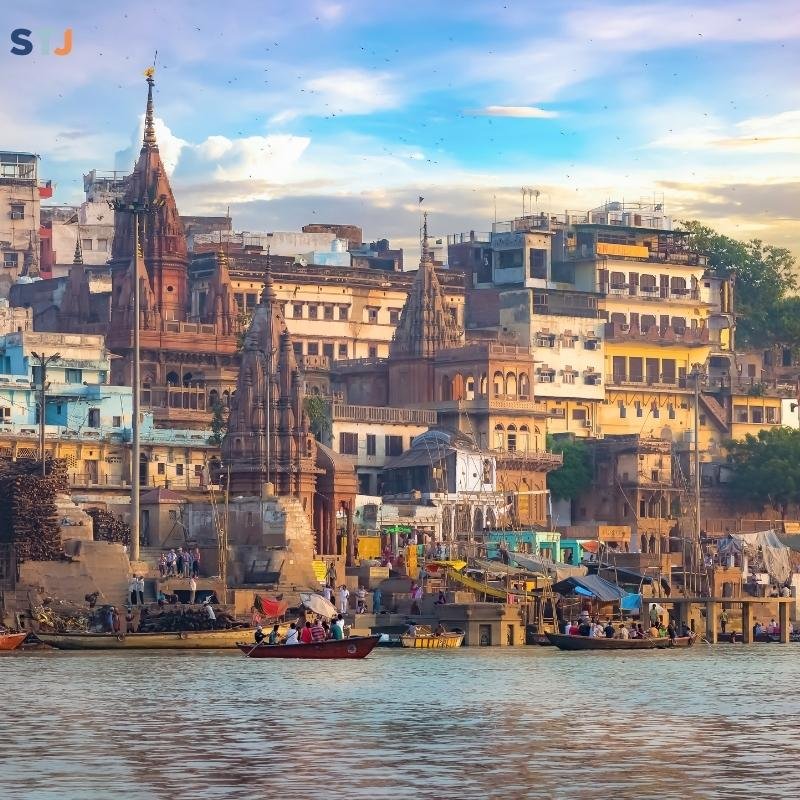
Every morning I went back to the same spot to watch the sunrise. I began to notice details that had escaped me at first: the way the light changed over the river, the patience of the boatmen, the whispered prayers, the naturalness with which life and death coexisted on its banks. On some ghats, cremation ceremonies burned day and night; far from being morbid, that constant presence of death seemed part of a broader understanding of existence. For years I had lived trying to control the future, planning every step. The Ganges, by contrast, never stopped: it accepted whatever came to it and carried on. I realised then that much of my anxiety came from my resistance to change.
One afternoon I hired a small boat. The boatman was a young man called Arun. As he rowed, the water reflected the colours of dusk: the sky turned from blue to orange, then red and finally a deep violet. “Do you like India?” “Much more than I imagined.” “India is difficult,” he said. “But once it gets into your heart, it never leaves. The country doesn’t change you; you change.” I looked at the banks lit by hundreds of lamps and, for the first time, understood exactly what he meant.
The country that lives in me
That night I attended the Ganga Aarti ceremony. Thousands of people gathered by the river while priests raised great fire lamps and recited prayers. The darkness was overcome by hundreds of small flames: many people set floating candles on the water, and each light seemed to stand for a wish, a hope or a memory. I left one too. As I watched the current slowly carry it away, I thought about the sleepless night that had started the journey and understood that the real journey had not been a geographical one: it had begun the moment I decided to give up the comfort of certainties and accept the possibility of being transformed.
Sometimes I close my eyes and return to the banks of the Ganges. I hear again the murmur of the water slipping through centuries of history, the ringing of bells at dusk, the prayers rising with the incense smoke towards a copper and violet sky. We are all a little like that river: we are born in a particular place, cross unexpected landscapes, gather encounters and farewells; sometimes we surge forward and sometimes we pause in pools of uncertainty, but, like the Ganges, we never stop flowing. Because there are places you visit once, and others, like India, that end up living in you forever.
Juan Diego Fernández wrote this piece as part of their training at the School of Travel Journalism. If it inspired you, take a look at our Master in Travel Journalism and our Master in Gastronomic Journalism and Communication, watch our students’ travel documentaries on YouTube and listen to their stories on our podcast on Spotify.
Interested in writing about travel that explores the extraordinary? Discover the Master in Travel Journalism and the Master in Gastronomic Journalism and Communication at the School of Travel Journalism.