
By Julia Koopmans
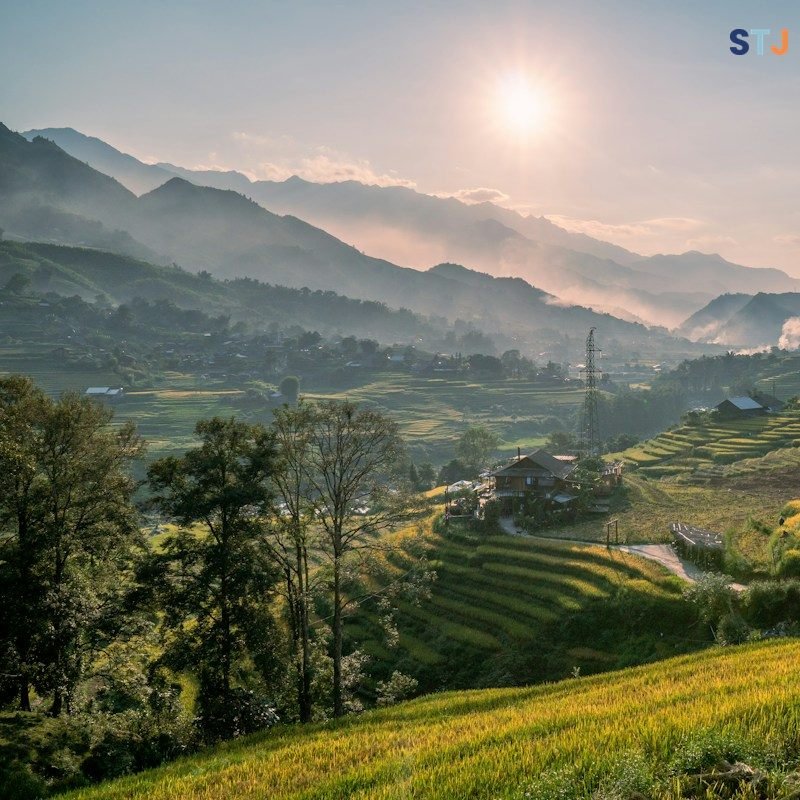
The Weight of a Few Bills A year later, Vietnam's colors, mountains and tropical warmth still cling to me like humidity on the skin. Especially one moment in the hills around Sapa. We booked a guided walk through the surrounding villages. The glossy platform promised a seamless experience, but when communication faltered, distrust crept in. One friend even began muttering about “untrustworthy Vietnamese,” forgetting, conveniently, that she had been happily travelling through the country for two months already. Then the door opened. A shy young woman stepped inside, introducing herself as Mango. She wore a crisp white blouse, a green scout-like hat, a soft black satin skirt, and long black stockings trimmed with a band of traditional patterns. With a gentle smile, she guided us through Sapa and toward the next village, always waiting for the slowest among us, always ready to share stories about local clothing or her life in the valley. As Mango showed us photos of her four‑year‑old daughter and her twelve‑year‑old son, it struck me how different our paths had been, even though we were born the same year. No wonder she asked whether I was married or had children. I laughed it off with an awkward, “I’m still too young for that”, but the truth was more complicated. We descended into the green valley, bamboo arching over us like a cathedral of stems. After a brief rainfall, the narrow paths turned into slick ribbons of mud. My expensive hiking boots were no match for the terrain, while plain rubber rain boots seemed the true luxury here. Local elderly women, carrying baskets of souvenirs on their backs, offered their hands to steady us. I felt a sting of embarrassment when I didn’t repay their kindness by buying anything. The sun broke through as we reached the next village and a group of children ran toward us. Mango encouraged us to give them sweets if we had any, so I offered the crunchy matcha rolls I’d bought the day before. Their eyes widened with curiosity as this was a flavor they had never tasted and probably will never be able to buy themselves. I handed them the whole box. The elderly woman watching over them had only a few teeth left, but that didn't seem to bother her at all. A little further on, we were invited into a small wooden house. A woman greeted us with a modest but warm smile, as though welcoming honored guests. Inside, the simplicity of her life revealed itself piece by piece. She pointed at her two tiny sleeping spaces in the corner of her shed. Above us, heavy sacks of harvested rice filled the attic. In front of us, a rusted metal rack holding two blackened pots served as a kitchen. I thought of my own kitchen back home. The contrast was almost disorienting. I don’t consider myself wealthy, yet standing there, I felt how far a few hundred thousand Vietnamese dong can reach. The poverty in that little shed made me keenly realise just how much I take my freedom for granted: the freedom to travel, to make choices, or even just to imagine a different future. The air was warm and heavy and the smell of woodsmoke clung to my clothes. I could feel the folded bills in my pocket, a weight that meant almost nothing to me, yet could mean everything to her. Suddenly, I found myself at the thin, uncomfortable line between witnessing and intervening. As a travel journalist, I learned to observe, to listen, and to avoid projecting my own assumptions onto another culture. It urges you to document without distorting, to respect the integrity of the story rather than shaping it to your own expectations. But in that dim wooden shed, neutrality felt like a luxury I wasn’t sure I could justify.
Would giving money reinforce the stereotype of a wealthy Western visitor? Was I helping her, or helping myself feel better? And if I chose not to help, was that really neutrality, or simply privilege disguised as professionalism? I realized that the story I was witnessing wasn’t abstract. It was a life, one shaped by loss, by limited choices, by a future that looked nothing like mine. Pretending I could stand outside of it felt dishonest. So I gave her some money. Later, Mango touched my arm gently and explained that the woman had recently lost her husband and now relied entirely on her village and her eleven‑year‑old son. That moment has stayed with me. It taught me that travel journalism is never as neutral as it pretends to be. The writer is never invisible. The act of observing is already a form of participation. And sometimes the fairest thing we can do is to acknowledge that the imbalance of power makes us uncomfortable, that our understanding is limited, and that it is impossible to remain unaffected by it.
Julia Koopmans wrote this piece as part of their training at the School of Travel Journalism. If it inspired you, explore the Master’s Degree in Travel Journalism and the Master in Gastronomic Journalism and Communication, watch our students’ travel documentaries on YouTube, and listen to their stories on our Spotify podcast.
Read more on Travel & Create: I Threw a Dart at a Map… and Ended up in Kyrgyzstan · Walls that Speak: A Journey Through Rome’s Street Art.
This article is part of the practical work carried out by students on the Master’s Degree in Travel Journalism at the School of Travel Journalism.