
Words and photos: Ana Albors Sancho
Sierra Nevada in summer
Think of the peaks of Sierra Nevada and a beautiful image of a cold white blanket immediately springs to mind. In summer, however, this mountain landscape is transformed, offering a Martian scene full of species found nowhere else but in this range.
The fierce Andalusian sun of August feels kinder among the white villages of the Alpujarra. Ringed by the high peaks of Sierra Nevada, they enjoy an alpine freshness that is very welcome at this time of year. Between cobbled lanes and traditional Alpujarra houses, she peeks out: the summit of Mulhacén, the roof of the Iberian Peninsula. It is hard not to think of snow and skiers when you hear the words Sierra Nevada, but this protected area has much more to offer in summer: a landscape and an alpine experience completely different from the usual winter one.
You could spend hours uncovering the history hidden in every corner of Capileira, the highest Alpujarra village in Sierra Nevada National Park. You could let its white Berber-style architecture carry you back to the fall of the Nasrid kingdom, when the Moriscos found shelter among these mountains, or spend hours gazing at the historic ensemble of the Poqueira gorge from the best natural viewpoint in the whole Alpujarra of Granada. But time is pressing, and every minute counts when your goal is as clear as ours: to reach the summit of Mulhacén.
Traveller, there is no path; the path is made by walking
Trevélez viewpoint. Ahead of us lies a first gruelling stage, with more than 1,000 metres of ascent and over four hours of walking to the Poqueira refuge. Essential travel companions: good mountain boots, trekking poles, sun cream, sunglasses, a windproof jacket, water and an expert guide, who gives meaning to all of this. True mountain lovers will have hundreds of questions about the wildlife, the plants, the terrain, its history, and the legends and anecdotes of mountaineering that only an expert guide can answer. Their company is also essential when venturing on a climb like this for the first time, because however often people say Mulhacén is an easy ascent, it is still high-mountain terrain where anything can go wrong in a matter of seconds.
The climb begins full of motivation and energy among pine woods that are a blessing in the middle of August. Soon, though, the shade starts to thin out and the vegetation shrinks to a fine carpet, rewarding the walker with green, fertile mountains and gentle natural springs. The ascent goes on, the sun grows ever more present, and the extra grams in your rucksack turn into kilos: sleeping bag, windproof, neck warmer, gloves and fleece, water, lots of water, and all the just-in-cases you now wish you had left at home.
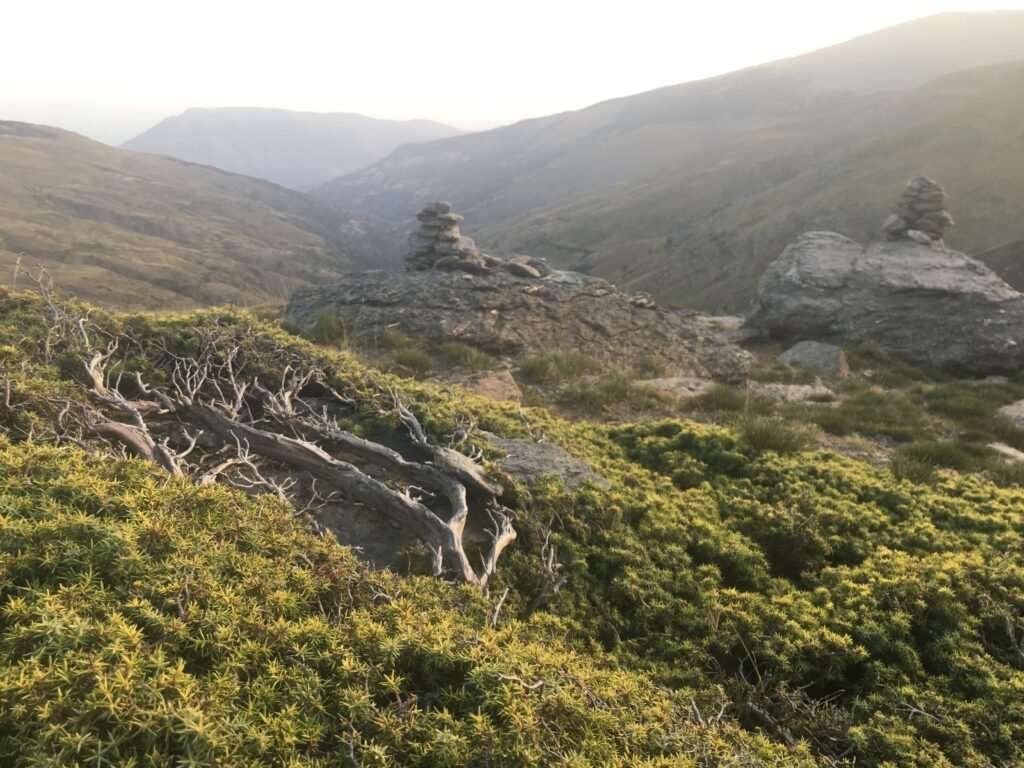
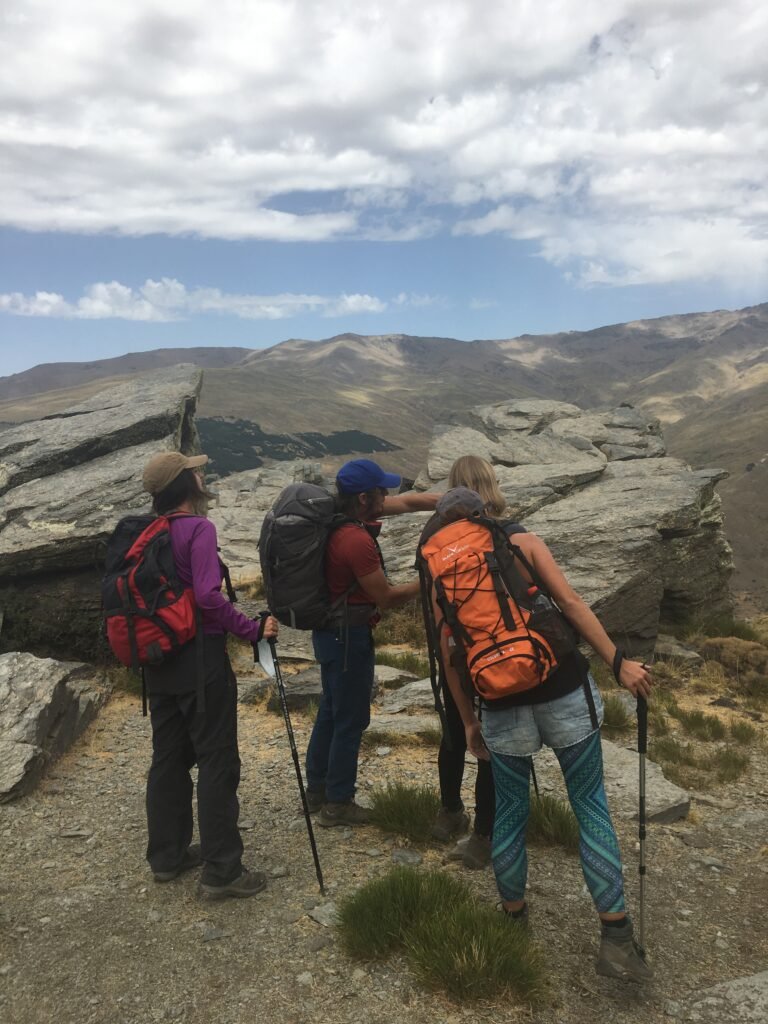
The route invites you to practise the popular art of mindfulness: to feel the effort of every step, to store in your memory the beautiful images the high mountains offer, to feel the heat of the sun or the ever-stronger wind on your skin, and to enjoy the silence and the sense of freedom every hiker inevitably experiences. Suddenly the guide’s voice breaks into that full attention: “Look, there it is!” Peeping out between the rocks, forming a tiny meadow of greens and whites, is the flower of love, the Sierra Nevada snow star, named after its shape and its green leaves covered in white down where the dew settles every morning. An endemic species that has managed to adapt to the extreme conditions of the high mountains, always staying fresh and symbolising a love that lasts and never withers.
There is nothing more comforting than a hearty stew after a hot shower. Mountain refuges play a vital role in looking after climbers, who arrive exhausted, hungry, thirsty and half dazed by the altitude. All they need is a homely shelter that covers the basics: a shower, food and a good night’s rest. An extraordinary sunset and a sudden drop in temperature mark the end of the day. A few night owls squeeze out every last minute, wrapped in a blanket under a sky with far more stars than usual.
A stone’s throw away
The second day of the route delights with snowfields, streams, cattle, Iberian ibex and more endemic species. This time it is Baetica ustulata, the high-summit bush cricket, cleverly hidden among slates of its own colour. It lives above 2,200 metres and is threatened by the activity of the ski resorts.
For a moment, that sense of heaviness and vastness, together with the arid horizon of grey and reddish tones, makes you feel like an astronaut on the red planet.
Distances are deceptive in the mountains, and what seems within reach is several hours away. The landscape grows ever barer of vegetation and stands out for its harshness and aridity: steep, rugged massifs in reddish hues, the scars of glacial erosion, metamorphic rock, more rock, a great deal of rock, and nothing else. The altitude makes breathing harder and slows your ever-heavier steps, the wind gives no respite, and for a moment that sense of heaviness and vastness, together with the arid horizon of grey and reddish tones, makes you feel like an astronaut on the red planet.
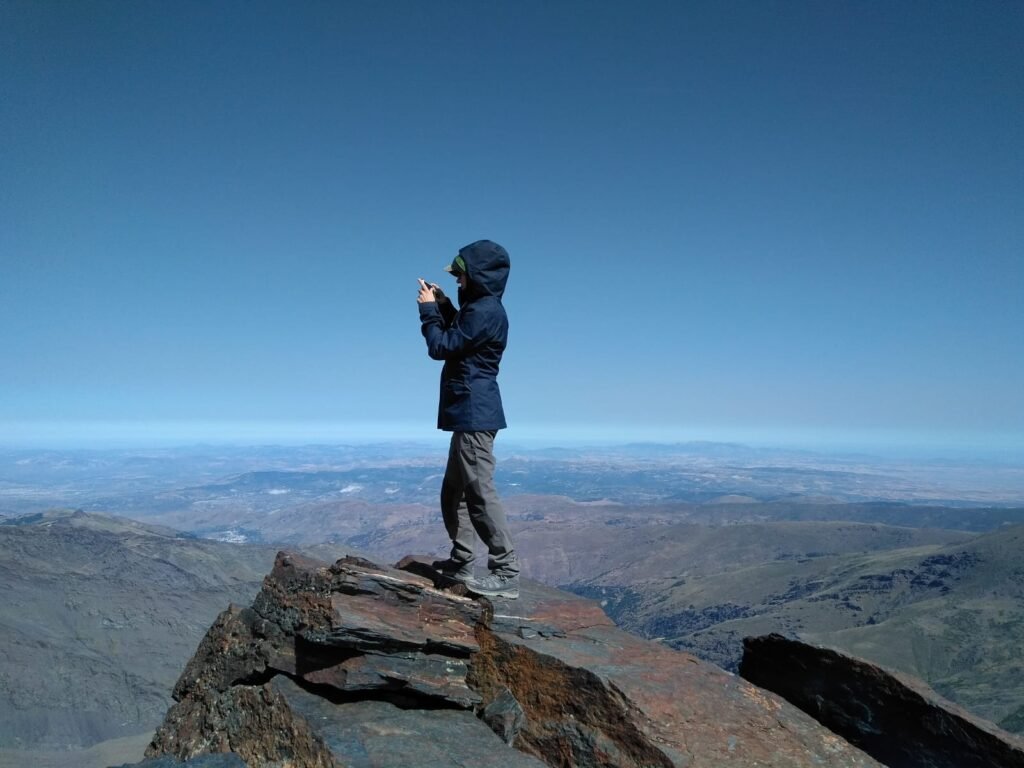
There it is, a stone’s throw away at 3,482 metres: the majestic summit of Mulhacén. The satisfaction of standing on the roof of the peninsula and a 360-degree panorama are the reward for such a hard climb. Not to mention the sandwich you eat while taking in the view, which at this altitude tastes a thousand times better than usual.
One of the most common forms of sustainable tourism is ecotourism: any kind of holiday or recreation in natural surroundings that also involves social responsibility. It means travelling with intent to natural areas in order to understand their culture and natural history, taking care not to disturb the integrity of the ecosystem, while creating economic opportunities that make conserving natural resources worthwhile for local people.
When the view takes a 180-degree turn
Around the summit, the silence is broken. Conquering the highest peak of the Iberian Peninsula is a big draw for mountain lovers. Since the pandemic, however, mountaineering, a high-altitude sport with real risks, seems to have become an activity for everyone, triggering a considerable rise in “new hikers”.
Long periods shut in between four walls and coming face to face with death have made many people appreciate the importance of spending time outdoors in contact with nature, that free medicine that can heal so many ills. But at what price? Every coin has two sides. What on the one hand seems to benefit visitors, on the other means that this mass alpine tourism not only damages the natural environment through a lack of awareness but also leads to tragic outcomes for inexperienced beginners who underestimate the dangers of the high mountains. Crowds, litter and plastic left on the ground, rescues of injured hikers and cases of hypothermia among people dressed as if for a stroll in the countryside are increasingly common. And sadly, there are even more unfortunate endings that result in death. New hikers urgently need to become more aware.
Now, with the satisfaction of having achieved your goal and a long, tough descent behind you, Capileira and its charms are waiting to be discovered. But not before enjoying a well-deserved Andalusian beer and tapa while you talk over your experience on Spain’s Mars, gazing at the distant summit.
Ana Albors Sancho wrote this piece as part of their training at the School of Travel Journalism. If it inspired you, take a look at our Master in Travel Journalism and our Master in Gastronomic Journalism and Communication, watch our students’ travel documentaries on YouTube and listen to their stories on our podcast on Spotify.
Interested in writing about travel that explores the extraordinary? Discover the Master in Travel Journalism and the Master in Gastronomic Journalism and Communication at the School of Travel Journalism.