
By Dessiré Camporro
It is a very sunny, hot June morning in Athens. I am staying at the Crowne Plaza Athens City Centre. I haven’t rushed down to the hotel breakfast because, although you can try Greek delicacies there, I have decided to keep up my now traditional habit of finding a brunch spot in every part of the world I visit and eat something healthy after my strength training.
There are plenty of places to eat in this city; it all depends on what you are looking for. Today I have chosen The Roosters, a modern brunch café in the Ilisia neighbourhood, at 58 Ionos Dragoumi Street. It is a few minutes’ walk from the hotel and a 7-minute drive from the Acropolis Museum.
As I walk in, I can sense an atmosphere that is relaxed and a little lively at the same time. Leon Bridges’ Coming Home is playing. The white marble walls seem deliberately unfinished, with wooden tables and chairs of different designs that oddly work very well together. Beside some tables, instead of chairs, there is a long wooden bench reminiscent of a Catholic church pew. There are also plants in every corner, hanging from macramé knots or dried in vases on the shelves of a kind of library with almost no ornaments or books, in a minimalist style.
The windows are large and let in plenty of light. There is a clear intention to wrap customers in an organic atmosphere. It fits rather well with what they serve: although there are options for those with a sweet tooth, the menu follows a fairly healthy line. This whole setting of imperfect white walls, plants and mismatched wood gives it a casual, almost unplanned feel that suits the kind of customers in the café, who seem to be in no hurry at all.
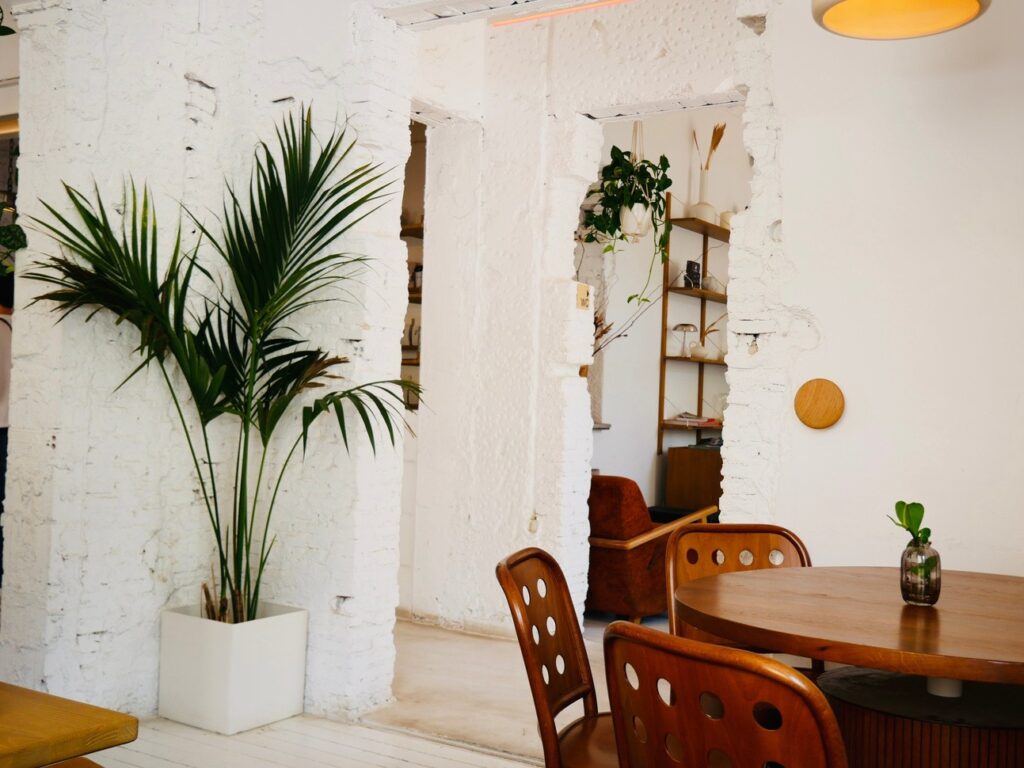
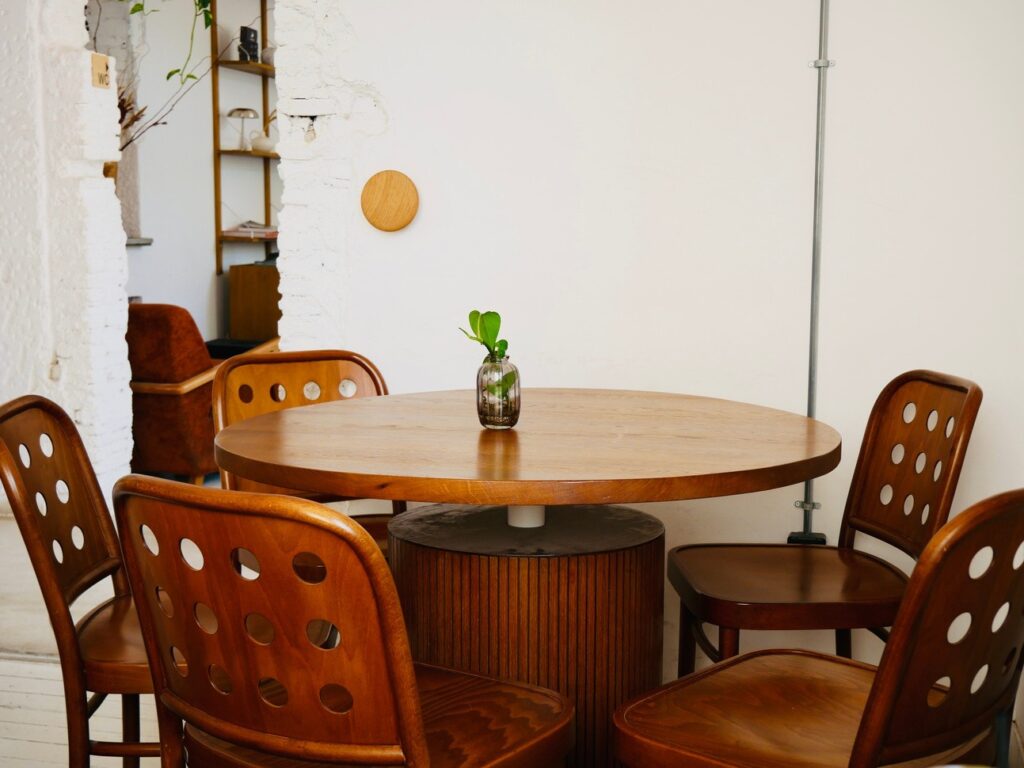
Most of the customers I can see are groups of people in their thirties, pairs of friends or couples calmly holding their drinks with their sunglasses on, enjoying the mid-morning breeze on the large L-shaped terrace that wraps around the building. I watch them, absorbed in their conversations.
It is very hot, but the terrace, which has its own parasols and also enjoys the shade of the trees around it, is a very pleasant spot and the mood is calm. You don’t feel like going back to work. It is quite a different feeling from the frantic streets of central Madrid, where everyone seems to be in a hurry from first thing in the morning.
I went up to the counter and, after a smiling kaliméra, began leafing through the large menus one after another until I found the English one. I told the waiter what I would have and he kindly invited me to sit down first; one of them would then come and take my order.
All the waiters and waitresses were young and some had a slightly alternative, casual look – tattoos, piercings, streaks of blue hair – but they did not look scruffy; I would even say they were all easy on the eye. They could easily have passed for customers.
A young man in a baggy white T-shirt came to take my order. He spoke to me directly in English and did not smile until I did. Although he seemed a little serious at first, he soon relaxed. Perhaps it was his first week: I noticed that others were keeping an eye on him. We shouldn’t forget how challenging it is to speak another language at work if we are not yet used to it. Even so, he and the rest of the staff spoke good English and were friendly.
The menu at The Roosters offers, among other things, what everyone now understands as healthy food. From fruit smoothies, matchas and speciality coffee to main dishes with eggs, smoked salmon and avocado, or sandwiches with supposedly unprocessed ingredients and different kinds of bread, as well as a few sweet treats. The cinnamon rolls and cookies are huge, and if you look at them for too long they become a real temptation.
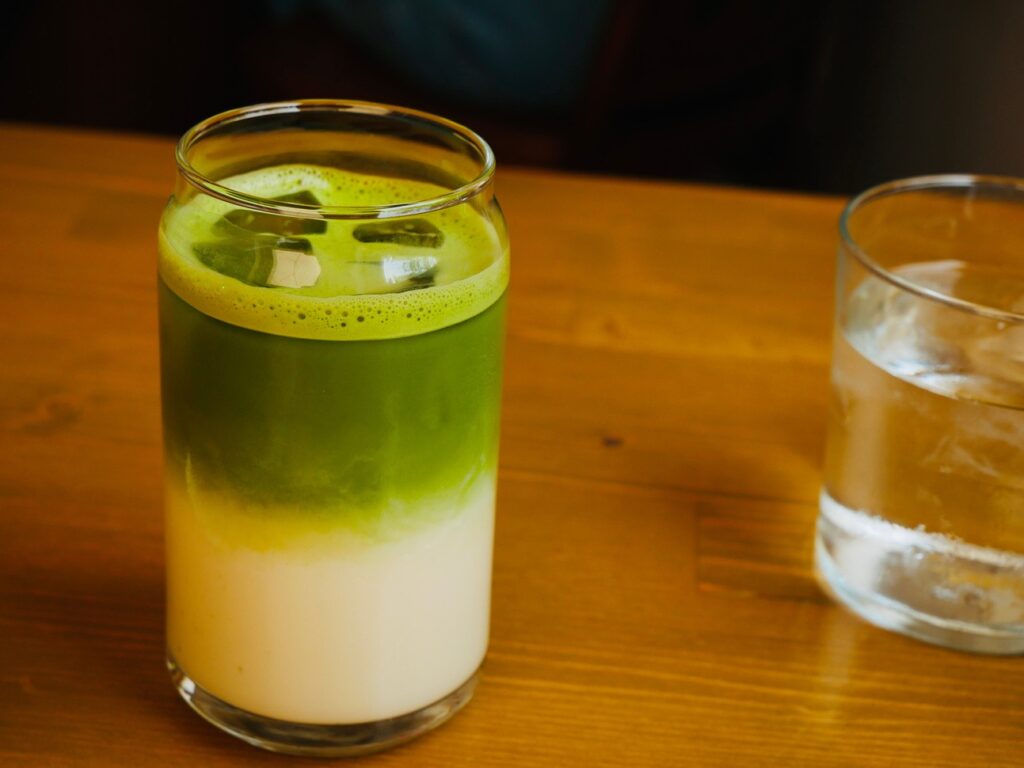
To drink I ordered an iced matcha with oat milk, and to eat their healthy omelette and the Greek yoghurt with granola and berries.
I chose oat milk because plant milks, although some contain a lot of sugar, have less fat than cow’s milk and don’t usually leave you feeling bloated.
Unfortunately, many places add syrup to matcha without asking the customer first, so it loses its characteristic grassy, earthy flavour and becomes a much more “crowd-pleasing”, sweetened drink, losing its true personality.
Let’s talk about matcha
There are many kinds of matcha. A very famous one in Japan, which is also sweeter and creamier – making it almost irresistible – is Uji. It comes from the Uji region of Kyoto, where the climate and soil are ideal for growing fine tea, so its leaves are more tender.
For a little context, matcha was first used in China, although it was not yet called that, but simply ground tea. Its use dates back to the Tang dynasty, between the 8th and 10th centuries, when the leaves were steamed, and it was popular at court and among Buddhist monks, who drank it during meditation.
This tea keeps the mind active, alert and focused, but without the jitters or edginess that coffee can bring. It offers a kind of calm energy, as it contains mild caffeine and L-theanine as well as antioxidants, which is why it is considered a superfood.
Later, in the 12th century, it reached Japan and began to be grown in Uji. And around the 15th century it began to be used in the tea ceremony, based on the Zen principles of simplicity, harmony, respect and tranquillity.
In the 20th century it went from being reserved for the aristocracy and temples to more popular use in confectionery (mochi, ice cream and so on), until in the 21st century we adapted it to Western culture with our matcha lattes and smoothies.
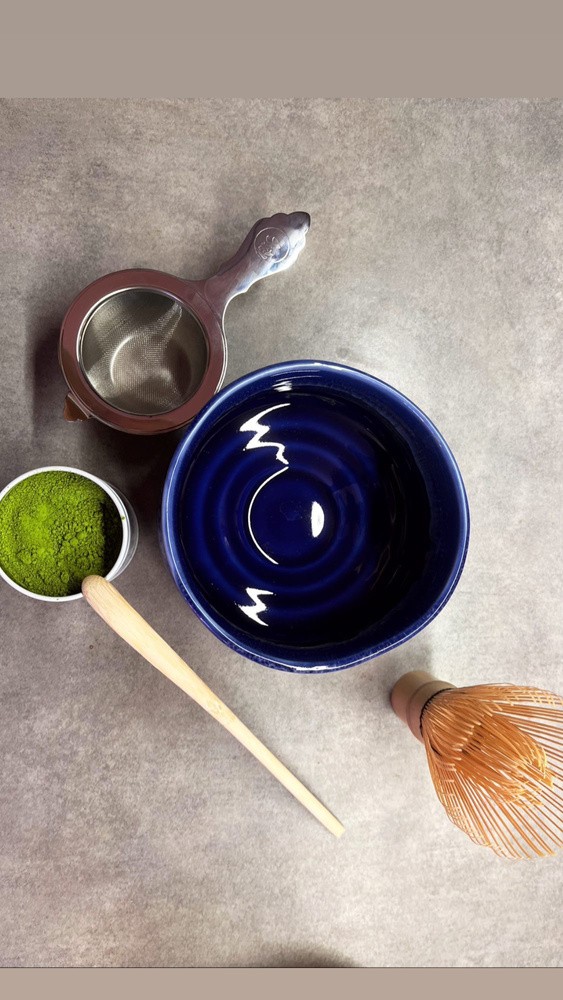
That said, many people who have attended a tea ceremony – especially those lucky enough to do so in Japan – or who have simply approached this ritual with respect and curiosity have acquired all the traditional utensils needed to prepare it at home.
Starting with the chawan, the wide, deep ceramic bowl; the chasen, the handmade bamboo whisk used to whisk the matcha powder (a technique that is not easy to master) with hot water (around 70–80 ºC, not boiling); the chashaku, the long, curved scoop used to measure just the right amount of matcha; and the tamagawa, the sieve that stops lumps from forming.
But let’s get back to our brunch in white Athens…
The young waiter in the white T-shirt brought my drink. The matcha is served over ice in a glass. The green upper half of matcha was perfectly separated from the white milk below. Visually it was a balanced and rather striking drink. After the first sip, my impressions were very positive. You can taste the umami, that deep, vegetal flavour so enveloping and characteristic of this tea. I couldn’t taste any sweetener, apart from the very likely sugar in the oat milk.
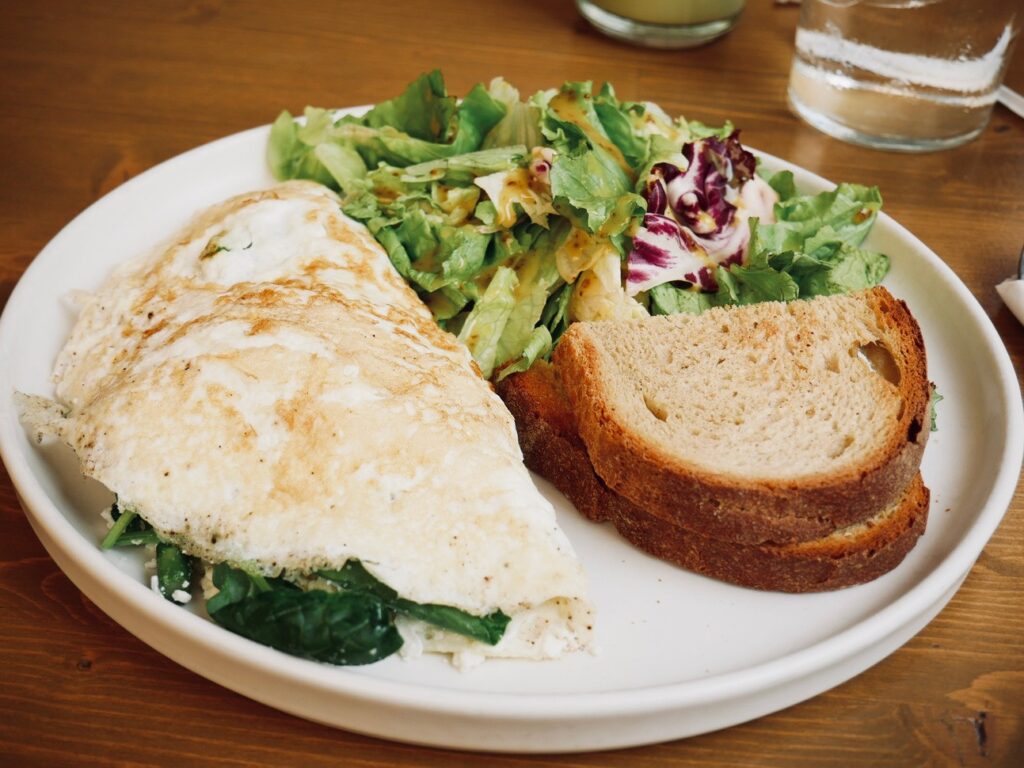
I decided to try one of their omelettes, the healthy omelette, made with egg whites and filled with asparagus, feta, spinach and broccoli. It was a large, pale French omelette, whitish because of the egg whites. It came with a side salad and toasted sourdough bread, cut in half.
The salad dressing contrasted quite well with the flavour and slightly pale colour of the leaves, which were not exactly eye-catching, but the dressing added an interesting, unexpected touch – a kind of sweet-and-sour mustard. In my view, they could have chosen different leaves.
Perhaps lamb’s lettuce or rocket would have worked better, or they could simply have dropped the salad, since the omelette already contains spinach, and replaced it with a quarter or half an avocado sliced into a fan, which would have brought visual balance to the plate; as Vitruvius said, “beauty is born of proportion”. Then again, perhaps they wanted to avoid the fat that avocado adds and keep the dish to a good amount of protein and plenty of fibre from the vegetables.
The omelette was soft and fluffy, with a slightly bitter note from the broccoli and asparagus, balanced by the creamy saltiness of the feta. The spinach added freshness, and together with the warmth of the dish the whole was very well judged. Simple and very pleasant on the palate.
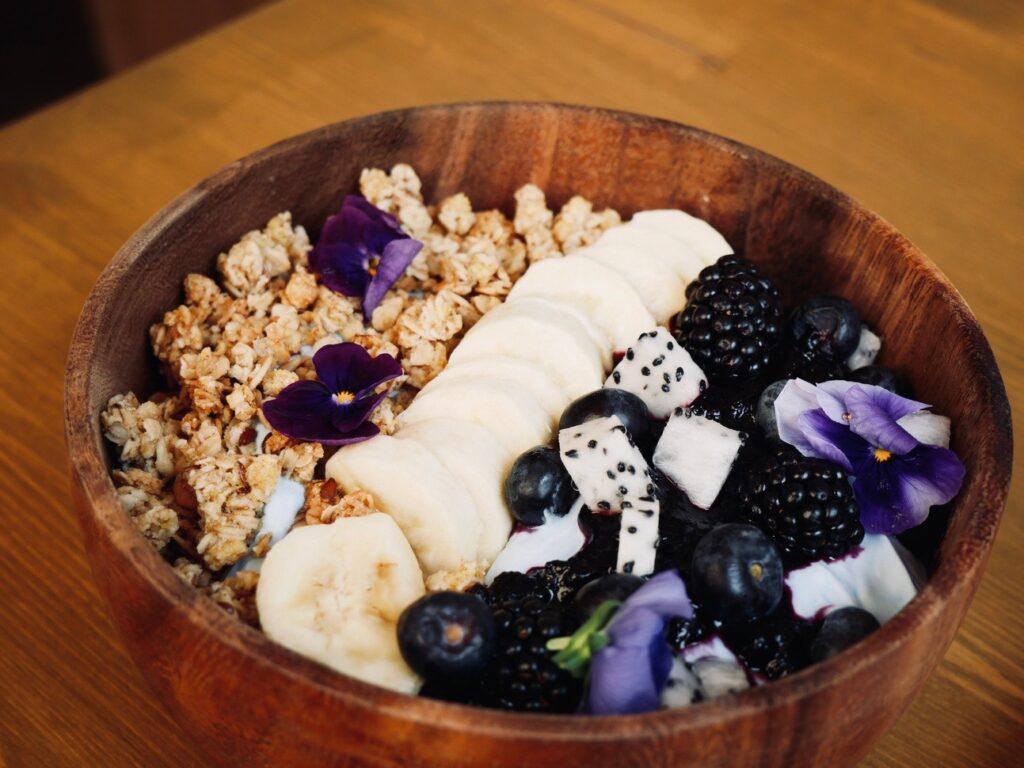
I also decided to try a Greek yoghurt with berries. It came in a large bowl that seemed to be made of wood (like the rest of the décor), in which a straight line of sliced banana separated the granola from a layer of black, dark blue and little white cubes.
They were blueberries, blackberries and dragon fruit. Four small, bright purple edible flowers delicately decorated the bowl. Beneath that blanket of colours and textures – the fruit brought softness and the granola that satisfying crunch – you could see shy streaks of raspberry jam.
Curiously, later on, when I began stirring the yoghurt into the granola, I started to notice a creamy – and suspicious – bluish tint in the dairy. I wondered whether it was one of those marketing tricks and there was actually some sweetener, syrup or ultra-processed ingredient in the mix. However, it tasted rather sour, as unsweetened Greek yoghurt usually does, and the only striking thing was the colour; the flavour was that of real Greek yoghurt.
As I savoured my food I looked around and wondered what all these people, free at midday on a Monday in Athens, did for a living. What were their lives like? Was there a university nearby and was this their meeting point several times a week between classes? Was there some influencer whose work was remote and whose time was completely flexible?
In the distance I see a couple kissing in the street, right on the corner of the restaurant terrace. It looked as if they had just been on a date. He was sitting on a motorbike and she was standing. She gave him a long, hard kiss. He seemed rather to be on the receiving end of this burst of passion.
Then she walked away smiling, her loose hair swinging from side to side with each step, while he stayed there on his motorbike, helmet in hand, watching her for a few more seconds before putting it on and speeding off. Was he going to work? Was he reflecting on how lucky he was to be with that young woman, or was he wondering how he would get out of a relationship so unbalanced in affection?
I turned my attention back to my food and realised that perhaps I had ordered more than I needed. The truth is that the portions are generous and with just one dish, chosen well, you don’t need a second. My generous brunch cost €23.45.
Both the healthy omelette and the yoghurt are portions that, ordered on their own, shouldn’t leave anyone hungry (even after a good strength workout).
Upstairs there is an open kitchen, right opposite the toilets, and further on a kind of enclosed balcony, full of young people working on their laptops, alone or in small groups. Perhaps more students or influencers?
After a quick search online, I found that the University of Athens was just a few kilometres away.
Downstairs, by the counter, there are wines and champagnes on display. Probably in the evening, when the sun goes down and people leave work, The Roosters becomes the place to meet for an Aperol Spritz if it fills with tourists, or something more Greek such as ouzo, an aniseed spirit drunk over ice and often mixed with water; tsipouro, stronger than ouzo and usually served with food; a Greek beer such as Mythos or Alpha; or a white wine or retsina, the latter with a very traditional resinous flavour.
I can easily picture this place serving good cocktails and a few late-night bites while people, tanned by the Mediterranean sun, chat cheerfully and loudly, trying to make themselves heard over the music. Or perhaps it is more a place of soft murmurs, with candles and a warm, sensual atmosphere.
We will have to come back to discover the other side of this charming, spacious place called The Roosters.
This article is part of the coursework completed by students of the Master in Travel Journalism and the Master in Gastronomic Journalism and Communication at the School of Travel Journalism.