
By Silvia Gago
It was my third day of diving in Baja California Sur. We left the little harbour of Cabo Pulmo at eight in the morning, heading for Los Morros, one of the most emblematic sites in the marine national park and our first dive of the day. On board the boat, the fresh air and splashes of cold water kept me wide awake. Although the sea was much calmer than the day before, there was still a bit of a breeze.
When the boat stopped at the dive site, we got ready to go in. I zipped up my 7-millimetre wetsuit, hood included, essential for the cold currents ahead, which would arrive suddenly and feel like gusts cutting through to the skin. Then I strapped seven kilos of lead to my belt, which made me feel heavy and a little clumsy. I adjusted my BCD, fins and mask, put the regulator in my mouth and let myself fall backwards into the water.
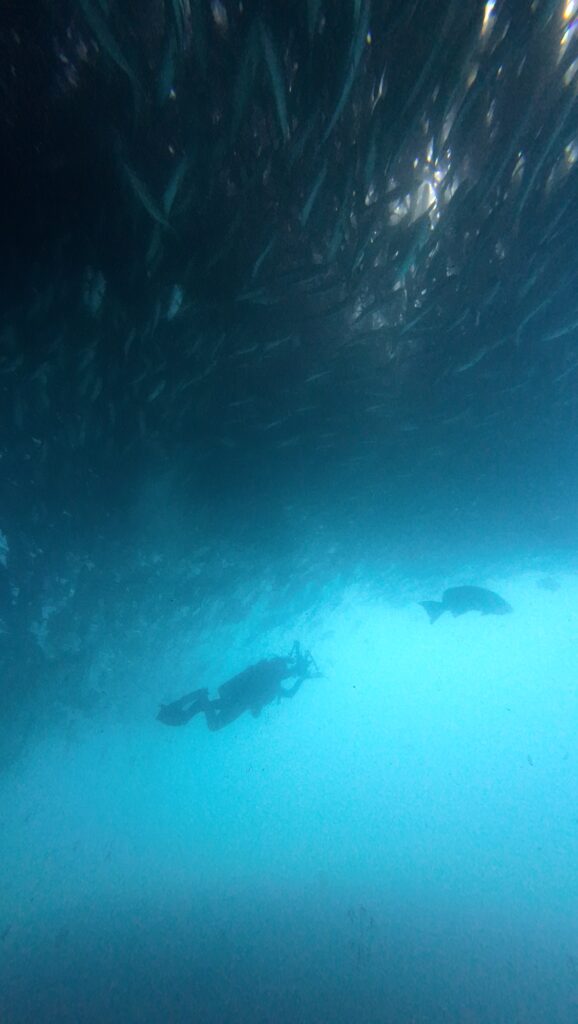
As soon as we descended, a huge shoal of jacks wrapped around us until it blocked out the sunlight, like a black rain cloud. Groupers almost my size swam through it, parting the fish like Moses parting the Red Sea. The feeling was overwhelming: I was completely euphoric, surrounded by life, and at times I lost all sense of space and time. It was the first time I had experienced anything like it underwater. Nothing prepares you for something so intense.
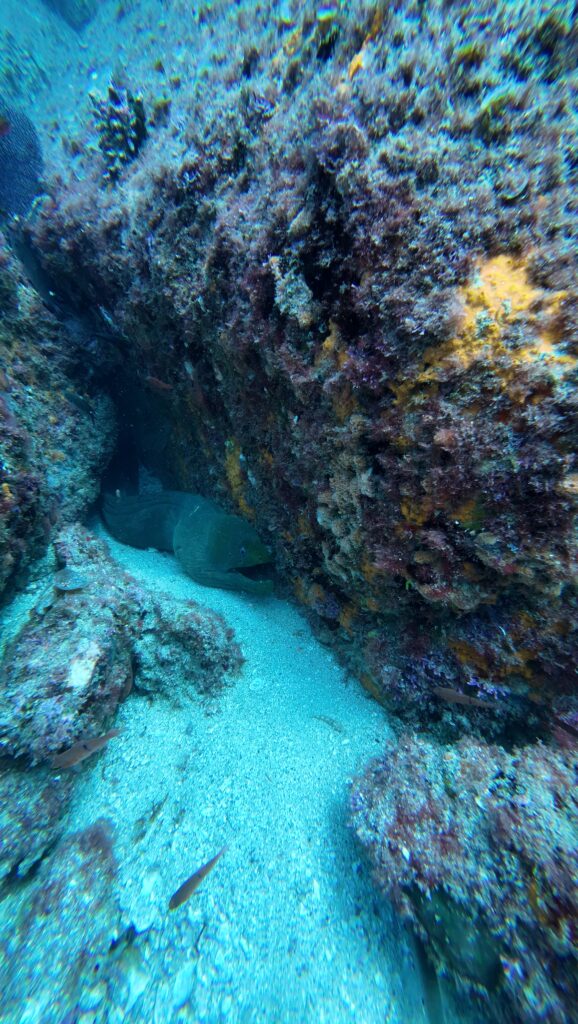
Further down, the outlines of the morros, volcanic formations covered in brightly coloured coral, rose like sunken cathedrals, home to butterflyfish, angelfish, surgeonfish and schools of pufferfish, among many others. They are also the hiding place of sharp-toothed moray eels peeking shyly from the rocks. Visibility was good for March, and we even glimpsed a mobula ray in the distance, elegant, near the surface, barely visible.
Underwater, everything is quieter. All I can hear are my bubbles as I breathe out and the faint creak of the regulator. Now and then, a distant click, the sound of another boat or the brush of fins. There are no distractions, which I actually welcome because, as I gain experience as a diver, it helps me focus on looking for small details such as brightly coloured nudibranchs and fireworms. Learning to look underwater is almost like learning a new language.
The dive was wonderful. I enjoyed every second, despite the cold seeping in at the edges of the suit, at the wrists, at the neck, wherever it could. The hood helps, but water always finds a way in. My fingers went a little numb, and yet every minute was worth it, from the first metres to the last look at the seabed during the safety stop.
Back at the surface, as soon as I take the regulator out of my mouth, the taste of salt is the first thing I notice. After almost an hour underwater, my mouth feels dry from the rubber, with a slightly bitter aftertaste that has become familiar, and even my jaw feels a little tired and tense.
Back on the boat, the smell of wet neoprene and sea salt is unmistakable. My instructor, a Catalan woman in her forties, opened a flask of cinnamon tea and offered me some in a plastic cup. Holding that steaming cup in my frozen hands was comforting. It warmed me from the inside and brought me back, little by little, to the land of the living, ready for the next dive.
I also had a few biscuits. Nothing special: industrial, packaged, probably more sugar than anything else. But at that moment my palate celebrated them like a feast.
As the sun began to warm my still-soaked wetsuit and the other divers chatted quietly about what we had seen, I thought about how special Cabo Pulmo is. I’m not just talking about the abundance of marine life. There is an energy there, a kind of balance between the wild and the protected, between calm and the unpredictable. It’s one of those places that, when you return to the surface and take off your mask, you know you’ll remember forever.
Silvia Gago wrote this piece as part of their training at the School of Travel Journalism. If it inspired you, take a look at our Master in Travel Journalism and our Master in Gastronomic Journalism and Communication, watch our students’ travel documentaries on YouTube and listen to their stories on our podcast on Spotify.
Interested in writing about travel that explores the extraordinary? Discover the Master in Travel Journalism and the Master in Gastronomic Journalism and Communication at the School of Travel Journalism.