
By Katrijn Geerts
“Travel is the only thing you buy that makes you richer.”
It’s a cliché I used to laugh at, until one impulsive morning in August when my friend Rebekka and I decided to fly to Morocco. We were two young women, each carrying a backpack full of restlessness and a head full of romantic ideas about distant places. Impulsivity was our specialty. And so, without hesitation, we bought tickets to Marrakesh simply because it was the first destination that appeared like a blazing lantern in the digital night.
Less than ten hours later, we stood on African soil. And from that moment on, everything unfolded in ways no one could have predicted — except perhaps God, who whispered inshallah above our heads every time we stepped into a new chapter of our adventure.
Marrakesh, city of a thousand colours and just as many vendors
The first thing that struck me when we stepped out of Marrakesh airport was the smell. Cinnamon, warm earth, leather, gasoline, orange blossom, dust — the air felt like a spicy soup simmering on low heat. Rebekka and I walked through the city with bright smiles, as if we had entered a fairytale. The red-brown walls reflected the sunlight, motorbikes zoomed past us from every direction, and the souks exploded before our eyes like a kaleidoscope of colours.
Later, I realized that our smiles were like a flag waving too eagerly. A flag that read: “Inexperienced tourists — come and get us!” Within minutes, vendors swarmed us. Trinkets, scarves, bracelets, spices — everything was pushed into our hands.
“Pretty lady! Good price, only for you!” “You have Berber eyes, very special!” “Come, come, meilleur prix!” Two young women with open faces — yes, we were exactly their dream targets. And I admit: we were easy to persuade. Their charm, their persistence, their cleverness — it worked. But after two days, that charm became overwhelming. The chaos of Jemaa el-Fna, the constant shouting, the endless refusals — we were drained.
Over a far-too-sweet tagine, Rebekka looked at me and said: “Shall we leave?” “Now?” She nodded. “Yes. Let’s just go.” Impulsivity, remember? Our talent.
The bus to the unknown
An hour later, we were on a bus to Essaouira. Not a tourist bus — oh no. This was the local bus, the one filled with women in headscarves, cardboard boxes and chickens clucking as if voicing their dissatisfaction with the journey. The heat was heavy, the air dry, the window stuck half-open. Every bump made the entire bus rattle like a rusty percussion instrument.
And the bus driver… he was a story in himself. He stopped whenever he felt like it, without warning. Sometimes he disappeared into a roadside shack and came back with a skewer of meat that still steamed in the sun. He ate leisurely, while the rest of us simply waited. Rebekka whispered, “Are we going to survive this?” I shrugged. “Inshallah,” I said — our motto for the rest of the trip.
The night in Essaouira
By the time we arrived, the sky was pitch black. No streetlights, no friendly hostel receptionist — only darkness and uncertainty. We stepped off the bus, and fear immediately crept along my spine. From the shadows appeared women in black garments, only their eyes visible. Their eyes glimmered in the dark as they approached. “Chambre! Chambre! Very good! Come with us!” Rebekka squeezed my arm. “Don’t,” she whispered. “Let’s just keep walking.”
And so we did — quick, nervous steps away from the unfamiliar eyes. The first hostel: full. The second: closed. The third: nonexistent. With every rejection, our hope shrank like the narrow pupils of the women watching us. Eventually, we had no choice but to return. The women were still there, eyes shining like coins in the night. They offered us rooms again. And this time, out of exhaustion and desperation, we agreed. We followed them into a narrow, dim alley and slept — half awake, uneasy — but alive.
Morning light and empty hostels
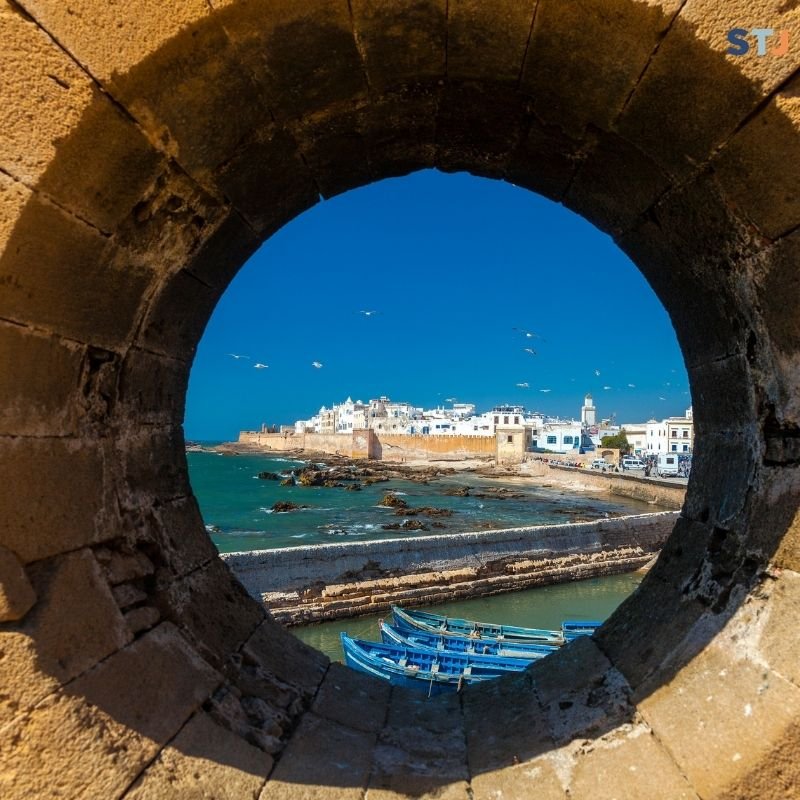
At sunrise, we slipped out as quietly as thieves. We hurried to the hostels we had tried the night before, but everything was still fully booked. Our luck was as thin as a mint leaf in hot tea. Exhausted and defeated, we collapsed onto a bench. Before us lay Essaouira: whitewashed walls, blue doors, seagulls screeching as they circled over the ocean. The air smelled of salt and fish — surprisingly soothing after the chaos of Marrakesh. And then, just as we were at our lowest, he appeared.
Abdul
He looked like a painting that had stepped out of its frame. A young man with slicked-back hair, a sparkling smile with a golden tooth, and a shiny gold chain around his neck. A bright red T-shirt, blue jeans, worn flip-flops. Everything about him gleamed — his skin, his teeth, his eyes, even the way he moved. “Salam aleikum, sisters!” he called out. “Today is my lucky day, inshallah!” Rebekka and I looked up in confusion. He sat down right in front of us. “Two girls sent from heaven!” he exclaimed. “I must show you my city!” Rebekka whispered, “We shouldn’t do this.” “We’re too tired to think,” I replied. “Let’s just go.” And so we followed him.
Essaouira through a local’s eyes
Abdul was not a guide. He was an event. He led us through winding alleys we would never have entered alone. Everywhere people called his name: “Abdul! Labas? Ça va?!” He seemed to know everyone — children, fishermen, butchers, old men sipping tea outside. He introduced us to his family in a white house with blue window frames and a door that creaked like it had stories of its own. His mother, a warm woman with soft eyes, welcomed us instantly: “Ahla w sahla! Welcome, daughters!”
At the market, the smells overwhelmed us: fresh fish, mint, olives, sea salt, charcoal. Abdul bought fish with theatrical flair. “No, no, my friend, too expensive! These girls need good fish! Special fish!” We laughed. We relaxed. Essaouira — this small fishing town filled with screaming seagulls — embraced us with surprising gentleness.
The hammam
“Come,” Abdul said later. “You smell like yesterday’s bus. Time for the hammam!” We didn’t dare refuse. Inside, the hammam was warm and steamy, filled with naked women whose bodies gleamed with black soap. They scrubbed each other like they were polishing old cars. We stood there stiff with discomfort. Suddenly, two strong women grabbed us. “Don’t be shy!” one shouted. And before we knew it, they scrubbed us too. “Sukran,” we whispered politely when they were done. They laughed wholeheartedly.
An evening with Abdul’s family
Abdul invited us to stay the night with his family. After our earlier fright, this felt like salvation. It became an evening full of warmth. We learned to cook tagine — slowly, lovingly, with far too much olive oil and even more mint. We drank mint tea thick as syrup. We spoke about life for hours. Abdul surprised us with his depth: “Life is like the sea,” he said. “Sometimes calm, sometimes storm. But always honest.” For the first time since we landed in Morocco, we felt safe. Comforted. Home.
A golden ring and a sudden exit
But the next morning changed everything. Abdul stood before me, smiling nervously. In his hand — a ring. “For you,” he said. “Marry me!” I froze. Was this a proposal? A misunderstanding? Did he think our presence meant something it didn’t? I stammered, “Thank you… but… no…” His eyes darkened, but he nodded. And once again, we fled — not from danger, but from complication. Morocco, we concluded, was not the most relaxing destination. But certainly unforgettable.
Richer than before
Months later, I still think of Abdul. His golden tooth, his warm family, his philosophical words. I think of the women on the bus, the chickens, the vendors, the dark night in Essaouira. I think of how afraid we were — and how fear is often just the beginning of a good story. And I finally understand the quote I once laughed at: “Travel is the only thing you buy that makes you richer.” Because it’s true. I came home with empty pockets, but with a mind full of stories, a heart fuller than ever, and a memory that gleams — like a golden tooth in the Moroccan sun.
Katrijn Geerts wrote this piece as part of her training at the School of Travel Journalism. If it inspired you, explore the Master’s Degree in Travel Journalism and the Master in Gastronomic Journalism and Communication, watch our students’ travel documentaries on YouTube, and listen to their stories on our Spotify podcast.
Read more on Travel & Create: I Threw a Dart at a Map… and Ended up in Kyrgyzstan · Walls that Speak: A Journey Through Rome’s Street Art.
This article is part of the practical work carried out by students on the Master’s Degree in Travel Journalism at the School of Travel Journalism.