
By Salomé Carreira
In October, Ovar, a small city in Central Portugal, hosted the ART&TUR festival. There, between screenings and interviews, one question took shape: can a tourism film festival reveal a place without turning it into a promise?
Before the Film
“What is the best word to describe Ovar?” I put this question to the national audience, organizers, and participants of ART&TUR 2026. Of the 29 responses, 52% chose “art”, 42% chose “people”, and 30% chose “tiles”. Respondents could select up to two options, which is why the percentages exceed 100%. Carnival, gastronomy, and the estuary ranked last.
No single word defines Ovar for this group. Art ranked first, followed by people and tiles.
Ovar, a city in the Aveiro District in Central Portugal, hosted the ART&TUR International Tourism Film Festival in October. Founded in 2008 by Professor Francisco Dias, the festival brings together professionals from tourism and audiovisual production, along with freelancers and students who want to showcase their work.
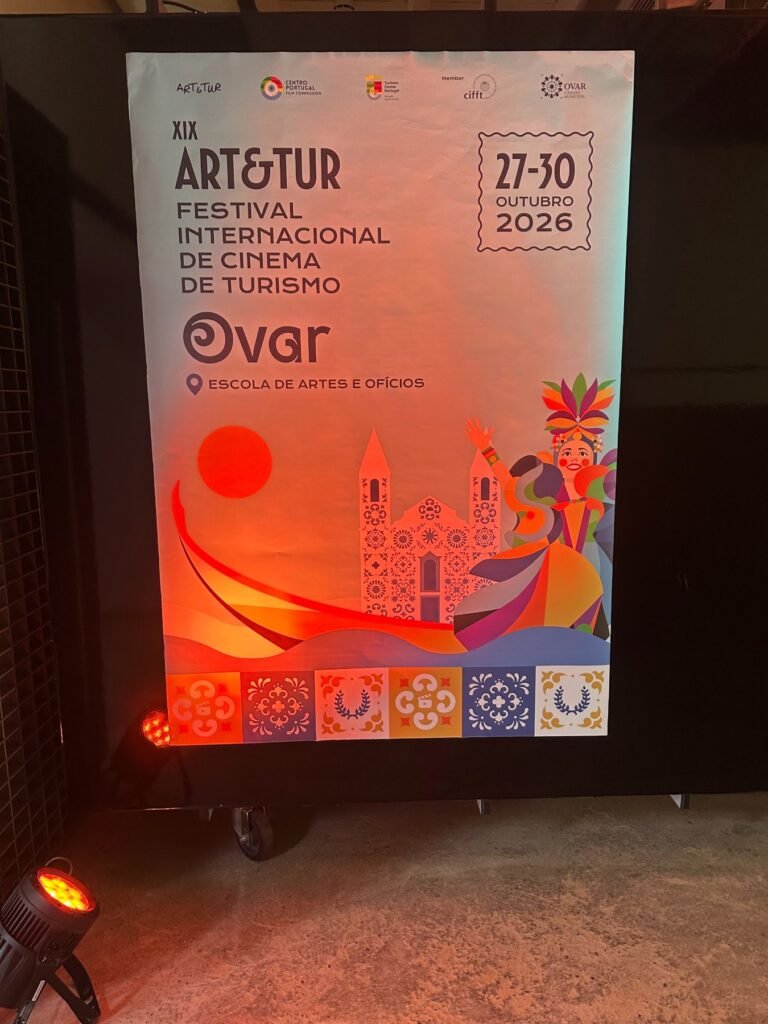
But what is Ovar?
Ovar is a place, a sense of belonging, a soul, and a sound. Arriving here is like stepping into a reserved space that reveals itself through the simplicity of being present. It’s meeting the fishmonger preparing fish in the city center, who asks, “So where are you guys from?” It’s walking into a hotel and learning that seniors gather in the dining room to sing karaoke. It’s finding a pão-de-ló in your room. It’s walking down streets lined with tiles that tell the stories of the people who live here. It’s trading whispers with the churches.
Architect Hélder Ventura calls Ovar an “aquamorphic” territory, a city that grew in constant dialogue with the water, evident in its clay, tiles, and mortar.
For Pedro Oliveira, owner of the AquaHotel, it is a complementary destination between Porto and Aveiro, driven by nature and sports.
This is the atmosphere that welcomes you—before the films begin, before opinions are formed, before ratings are given. Be present. Be Ovar.
When a Place Becomes a Story
Before it is presented at a film festival, Ovar is a city to be experienced: tradition, nature, flavor, memory. On screen, it becomes a story, told through images that highlight what defines it.
How do films turn places into narratives, identities, and promises? A film reveals a place when it shows what someone saw there. It makes a promise when it tells you what you will find.
Mariana Baptista, the festival’s director, told me there are different ways to tell the story of a place, from tourist attractions to the geography itself. Ovar’s continuous 5-kilometer promenade connecting the city to the sea is one example: in tourism storytelling, it can symbolize continuity and resilience, a path forward.
ART&TUR screens films from many origins. In 2026, 51 films from 45 countries were shown. Each film chooses what sits at the center of its story and leaves the rest out of the frame. The story that reaches the audience is both real and constructed.
The Moliceiro Boat—Some Say You’re Born One of Us, produced by IPDT, chose shipbuilding as its focus. Its story centers on the city’s relationship with water, which has shaped trades and ways of life across generations. For residents who grew up as the moliceiro gained renown, it is more than a boat: it is a form of identity.
Yet when that kind of identity is filmed for an outside audience, does it stay an expression of identity, or become a tourist image?
Other films make different promises. In A Connection That Ignites—Where Does Your Story Begin?, from South Africa, the message is that “it’s not about seeing it all, it’s about seeing what matters.” So Turkish, Go Turkish makes its promise openly: designed to attract more visitors from the United States, it gathers “So Turkish” moments, from Hagia Sophia to ferry rides on the Bosphorus, into a call to action to experience Türkiye.
These films show that tourism cinema follows no single formula: each makes a different promise, and for every element chosen, another stays outside it.
What Do Tourism Films Leave Outside the Frame?
When I interviewed Francisco Dias, I asked which elements should be highlighted to define a place’s identity.
He did not offer a fixed list of landmarks. Instead, he drew attention to what exists between them: “In tourism, some places are identified as attractions, but between one attraction and another there is also a space that needs to be told. Every tourism decision involves highlighting certain elements at the expense of others. There are no fixed elements, except for certain classifications, such as World Heritage Sites.” (Author’s translation)
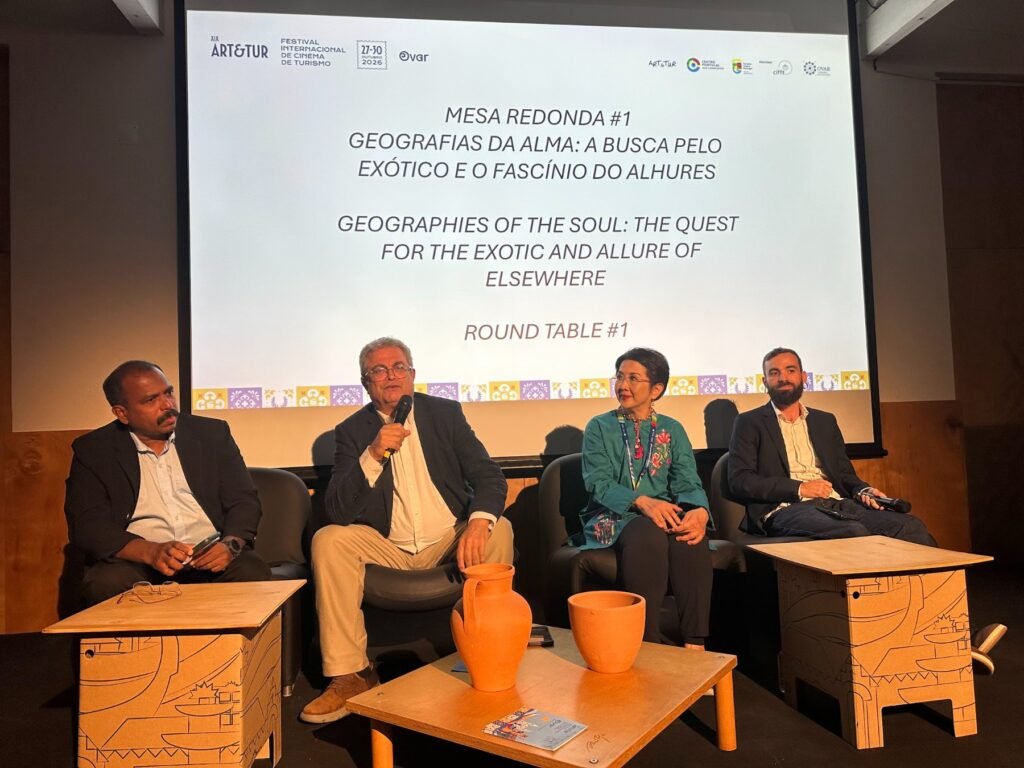
This answer shifts the focus from attractions to everything between them. In tourism, as in cinema, choosing what to show also means deciding what remains unseen.
The Moliceiro Boat presents the Aveiro region through water, shipbuilding, and the bond between community and craft. It emphasizes belonging and, in doing so, makes other parts of the region less visible: daily life, current challenges, and ways of experiencing the region beyond its heritage image.
JAJCE—The Place We All Came From takes another approach. It turns the difficulty of pronouncing the city’s name—even for some Bosnians—into a source of humour and curiosity. Its director, Robert Dacesin, draws on his repeated visits to Jajce, while the official synopsis, published by CIFFT and Terres Festival, calls it a “hidden European gem.” The result is ambivalent: the film acknowledges the limits of representation, yet also makes the promise explicit.
Perhaps a film doesn’t have to tell the whole story. A tourism film can be honest when it admits it falls short: it adds a layer, reinterprets the territory, and makes room for other narratives.
After the Screening, Does the Map Change?
For those who have never been to Ovar, a small, off-the-beaten-path town may seem far removed from the international tourist map. Can an audiovisual experience bridge that gap?
Avatar shows how an image can change the visibility of a place. The landscapes of Pandora have been linked to the rock formations of Zhangjiajie National Forest Park in China. In a 2013 article in TTG Asia, Yang Qian, head of a local travel agency, said the number of tour groups visiting the park had tripled since the film’s 2009 release. That is a promise at work: an image sets an expectation and visitors arrive to meet it.
ART&TUR works differently. It is not a single film seen by millions, but a festival that brings together many narratives, professionals, and destinations. It does not fix one image of Ovar; it lets people see the city for themselves.
Alfredo Araújo, a professor and jury member who has taken part in the festival for ten years, answered when I asked what role a tourism film festival plays in shaping a destination’s identity:
“It’s a great opportunity. The festival has an immediate impact, but also a long-term impact on the destination’s legacy and image. By linking this potential to the audiovisual sector, destinations can repurpose the films in promotional campaigns and capitalize on the contacts generated.” (Author’s translation)
The festival, then, does not end with the awards ceremony. The films can keep circulating and some will become promotional campaigns: promises of their own.
Don Falsario II, creative director of an Asian agency and a jury member, took part in ART&TUR in 2017 as a producer. Years later, he still remembers Portugal through the hospitality he received as a foreigner and filmmaker. A host city can become part of the emotional memory of those who visit it.
The festival may not immediately make Ovar an international destination, and there is no guarantee that every spectator will become a visitor. But it can change the city’s position on the mental map of those who discover it, without reducing it to a fantasy, an exaggerated promise, or a comparison with other places.
So I leave you with one question: has your map changed?
Sources: film synopses via CIFFT, Terres Festival and IPDT. Interviews conducted by the author at ART&TUR 2026, Ovar. Additional passages concerning Hélder Ventura and Pedro Oliveira are based on the author’s observations and notes from roundtable discussions held during the festival.
Salomé Carreira, a student on the Master in Travel Journalism, wrote this article as part of the School of Travel Journalism delegation at ART&TUR 2026 in Ovar. If it inspired you, take a look at our Master in Gastronomic Journalism and Communication, watch our students’ travel documentaries on YouTube and listen to their stories on our podcast on Spotify.