
By Ana Oubiña
For many people, sushi means rolls with raw fish. But that is only a small part of the vast universe contained in this Japanese dish, as popular as it is misunderstood. Behind the word “sushi” lies a world of techniques, shapes and combinations that can often confuse the uninitiated diner. Knowing how to tell them apart will not only let you order confidently in a Japanese restaurant, but also help you better understand a culinary tradition built on simplicity, respect for the ingredient and aesthetics.
The first thing to be clear about is that what makes a piece sushi is not the fish, but the rice seasoned with vinegar, sugar and salt. This rice is the base on which the different variations are built, some as well known as maki or nigiri, others less familiar outside Japan, such as gunkan or chirashi.
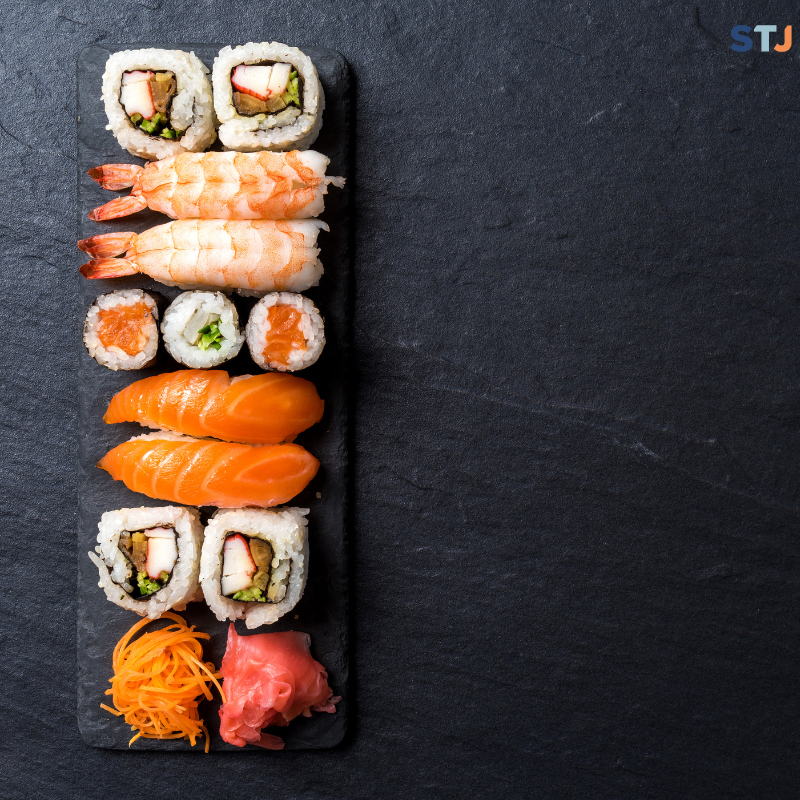
Nigiri, for example, is one of the most traditional forms. It is a small, hand-shaped portion of rice topped with a slice of raw fish, usually tuna, salmon or white fish. Sometimes a little wasabi is added between the rice and the fish. It is simple, elegant and lets you appreciate the texture of the fish in its purest form. It is usually eaten with the fingers or chopsticks, and when dipping it in soy sauce, the right way is to dip only the fish, never the rice.
Maki, on the other hand, is perhaps the most international image of sushi: rice and fish rolled in a sheet of nori seaweed and cut into small pieces. There are different types of maki depending on their thickness and the number of ingredients. Hosomaki, for example, is thin and usually has a single ingredient in the centre (such as cucumber or tuna), while futomaki is thicker and more colourful. It is normally eaten with chopsticks and is ideal for sushi beginners.
Then there is sashimi, which is not actually sushi, as it contains no rice. It is simply thin slices of raw fish served with wasabi and soy sauce. It is highly prized because it demands the freshest possible fish and precise cutting technique. If you want to appreciate the quality of the fish without distractions, this is the best option.
Temaki, by contrast, comes as a cone of nori filled with rice, fish and vegetables, eaten straight from the hand like a Japanese taco. It is less formal and very popular at casual dinners and parties. Its name says it all: “te” means hand in Japanese, and “maki” means roll. Literally, a roll you eat with your hand.
Another interesting form is gunkan, whose name means “battleship”. Its shape recalls a little boat: a base of rice wrapped in a strip of seaweed, leaving space on top to fill with ingredients such as salmon roe, sea urchin or seafood salads. It is harder to make, but offers intense flavours and soft textures that contrast with the rice.
Beyond individual pieces, chirashi offers a different experience. Instead of forming bite-sized pieces, sushi rice is served in a bowl or tray and topped with a variety of ingredients: raw fish, Japanese omelette, vegetables, roe… It is a kind of “deconstructed sushi” eaten with chopsticks, and very common on Japanese set lunch menus because it is simple and versatile.
And although it is not technically sushi, it would be impossible not to mention onigiri, Japan’s quintessential snack. These are triangles or balls of white rice, sometimes seasoned with salt, which may be filled with salmon, tuna mayonnaise, pickled plum or kombu seaweed, and partly wrapped in nori. They are sold in every konbini (24-hour convenience store) and are a practical, cheap option for eating on the go. Many Japanese people grow up eating onigiri, and their simplicity makes them one of the country’s best-loved snacks.
To remember all these types easily, you can picture a scale of “structure”. At the simplest end is sashimi (just fish), followed by nigiri (fish on rice), maki (rolled), gunkan (little boat), temaki (cone) and chirashi (everything scattered over rice). And alongside them, onigiri: a rice snack without vinegar, practical and homely.
As for how to eat sushi, a few guidelines are worth remembering. Traditionally it can be eaten with the hands (especially nigiri and temaki), although chopsticks are perfectly acceptable. The pickled ginger that usually accompanies it is not meant to be eaten with the sushi, but to cleanse the palate between pieces. And soy sauce should be used sparingly, preferably on the fish rather than the rice, so the piece does not fall apart.
Knowing the different types of sushi not only lets you enjoy this cuisine more, but also choose according to your taste, your appetite or the occasion. From the lightness of sashimi to the heartiness of uramaki or the convenience of temaki, each format offers a different experience. Some focus on the rice, others on the fish or the vegetables. Learning to tell them apart makes choosing easier and opens the door to a varied, balanced diet full of nuance.
This article is part of the coursework completed by students of the Master in Travel Journalism and the Master in Gastronomic Journalism and Communication at the School of Travel Journalism.