
By Monika Benduska
Imagine walking along unique trails surrounded by forests, waterfalls and three-thousand-metre peaks, with marmots watching you from their hideouts and cows grazing in alpine meadows. How can such an impressive place stay protected when 650,000 visitors arrive every year? That question now runs through any visit to Ordesa and forces us to rethink not only how to explore the park, but also the attitude we bring to it.
What is Ordesa y Monte Perdido National Park?
Ordesa y Monte Perdido National Park is in Spain, in the province of Huesca, and forms part of the Aragonese Pyrenees. The protected area covers roughly 89,000 hectares and is divided into four sectors: Ordesa, Pineta, Añisclo and Escuaín. The park was established in 1918, one of the first in Spain, initially protecting the Ordesa valley, its glaciers and the river Arazas.
Over time, specifically in the 1980s, the Pineta, Añisclo and Escuaín valleys were added, along with the Monte Perdido massif. In 1997 the area was recognised as a UNESCO World Heritage Site.
The park’s mission: biodiversity and a protected landscape
Ordesa’s main mission is to protect and conserve the Pyrenean landscape, together with its biodiversity, ecosystems and geological heritage. Protected species include the Pyrenean chamois (known locally as sarrio), red deer, marmots and a range of birds such as the bearded vulture, eagles and griffon vultures. Endemic species such as the Pyrenean newt and the Pyrenean frog also stand out.
As for plant life, the area is home to beech, fir and pine forests, as well as a great variety of alpine flowers, including lilies and the emblematic edelweiss. In terms of mountains, the Tres Sorores (Three Sisters) massif stands out, with summits such as Monte Perdido.
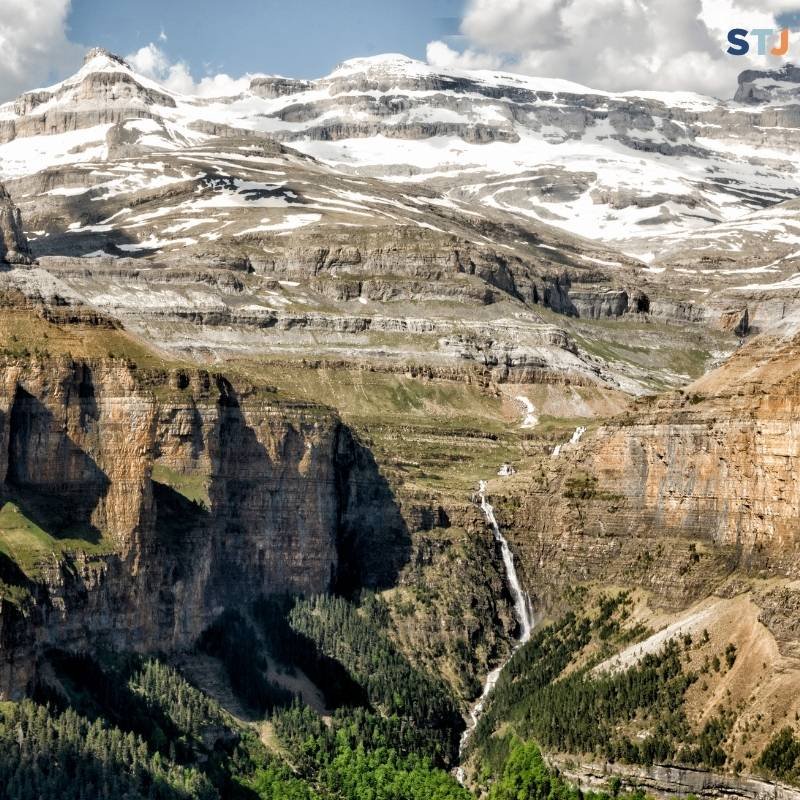
The landscape shows great environmental diversity: limestone massifs, waterfalls such as the Cola de Caballo (Horsetail Falls), rivers such as the Arazas and the Cinca, mountain lakes known as ibones, glaciers and wide plains where cows and horses graze slowly to the sound of their bells. This natural wealth needs constant attention, as these ecosystems are particularly fragile.
The area offers many possibilities for walkers. There are family routes, such as the well-known trail to the Cola de Caballo, as well as more demanding ones, such as the Senda de los Cazadores (Hunters’ Path) or the Faja de las Flores, set at the foot of the three-thousanders. It is precisely this variety of options, concentrated in a limited space, that makes it essential to regulate access to and use of the land.
The park is accessible in all four seasons. In summer, after a hike, you can cool off in rivers and pools; in autumn, the beech woods put on a show of coppery tones; in winter, snowshoe walks take on a special appeal; and in spring, the thaw turns waterfalls such as the Gradas de Soaso into a true work of art. Each season reveals a different face of Ordesa, which adds to its appeal and, at the same time, to the pressure on the environment.
It’s worth noting that Ordesa has well-developed infrastructure. The Góriz and Pineta refuges are properly equipped, the trails are waymarked and well maintained, and there are basic services at the main entrances. In the surrounding villages you can buy or rent mountain gear, an important point for many hikers.
Facing overcrowding: how Ordesa protects itself
Ordesa’s main challenge is the concentration of visitors, especially in the Ordesa valley itself during the summer season. Various control systems have been put in place to deal with this. Numbers are capped on the busiest trails and, in the peak months, access is only by shuttle bus at set times, which prevents the roads and car parks from becoming gridlocked.
The visitor centres run environmental education programmes explaining the value of the protected area, the impact of certain human behaviours and the importance of more respectful tourism. On the main routes, the presence of rangers reinforces monitoring and care of the environment. Together, these measures are not meant to limit the experience but to ensure that Ordesa can continue to be explored without endangering its natural balance.
Conclusion: visiting Ordesa without consuming it
All these measures help keep the park in good condition, protecting its natural wealth and encouraging greater environmental awareness. Anyone who visits Ordesa must accept that enjoying this place means respecting its fragility and accepting certain limits.
Visiting Ordesa without consuming it means exploring it attentively, unhurriedly and without needing to take it all in. Only with this mindful attitude will this landscape continue to offer the same experience to those discovering it today and to future generations.
Monika Benduska wrote this piece as part of their training at the School of Travel Journalism. If it inspired you, take a look at our Master in Travel Journalism and our Master in Gastronomic Journalism and Communication, watch our students’ travel documentaries on YouTube and listen to their stories on our podcast on Spotify.
Interested in writing about travel that explores the extraordinary? Discover the Master in Travel Journalism and the Master in Gastronomic Journalism and Communication at the School of Travel Journalism.