
By Milena Gnedkova
When Sanjar Azizov, owner of the Uzbekistan-based company Travelistan, presented his country at our School of Travel Journalism masterclass, he spoke as an insider: proud, diplomatic, careful. A few days later, I interviewed Leonid, a traveller in his early fifties who had just returned from a seven-day trip with his sister and a married couple of the same age. Putting the two accounts side by side is revealing — not because they contradict each other, but because they illuminate different layers of the same destination.
Why go: the pull of proximity
Sanjar built his case around history, accessibility and safety. Uzbekistan, he said, is the land of the Silk Road: “When people think about Uzbekistan, they think about the Silk Road.” Leonid’s motives were more prosaic — and, interestingly, they confirm Sanjar’s points while framing them differently:
“It’s a friendly country, easy to reach on a short direct flight, with no language problems, ancient culture, a fruit season we wanted to enjoy, and a hospitable, inexpensive welcome.”
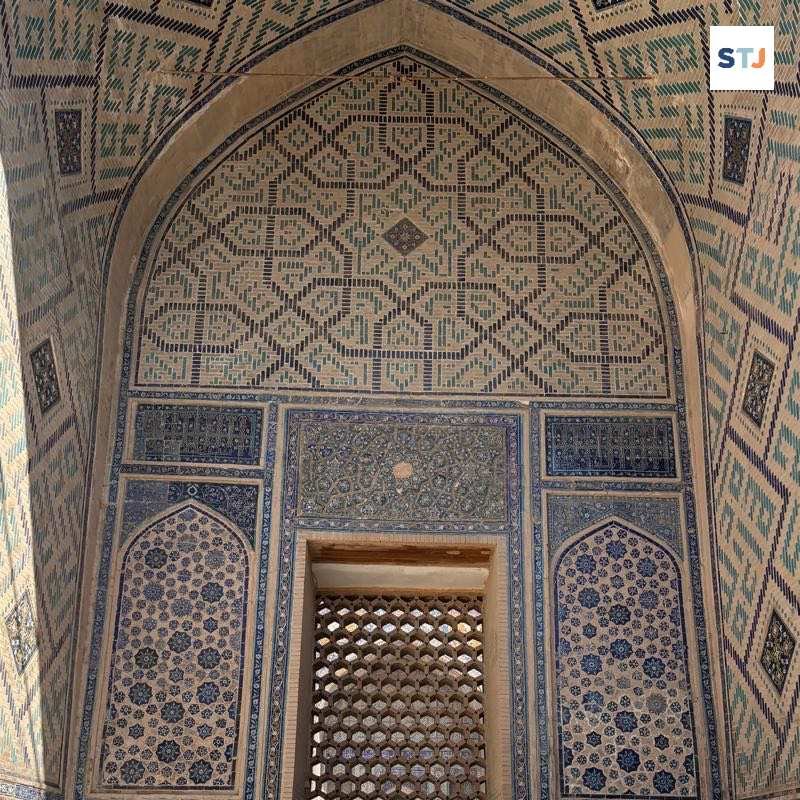
The route: the classic loop
Sanjar recommends a minimum of two days per city, ideally three in Bukhara and Samarkand, and warns against rushing. Leonid’s group spent two days in Tashkent, three in Samarkand and two in Bukhara, flying in and out of the capital because there were no direct flights from other cities. They moved by high-speed train, which he praised.
“There were enough days for Tashkent; one more would have been welcome in Bukhara, and Samarkand — the most beautiful of the three — deserved three.”
Sanjar’s formula holds, but the balance matters. Leonid confirmed that geography shapes itineraries — “we were guided by the flights” — and explained why they skipped Nukus and the Aral Sea: “according to reviews it’s inferior to the cities we visited.”
This is the difference between an expert’s map and a tourist’s map. With seven days and a group, Leonid chose to see fewer places in more depth — and has no regrets.
Samarkand, and a guide who felt like family
Sanjar calls Samarkand the cradle of Tamerlane, praises the Registan by day and night, and describes the Shah-i-Zinda necropolis as “one of the most beautiful places to see.” Leonid’s emotional highlight was the same city, for a different reason:
“Samarkand was the main impression: the central square is truly striking, and while Bukhara is monochrome — all yellow — Samarkand is ceremonial, everything there is very beautiful.”
What truly made Samarkand, however, was the human encounter. They hired a guide there and considered it “a good decision.” His description deserves to be quoted in full:
“The guide put us in the car and drove us around as if we had come to her home.”
This is precisely the hospitality Sanjar describes — “any of the local people can invite any foreigner to their house just to drink tea.” Bukhara delivered the opposite lesson: they hired a bad guide, paid a lot, and concluded “we could have seen it without her.” Sanjar’s advice to rely on guides is right — the quality of the guide, not the city, decides the day.
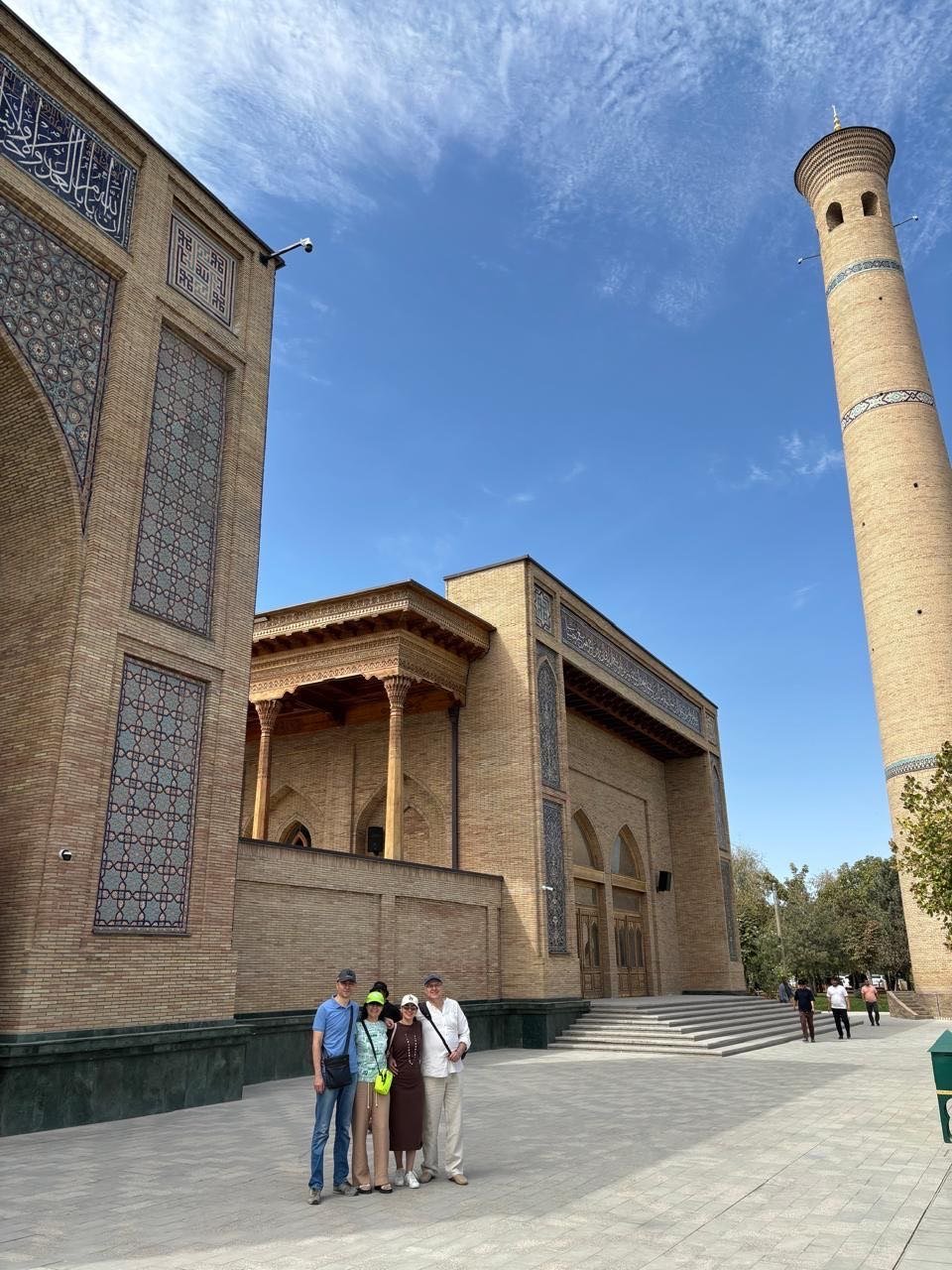
Hotels: the charm of guesthouses
Sanjar explains that in Bukhara’s old town buildings cannot exceed two floors, so visitors stay in small boutique hotels of 25–40 rooms close to the monuments. Leonid’s group did exactly that — small family-run guesthouses in the old towns of Samarkand and Bukhara.
“Especially in Bukhara. You step out and it’s like a scene from an old comedy, where the hero runs through narrow alleys among identical houses.”
Tashkent, however, produced the trip’s only real disappointment — a warning for anyone choosing a hotel by price and airport proximity. Their independent hotel was modern and comfortable but not central.
“Go right — the centre; go left — not the centre, and the difference is very noticeable. We ate, rested and walked to the centre, and it was like a different city: you can see the boundary where the cleaning ends — fountains, streets, beauty.”
By the next day they had decided to ignore the contrast. Sanjar’s presentation dwells on the polished centre; the traveller’s eye catches the line where the tidiness stops.
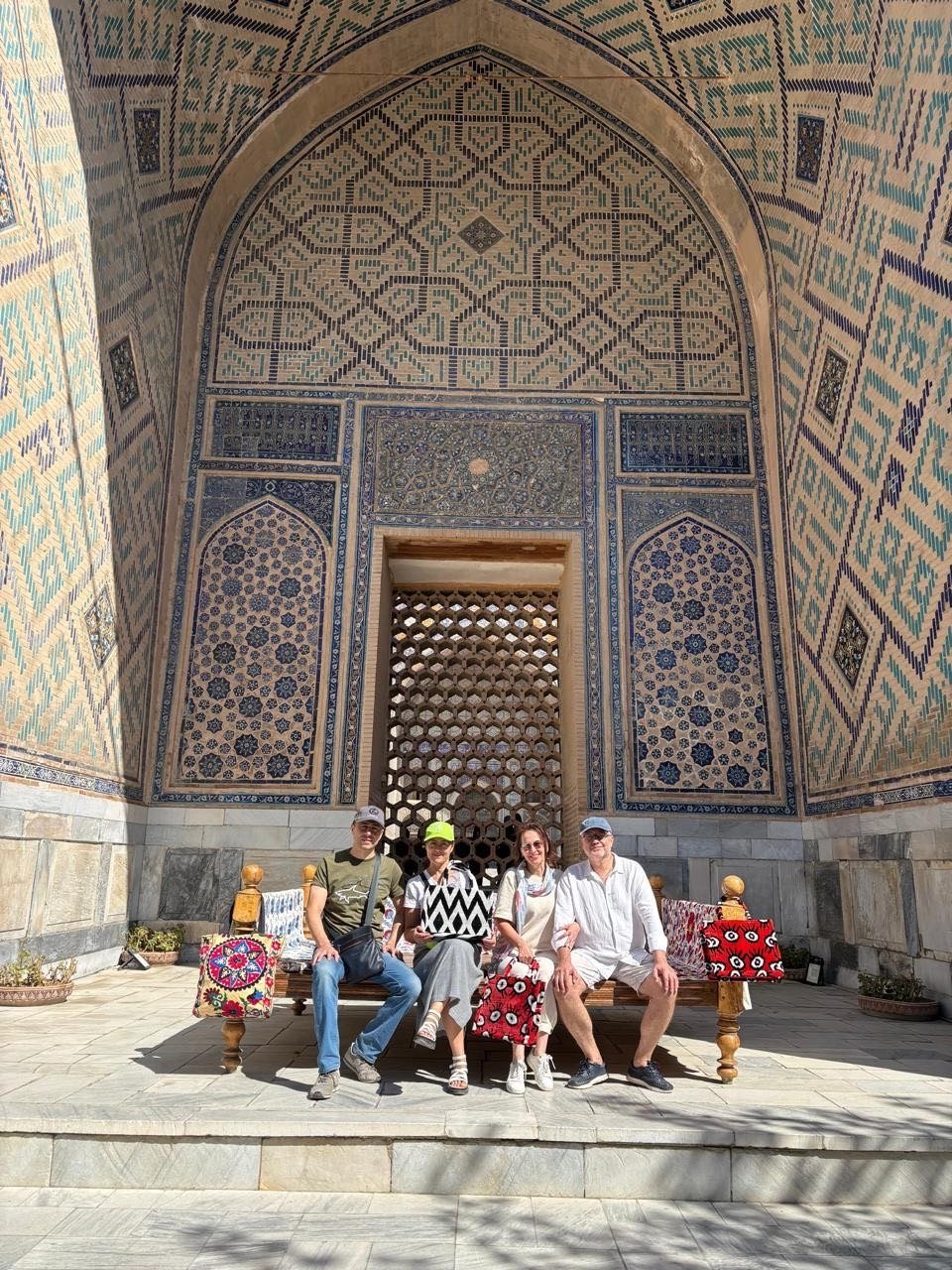
Safety and people
Sanjar insists that “most people from Europe who come say, we feel safer here than in my own country.” Leonid’s experience supports him: “We felt safe. We walked at night, there was no sense of a criminal environment.”
The people lived up to the expectations Sanjar had set. At the bazaar, a local woman asked where they were from, discovered a connection, and invited them home. Leonid also noticed the social stratification the guide spoke about — “a big difference in social hierarchy” — and the Chevrolets everywhere, “because they’re made in Uzbekistan, apparently they have import duties.”
Food: the pilaf pilgrimage
Sanjar calls pilaf the national dish, different in every region, and advises tourists to avoid restaurants near monuments and ask locals where to eat. Leonid’s best story is exactly this advice coming true. Pilaf was the trip’s gastronomic memory, “different everywhere,” but the best was in Samarkand, in a canteen rather than a restaurant.
“They start cooking in the morning and work only until two; once it’s sold out, they don’t cook anymore.”
The exterior nearly scared them off — tables covered in oilcloth. “We walked in on purpose and wanted to leave,” he recalls. “They said: look at the pilaf. We looked — oh, we want to try it.”
Despite the setting, “the pilaf was excellent. Locals eat there.” It is a perfect illustration of Sanjar’s rule — the best food hides behind an unimpressive façade.
The price of the boom
The most substantive difference — or rather, reframing — concerns tourism’s impact. Sanjar is ambivalent: Uzbekistan is “kind of a boom destination,” not fully ready for the high-season crowds, and “it’s a pity that we are losing a little bit some unique part of Uzbekistan. Maybe it’s good for the government, but it’s not cool for the travellers.” Leonid answered flatly:
“There were plenty of people, lots of tourists, we felt it. From different countries. But I wouldn’t say it was overcrowded — there were no queues. A lot of tourists bring money, and with that money the cities develop: old buildings are restored, restaurants open. It would collapse without tourism.”
A traveller’s impression
Leonid’s summary is a line worth remembering: “Inexpensive, hospitable, tasty and beautiful.” He recommends the country to those who enjoy discovering something new and to fans of active travel — “anyone who likes lying on a beach, this is not for them; you’re constantly on your feet, on the road.”
What does the comparison teach us? First, that Sanjar’s advice is reliable at the level of structure — the classic route, the two-to-three days per city, the guesthouses in the old town, the search for local food — but that execution, not concept, decides the experience. Second, that the insider’s anxieties (overcrowding, loss of uniqueness) and the outsider’s satisfactions (development, restoration, no queues) can both be true at once: they are looking at different time horizons. And third, that the space between a masterclass and a traveller’s account is exactly where travel journalism lives. Sanjar describes what Uzbekistan is becoming; Leonid describes what it is like to be there — and, for now, the two stories fit together better than either narrator might expect.
Milena Gnedkova wrote this piece as part of her training in the Master in Travel Journalism at the School of Travel Journalism, after the masterclass on Uzbekistan given by Sanjar Azizov.
Want to turn your travels into stories that get published? Discover the Master in Travel Journalism and the Master in Gastronomic Journalism and Communication at the School of Travel Journalism.