
By Ana Gabriela Quiñones
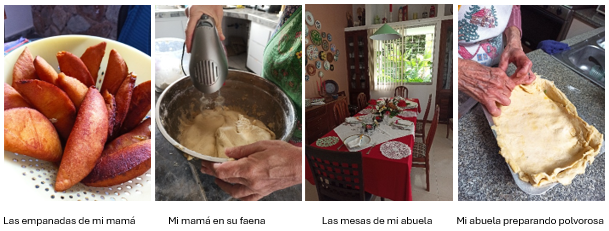
Although cooking isn’t really my thing, food has always been part of my life: from my mum’s arepas to her much-coveted gnocchi and the exquisite pasticho she made for every big celebration, an unfailing show of love; my grandmother’s lunches, both the special and the everyday ones – dishes harmoniously served on the prettiest tables, everything made with special care and attention to detail.
That is where I found myself transported when talking to Mamazory – as Zoraida Barrios is affectionately known – co-founder of Carabobo Gastronómico, a non-profit organisation that seeks to promote, spread and defend the culinary culture of the Carabobo region, in Venezuela.
The conversation with this woman of refined charisma and intellectual sensitivity was like those chats with my grandmother, in which, with measured passion, she would tell the origin of a dish, how “mamaíta” or “abuelita” used to make it for her, and how those preparations had changed over the years after arriving from Curaçao or Spain, or by force and in pain aboard the “slave ships”.
The landscape in the pot
The work of Carabobo Gastronómico is less a culinary project than a way of rebuilding identity. “A cuisine without history disappears,” she says with conviction. And that sentence sums up the philosophy behind the organisation.
It all began with an idea: to travel around the 14 municipalities of Carabobo, knocking on doors to discover and document – in their book El Paisaje en la Olla (The Landscape in the Pot) – the stories and recipes that define its cooking, which they then went on to cook and validate with “their owners”, as Mamazory calls them.
“We took the stoves, with the students” – from her Laurus Culinary Institute – “and we cooked live in the Plaza Bolívar of each municipality,” with the support of town halls that always opened their doors to them. “At first people didn’t come near, but then the grandmothers arrived and sat down to listen and taste the food, and that’s when the magic began,” Mamazory recalls.
Those women – whom she calls “the wise ones” – were the starting point for rescuing recipes, family versions and old techniques, discovering that the same dish could be made in many different ways, and that this too is identity. “For a dish to become part of a story, of a culinary cultural rootedness, it has to be repeated and tell a story,” Mamazory explains confidently.
“Cuisines come from the regions”
When I asked Mamazory how she would define Carabobo’s culinary identity and what makes it unique in a country as gastronomically rich as Venezuela, she replied: “Cooking comes from the regions; there is no national cuisine. Each region has its own culinary cultural identity.” That is why they divide the region into four zones – coastal, central, mountain and plains – because they are clear that each has its own culinary identity, its own history and origins, hence the title of their book, which seeks to protect “the roots and knowledge of each of those elements found in the different landscapes”.
Festivals that preserve local food
The work of Mamazory and her team has rescued dishes that barely survived in oral memory, as I realised when I admitted that I, born in Carabobo, did not know most of them: pan de butaque, quesito valenciano, the seasoned funche of Puerto Cabello, the sopón de Montalbán, potaje de ovejo, the panelitas de San Joaquín and Señora María’s arepa. Each discovery is a piece in the puzzle of Carabobo’s culinary identity.
From this they have created food festivals that are now part of the state’s cultural calendar: the Sancocho Festival in Patanemo, the Polenta and Sopón Festival in Montalbán and the Hallaca Festival. Each aims to rescue and identify traditional recipes, revive community life and keep local produce in use. “Festivals are the way to make some noise. They get bigger every time. Journalists, students, influencers: they are our tools.”
Food as tourism heritage
Carabobo Gastronómico has turned its research into a platform for showcasing the region. Its events attract visitors, strengthen community ties and position food as a cultural expression in its own right. In doing so, they have paved the way for Carabobo’s cooking to be recognised as tourism heritage, capable of telling the story of the state through the senses and through people.
In line with this, they run all kinds of initiatives, such as talks and food tours, with other non-profit organisations working in the region, such as Más Valencia, which seeks to build civic identity through tours of history and cultural heritage – a category into which food fits perfectly as intangible heritage.
With the same aim they created the “El Sol de Carabobo Gastronómico” award, given in several categories to promote and recognise the best of the state’s cooking and gastronomy – a region known for its variety of dishes blending Indigenous, Afro-Venezuelan and European influences – with the goal of fostering the development of local food and tourism in the region.
Carabobo is for tasting
Talking to Mamazory, you understand that food not only nourishes, it also preserves, educates and unites. That is why her work insists on rigorous research and passing knowledge down the generations: so that Carabobo’s tables go on telling the story of the region.
Through Carabobo Gastronómico, the state has found a way to recognise itself. Not through nostalgia, but through action: through lit stoves, squares turned into festivals and books that gather recipes and stories about an entire people.
In the end, Carabobo is not told: it is tasted. And in the hands willing to repeat each recipe, generation after generation, there will always be the chance to be at home even when far from it.
Personal reflection after completing the assignment
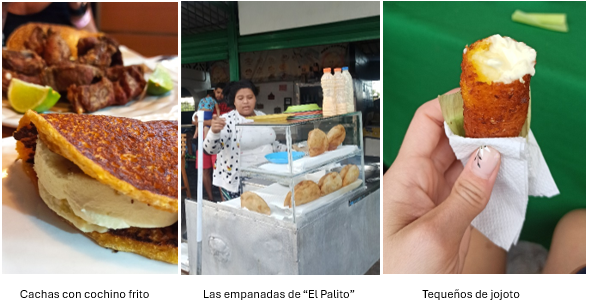
As with the Travel Journalism assignment, in my eagerness to produce perfect work, worthy of publication, well structured and error-free – as if I were a machine rather than a journalist in training – I was limiting myself and putting up barriers, stopping myself from enjoying the process and letting my emotions come through as I wrote about the region where I was born: those beaches I went to every weekend with my brothers and cousins, stopping to eat empanadas at El Palito, or the ones my mum made for us early in the morning and packed in our rucksacks.
On the other hand, while choosing my source, the need to meet the brief and approach a local state institution was weighing on me, as it set me at odds with my principles and convictions, since I consider every institution linked to the Venezuelan government illegitimate. I wondered whether to approach it from a perspective that would expose them, but that is not what drives me. I preferred to show the good things, what is actually being done, what people themselves are doing. Until, once again, Edgardo showed me that I was focusing on what didn’t really matter. It didn’t matter if it wasn’t a state source; what mattered was to live the process, and to do it from what moves us.
That is when things began to flow. I enjoyed my interview with Mamazory, I connected with her, I was moved and I felt I was fulfilling my purpose. That is how I knew I was doing it right, and that this is where I want the foundation of my work to be: in my purpose and my values.
This article is part of the coursework completed by students of the Master in Travel Journalism and the Master in Gastronomic Journalism and Communication at the School of Travel Journalism.