
By Louise T. Davies
Conference report: Discovering Kosovo – The Role of the Tourst Guide in an emerging destination, building a tourist guide association in a post conflict destination.
By Enes Toska – licensed national tourist guide and trainer certified by the European Federation of Tourist Guide Associations; co-founder of GUIDEKS, the Kosovo Tourist Guides Association.
For a country that has spent the past 25 years trying to move beyond the war, Kosovo faces a curious problem: the conflict may be history at home, but abroad this story remains the headline most people remember.
Enes Toska, co-founder of the Kosovo Tourist Guides Association (GUIDEKS), encountered that gap directly during a recent session with travel journalism students. When he asked the audience what came to mind when they heard “Kosovo”……. ‘war’ was the resounding answer. Some students were still unsure where Kosovo was. For people who have never visited Kosovo, war and conflict still occupies the space where the destination’s modern image of Remusica festival, Sharr mountain skiing, and Rahovec valley wine should be.
For Toska, that disconnect is partly a consequence of Kosovo’s difficult beginning. The war ended in 1999, “War is a very distant memory,” Toska told the students, but the country then had to “restart… from zero, from scratch”, building institutions while tourism remained a low political and economic priority.
His argument is not that Kosovo should erase its past. Nor does he suggest turning the country into a destination built primarily around ‘dark tourism’ such as war memorials and conflict sites. Instead, he describes a tourism strategy based on giving visitors more reasons to stay — and, crucially, more things to remember.
The raw ingredients are already there. Toska points to Kosovo’s mountains, hiking, skiing and adventure tourism; Ottoman and Yugoslav architecture; wine valleys; rural fortified houses; historic cities; festivals and the everyday hospitality of a young European state. He also identified that investment is needed to overcome very practical obstacles: some attractive archaeological and natural sites remain difficult to access; signage and interpretation can be poor; even online information is sometimes inaccurate; professional development is incomplete; and coordination between businesses and institutions is weak.
In Peja, he says, investment in adventure tourism activities alongside natural and historical resources helped transform the town into a stronger tourism draw. It has turned a place once passed over into one of Kosovo’s stronger destinations. This deeper experience offers an escape from the curse of the short Balkan tour. Toska says visitors once arrived for only a few hours before continuing towards Albania. Today, the average stay is around three days, while mountain-tourism groups travelling through Albania, Montenegro and Kosovo may stay for a week or even two weeks.
That points to a different kind of tourism proposition: not mass tourism, but a destination where culture, landscape, food and wine, festivals and outdoor experiences reinforce one another.
Toska is explicit that mass tourism is not currently the goal. Kosovo is small, he argues, and lacks the capacity — and sometimes the desire — to overwhelm sensitive heritage sites with large crowds. Some of its heritage sites are too fragile for that to be the sustainable ambition. Instead, he favours attracting smaller groups of visitors who stay longer and are genuinely interested in the country.
The challenge is that building the tourism product is just the start. Kosovo also needs to communicate this message more clearly and widely. It was evident that the audience, representative of many Europeans, needed to have their persistent image of Kosovo updated with better information. The OECD (2024) found that the country has made progress in tourism governance and skills, but much less so in marketing and the wider promotion of its natural and cultural heritage. It also notes that Kosovo’s draft tourism branding strategy was never published and that there is still no formal marketing coordination body. That helps explain why the old image has proved so durable. A country cannot simply announce that it has changed; visitors need to encounter a compelling alternative.
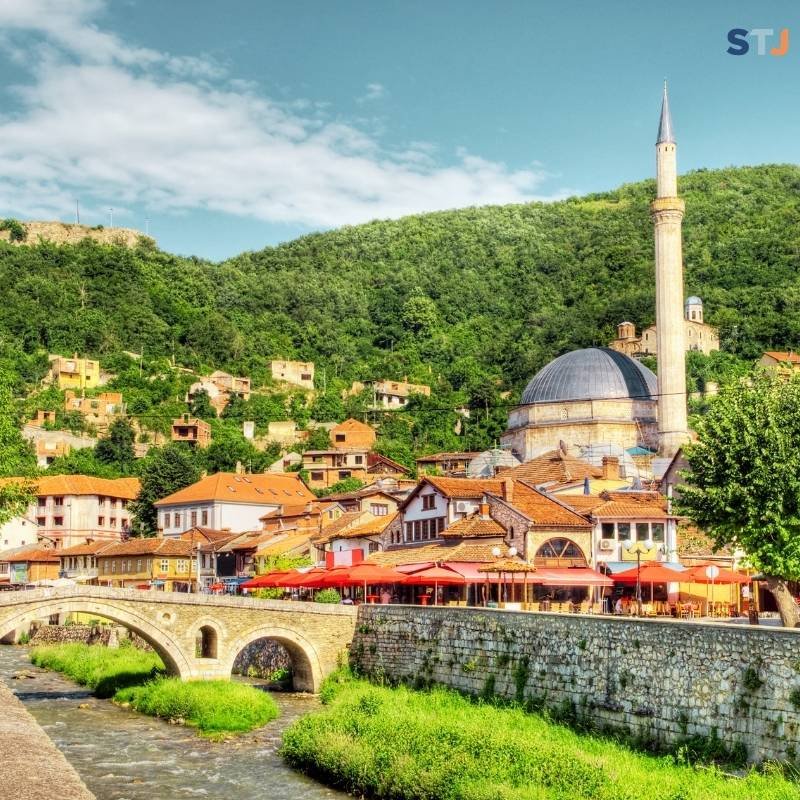
For Toska, responsible storytelling is therefore central. The war remains part of Kosovo’s landscape and memory, and pretending otherwise would be neither credible nor responsible. But it should no longer be the whole story. Visitors will continue to ask about the past conflict, and some will want to see the places connected to it. But responsible storytelling means putting that history in context rather than allowing it to become the destination itself.
Guides should not exploit victims or turn difficult history into a tourist product. Instead, they should verify information, provide context, acknowledge different/contested perspectives, and include local voices. The guide acts as a mediator between visitors, historical events and communities, using tourism to promote understanding and remembrance rather than sensationalism.
The presentation explored how Kosovo can develop tourism successfully with the help of GUIDEKS by professionalising its guides, promoting its diverse attractions, and telling its sensitive history accurately, fairly and responsibly. Toska explained why training and accreditation through FEGS is so important, so that Guides are equipped to deal with sensitivities: ‘we don’t have the right to change the narratives, but at least we need to give the reflection of different sides of the stories’.
The task for those like Toska and GUIDEKS is to make the experience of contemporary Kosovo — its people, landscapes, culture and everyday life — powerful enough to become the memory visitors take home and then start to tell others to come and experience it for themselves.
The real test, then, is not whether Kosovo can make visitors forget the war. It is whether, after they have heard about it, they leave remembering something else.
Read more about the School of Travel Journalism, watch our students’ travel documentaries on YouTube and listen to their stories on our Spotify podcast.
Also on Viajar & Crear: Periodismo de viajes: el lugar que me hizo suyo · Santuario (in Spanish).
Interested in telling travel stories that go beyond first impressions? Explore the programmes at the School of Travel Journalism.