
By Chloe Nguyen
Leaving home to go home
Leaving friends to see friends
Switching languages to still speak my own
Missing one place while arriving at the other
I first came across these words on a screen, scrolling through the digital noise of TikTok, yet they resonated with a quiet, persistent frequency. For years living abroad, they have hummed in the back of my mind, tethered to a single, nagging question: “Where do I belong?” We move away, we change. The city stays, the city evolves. Suddenly, you find yourself inhabiting a ‘middle space’ — a liminal geography where you are too foreign for your birthplace and too ‘other’ for your adopted country. This time, however, I returned with a specific longing: to view my Da Nang through a traveler’s lens, with the hope that by seeing my hometown with fresh eyes, I might finally see myself with more clarity.
Landing in Da Nang: a tearful homecoming
“Ladies and gentlemen, we’ve just begun our initial descent into Da Nang International Airport. The local time is 6:30 PM and the temperature is 25 degrees.”
The pilot’s voice broke through the cabin with a clinical, detached indifference. It might sound strange, but to me, that sound was a long-awaited comfort. When his announcement shifted into Vietnamese, the familiar tones hit me like a wave. I burst into tears without quite knowing why. For years, I had been living in the ‘elsewhere,’ building a life in a different language and navigating streets that refused to leave a familiar mark on my soul. That moment on the plane was the final straw, but not the one that broke me. Instead, it felt like the firm, comforting embrace of a mother welcoming her child home.
As the aircraft dipped below the clouds, the city lights and the silhouettes of rising buildings began to shimmer beneath the wing. The Son Tra Peninsula rose to meet us, with the Lady Buddha standing firmly in the darkness. It felt like a quiet welcome for my return, and a grand introduction for the strangers stepping into Da Nang for the first time. Andrea was one of the latter. I had brought her with me this time, eager to show her the place where I was born and raised, the place that made me, even if I no longer felt I entirely fit within its borders.
Waiting for me was Nga, my sister, her face with a familiar map of smiles and love. Her kids swarmed me, their small arms providing the kind of grounding hug I hadn’t felt in years. As we stepped out of the terminal, the cool, deceptive breeze of a Da Nang spring brushed against my skin, but it was the sound that truly announced my arrival: the nonstop, rhythmic bip-bip of motorbike horns — the chaotic heartbeat of the city — invaded my ears.
Finally, I was here. I was back to Da Nang.
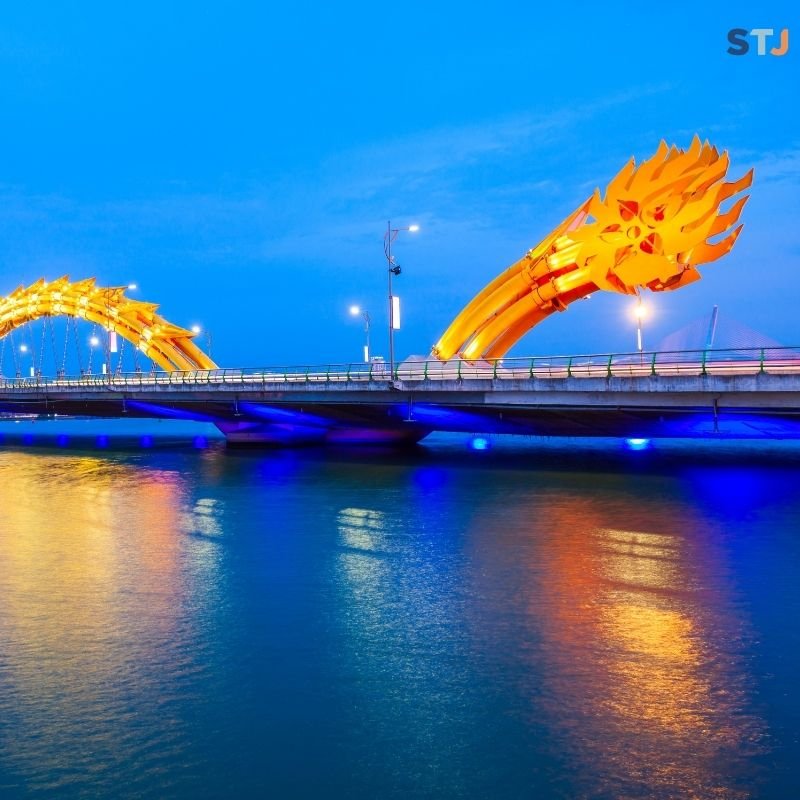
As we drove toward the center, the 666-meter-long steel body of the Dragon Bridge loomed ahead, its yellow scales shimmering. It is the most iconic landmark of modern Da Nang, yet its undulating form is rooted in the aesthetic of the Ly Dynasty — slender, serpentine, and elegant. In Vietnamese culture, the dragon is a vessel for power, nobility, and good fortune. Even its dimensions are a prayer for the future: the number six is phonetically close to the word lộc, meaning “luck” or “prosperity.” The bridge is famous for its weekend spectacle, a fifteen-minute display where the dragon breathes fire and sprays water into the night sky. Seeing it brought back a vivid memory from the year it was inaugurated. I had stood too close and received a “free shower” from the dragon’s mouth. The cool mist, the laughter of the crowd, and the scent of the river — that moment still lingers in my mind like a faded photograph that has suddenly regained its color.
A Da Nang food tour: Japanese BBQ and a jazz club
We kicked off our food tour in Da Nang with a curious choice: a Japanese BBQ restaurant named YEN. It might seem contradictory to seek out sushi in the land of Mì Quảng, but as an Asian, the lure of the grill and the freshness of sashimi is a universal language. As I stepped inside, I realized Graham Greene was right in The Quiet American when he noted that “it is the smell that hits you first.” While he spoke of the humid streets, the same truth lived here: a thick, fragrant cocktail of seared meat and the earthy, primal scent of burning charcoal emanating from every table.
To some, the atmosphere might have felt like “noise pollution.” The restaurant was a chaotic symphony of nonstop laughter, the rapid-fire “yapping” of families catching up, and the frantic, efficient pace of the servers. But to me, this wasn’t pollution, it was the sound of life, a ceaseless and vibrant energy. Vietnamese can be loud, yes, our joy often requires a high volume. Sitting there, I felt a strange sense of peace within this sensory overload. The high-tech spectacle of the Dragon Bridge, glowing just outside the window, felt miles away from the small, glowing embers of the charcoal brazier in front of me. The bridge represented the city’s future, but this smell, the smoke that clung to my hair and skin, anchored me back to the Da Nang I once knew.
I realized then that no matter how far I traveled, or how much I had been “mixed” by other cultures, my roots were still reactive. The environment hadn’t changed to fit me, I was the one who had changed, yet I could still plug back into this vibe as if I had never left. I was still Vietnamese, and I loved this ambiance, this cuisine, and this unapologetic noise.
Our night led us to The Craftsman, a jazz club that had served as my personal escapism back in the day. To my surprise, the same jazz playlist that soundtracked my twentieth birthday was still playing, weaving through the dim, amber light of the room. They still served the signature salty popcorn, a simple, nostalgic appetizer that felt like a secret handshake between the past and the present. The Craftsman is a unique hub where the local pulse of Da Nang meets a global rhythm. Inside, the city’s tropical heat is replaced by a cool, “different planet” atmosphere where people from across the globe gather to share a singular taste in music. The house was so packed that Andrea and I were relegated to the bar, which turned out to be the best seat in the house. From there, we had a front-row view of the artists on stage and the rhythmic, expert movements of the bartender.
“It’s like everyone here has forgotten there’s a world outside those doors,” Andrea whispered over the music.
She was right. The room was thick with the sound of deep laughter and the sight of strangers dancing, their faces illuminated by a shared, funky joy. I took a sip of my ‘Pistachio Cake’ cocktail. The smooth, velvet burn of rum ran through my throat, making me feel as though I were floating on a cloud.
Watching the foreigners in the room, I felt a swell of pride for my hometown. They seemed to be living in a temporary heaven, yet their presence triggered that nagging question again: where do I belong? I found myself torn between two realities. Part of me craved the European life I had built — the work-life balance, the crisp, clear air, and the structured living. Yet, another part of me was desperate to immerse itself back into this “beautiful chaos”: the heavy air, the relentless noise of the streets, the disorganized infrastructure, and the unmatched warmth of the people. I was caught between the quiet efficiency of the West and the loud, beating heart of the East.
Dawn at Man Thai: one of Da Nang’s oldest fishing villages
They say the most profound lens through which to view a culture is its local market, and I couldn’t agree more. It started with a simple invitation: “Let’s wake up early tomorrow. I want to show you something.”
At 4:00 AM, the alarm pulled me from sleep. Andrea, Nga, our friend My, and I hopped onto our motorbikes, riding through the dark for thirty minutes until the salt-heavy air announced Man Thai Beach. If My Khe is the polished face of modern tourism, Man Thai is where the city’s heart still beats to a centuries-old rhythm. This isn’t just a beach, it is one of the oldest fishing villages in the region, dating back to the 18th century. By 5:00 AM, the shore was dotted with thúng chài — the iconic circular basket boats. Legend has it these were born from defiance during the French colonial era: when the French taxed “boats,” local fishermen claimed these were merely “baskets” to avoid the levy, accidentally creating one of the most seaworthy vessels in the world.
We walked along the shoreline, our nostrils filled with the sharp, brined scent of a fresh catch. Even at this hour, the beach was a theater of life. Youngsters and seniors alike crowded the sand, their voices lost in the rhythmic “thump-thump” of runners and the crashing surf. This is how we live in Da Nang: we embrace the present while we are still here to witness it. We waited for the sun to break over the horizon, watched the fishermen row toward the coast. A sudden, unexpected serenity overflowed within me, even as the scene grew hectic. Perhaps it came from the company I kept, the smiles reflected in the dawn light, or the familiar nostalgia of the dancing waves fighting the early morning breeze.
That morning, the ocean was generous. What struck me most was the squid, iridescent and sparkling against the sand under the first rays of the sun. The crowd surged forward, a competitive dance to secure the freshest ingredients for breakfast. Our group joined the fray, rushing to claim half a kilogram of fresh squid. Yet, strangely, I didn’t feel the rush. It felt like a game, vibrant and deeply human.
We took our prize to a stall across the road, a common local ritual where the owner cooks your fresh catch into a steaming bowl of instant noodles. As Anthony Bourdain famously noted, a low plastic stool, a tiny table, and something delicious in a bowl is the secret to happiness. We sat on those humble stools, clutching polka-dot glasses of cà phê muối — salted coffee — prepared by the resident “grandma.” The bitterness of the coffee reached its peak just as the salt cut through the sweet thickness of the condensed milk.
Watching the sun climb higher, yapping about our lives over empty noodle bowls, I felt it. A quiet, undeniable realization: this was home.
Hai Van Pass: a bridge between two worlds
They say to truly see a place, you must hike to its highest peak. Still fueled by our coastal breakfast, I brought Andrea to join a small hiking expedition led by a young boy named Dong. While the title “tour leader” suggests a formal authority, Dong was actually just an architecture student from a local university, driven by a quiet passion for uncovering the city’s hidden vistas. Our group was a mix of local youngsters, all of us sharing a singular desire: to escape the mechanical roar of the motorbikes and see our city from above.
Our destination was the Hai Van Pass. Historically, this mountain road has served as the dividing line between the North and South of Vietnam, a frontier where ancient kingdoms once clashed. The road itself is a “ribbon of perfection,” a winding path carved between the mountainside and the abyss. As we ascended, the urban chaos faded, replaced by a profound silence broken only by the whistling of the wind through the pines and the distant, rhythmic roar of the waves crashing 500 meters below. The name Hải Vân translates literally to “Sea Cloud,” the place where the ocean and the sky shake hands. As we reached the summit, the transition was physical, we were suddenly enveloped in a thick mist that turned our skin clammy and cool in an instant. Standing there, I felt suspended between two provinces, two climates, and two eras. To my left lay the path to Hue and the weight of the old world; to my right, the descent back toward the modern buildings and the future of Da Nang.
Throughout the climb, Dong shared stories of his life in the city, showed me Da Nang, his voice brimming with a pride so infectious that he didn’t realize he was preaching to a local — me. I didn’t correct him. Watching the younger members of the group, pure of heart and seeking only a momentary getaway from their studies, I saw a version of my younger self. I realized then that, like the Hai Van Pass, I was a link between two worlds: the past and the future, the rooted and the restless, the adult and the inner child. My question of “belonging” began to shift. It seemed that the more I talked with those who had stayed, the clearer my own reflection became. I wasn’t a broken piece of a puzzle that didn’t fit — I was the bridge that allowed both worlds to exist at once.
A Vietnamese Memorial Day: family, feasting and Mì Quảng
Our journey took a more somber, yet vibrant turn as we headed to my parents’ house in Quang Nam for my grandfather’s Memorial Day. In the West, a memorial is often a quiet, hushed affair. In Vietnam, it is a grand reunion — a “huge gathering” of over a hundred relatives, neighbors, and friends. It is a tradition that breathes life into the memory of the dead through the boisterous energy of the living.
As we arrived, the air was thick with the savory, heavy scent of incense from the altar and roasting meats. Round tables stretched across the house, laden with enough food to feed a small army: platters of sticky rice, bowls of broth for Mì Quảng — a noodle specialty exclusive to Central Vietnam — and mountains of fresh herbs. Andrea watched in wide-eyed wonder as the house transformed into a hive of activity.
“Is it always this… loud?” she asked, leaning in to be heard over the rising tide of conversation.
I laughed, realizing that the “polluted noise” I had romanticized in the city was here too, but it was warmer, more intimate. By lunchtime, the beer started flowing, and with it came the inevitable karaoke. The rhythmic, often off-key melodies of old folk songs blasted through the speakers, echoing off the ancient trees in the garden.
I watched my aunts and uncles, their faces flushed with beer and joy, navigate the chaos with practiced ease. I found myself caught in a whirlwind of introductions to distant cousins I hadn’t seen in a decade and “aunties” who remembered me only as a teenager. Sitting on a small stool among a hundred people who shared my blood, the world felt strangely aligned. I saw my father laughing with a childhood friend, his gestures mirrored my own. I heard the specific Quang Nam dialect — harsh, melodic, and earthy — vibrating in my chest.
No discussion of Memorial Day in Vietnam would be complete without talking about the feast. In our culture, hospitality is synonymous with feeding our guests, and the table was a testament to that, a complex spread ranging from starters to dessert. Mì Quảng, a signature noodle dish made from rice flour, is the heartbeat of any Central Vietnamese gathering, and it was, as always, the centerpiece. We began with chicken salad, a dish that has lingered in my mind since I left. It was a perfect balance: the sharp tang of lemon, the savory depth of fish sauce, and the aromatic burst of fresh herbs, all complementing the tender chicken meat and silky skin. Following this was the main course, Mì Quảng, served in a succulent, golden broth enriched with pork and quail eggs. To eat in Central Vietnam is to embrace the heat: the spice of our local chili is not just a condiment, it is an essential companion to every meal.
There is a popular meme suggesting that being Vietnamese is similar to an obsession with greens, and I knew it was true. No dish is complete without a side of fresh vegetables — basil, cilantro, cabbage, and crisp greens — that seem to accompany every type of noodle. In rural areas like Quang Nam, we don’t buy these, we pick them straight from the garden out front, just moments before they hit the table.
For dessert, we kept it simple, serving tiny, tart mandarins to cleanse the palate and balance the richness of the meal. Eating this, I realized it was everything I had been craving: the familiar spice, the layered textures, and the complex blend of seasonings I had missed for years. It wasn’t just a meal, it was a sensory homecoming.
Amidst the clinking of glasses and the roar of the karaoke machine, the inevitable interrogation began.
“Our Việt Kiều (Overseas Vietnamese) is back!” my eldest aunt announced, her voice booming over the music as she pulled me into a tight, scented embrace. She held me at arm’s length, squinting. “You look so much skinnier than the last photos you posted. And your skin, you look younger. Life in Europe must be treating you well!”
I felt the familiar tightening in my chest. In Vietnam, a judgment on your body — whether you’ve gained weight or lost it, whether you look tired or “fresh” — is often the standard opening of a conversation. It’s a cultural shorthand for care, yet to my Westernized ears, it always feels like a critique. I used to be deeply annoyed by it, but now I saw it as the blunt, unfiltered language of family.
Then there was that term: Việt Kiều. I have always harbored a secret distaste for it. To me, it feels like a label of “otherness,” a linguistic fence that categorizes me as an “Overseas Vietnamese,” as if I am a satellite orbiting the country rather than a part of its gravity.
“I’m eating well, Cô,” I replied with a practiced smile, gently slipping back into the local dialect to bridge the gap. “But the food here is better. I’ve missed the taste of home.”
My uncle leaned in, a beer in one hand and a chopstick in the other. “So, are you a foreigner now? Or are you still one of us?”
He asked it with a laugh, but the question echoed the TikTok words that had been haunting me. Looking at the sea of faces — people who shared my eyes, my stubbornness, and my past — I realized that while they saw a Việt Kiều, I was starting to see something else.
At that moment, I didn’t feel like a guest. I didn’t feel like the traveler with “fresh eyes.” I was simply a granddaughter, a daughter, and a piece of this vast, chaotic, loving puzzle. The karaoke was deafening, the air was humid, and the food was spicy, but the nagging question of where I belonged finally went silent. I was exactly where I was meant to be.
Hoi An: lanterns, yellow walls and egg coffee
The other morning, Andrea and I found ourselves drifting through the lantern-lit streets of Hoi An. A day trip to this ancient town is a standard itinerary item for any traveler, but to truly understand it, you have to navigate it on two wheels.
Hoi An is a time capsule — a UNESCO World Heritage site that has been carefully preserved since 1999. From the 15th to the 19th century, it functioned as one of the most bustling international trading ports in Southeast Asia. Merchants from Japan, China, and Europe converged here, leaving behind a unique architectural fusion that defines the town’s character today. Photographers flock here for the “yellow walls” — the iconic mustard-hued merchant houses and the narrow alleys draped in vibrant pink paper flowers. The town’s most famous landmark, the 16th-century Japanese Covered Bridge, remains a testament to this history, built originally to link the Japanese and Chinese quarters.
As the sun began to climb, Andrea and I pedaled out of the Old Town, merging into a river of bicycles, heading toward An Bang Beach. The salt-tinged breeze grew stronger, and the distant, rhythmic roar of the waves replaced the town’s chatter. It was a meditative peace. We joined a group of travelers to visit the Tra Que vegetable village, watching local farmers working on rows of lush herbs. By noon, however, the heat began to press down on us, turning the air thick and heavy.
Along the way, we witnessed a moment of pure, rural stillness: an elderly man taking a nap on the back of his water buffalo. Oblivious to the frantic hum of nearby motorbikes, he seemed to exist in a world where only he and the beast remained. We stopped, struck by the simplicity of the scene. Sometimes, a midday nap in the rice paddies is the most honest representation of happiness. When he finally stirred and saw us, his face broke into a wide, bright smile, and he gestured for Andrea to approach the buffalo — a creature that remains the noble symbol of Vietnamese agriculture.
Seeking refuge from the midday heat, we retreated to Faifoo Coffee, claiming a second-floor window seat to watch the town flow beneath us. From this vantage point, we saw the rhythm of daily life of Hoi An: grandmothers selling tiny figurines, tourists wandering in wide-eyed wonder, and the shifting shadows cast by the afternoon sun. I ordered an egg coffee (cà phê trứng). The drink was a masterclass in contradictions — the sharp, dark bitterness of the coffee collided with the rich, velvety creaminess of the egg yolk, all chilled over ice to combat the oppressive heat. I realized then that happiness is infectious: surrounded by people on vacation, their faces constantly lit by smiles, I felt a lightness I hadn’t carried in years.
Our culinary exploration continued at a humble chicken rice stall. Hoi An chicken rice is a sophisticated dish: unlike the steamed simplicity of Singaporean Hainanese chicken, our version involves shredding the boiled chicken and tossing it with a medley of zesty herbs and pickles. To my surprise, it was served with broken rice (cơm tấm).
As I explained the history of these “broken” grains to Andrea — how they were once discarded as waste during the French colonial era only to be transformed by the ingenuity of laborers — I felt a pang of nostalgia. These humble grains, once considered imperfect, had become a cultural icon of resilience. Finishing the plate with a glass of iced tea, Andrea joked that her trip to Central Vietnam had turned into a full-scale food tour. She wasn’t wrong. In Vietnam, to eat is to understand the history, the geography, and the soul of the people behind. These flavors didn’t just nourish me, they acted as a tether, pulling me back to the child I once was, growing up in this vibrant, spicy, and resilient landscape.
Where do I belong? Coming home to myself
Time fleets when you are truly present, living each day to its absolute fullest. As I stood at the departure gate, my journey into my childhood drawing to a close, the answer to the question that had haunted me for years finally came into focus. I happened to remember the words of Pico Iyer: “Home is not just the place where you happen to be born. It’s the place where you become yourself.” This trip was never just a vacation, it was an act of reclamation.
Nga seeing me off at the airport was the final, quiet ache of the trip. She stood by the security checkpoint, her small frame becoming a landmark in the bustling terminal. As I walked toward the gate, I looked back one last time. Her figure began to fade into the blur of the crowd. For years, I had feared this distance, the way people and places seem to dissolve the further you travel. But as I passed through security, I realized the distance wasn’t a loss, it was a connection.
By returning to the place of my birth and viewing it with fresh eyes, I was finally able to see myself clearly. I came to realize that if we observe closely enough, if we truly notice the world around us, the answers we seek reveal themselves. Over these three weeks, I encountered such grace in the people I met. From the guard who watched my motorbike to the woman selling fish balls by the glow of My Khe Beach at night — everyone was navigating their own quiet struggles, yet they chose the silver lining.
I’ve learned that the question “Where do I belong?” does not require a specific coordinate on a map. “Home” is not a static patch of earth, it is the person you have become, and the people you carry with you. If your soul can connect with the spirit of a place, then that, for that moment, is where you are meant to be.
As the plane taxied down the runway, I watched the Dragon Bridge shrink to a golden thread against the landscape. I am returning to Europe, but I am no longer “elsewhere.” I am home, I belong to myself, a bridge between worlds, the keeper of my own history, and the author of my own journey. It becomes clear that I wasn’t leaving home, I was simply carrying it with me, wherever I go.
Chloe wrote this piece as part of her training at the School of Travel Journalism. If her journey moved you, explore the Master’s Degree in Travel Journalism and the Master in Gastronomic Journalism and Communication, watch our students’ travel documentaries on YouTube, and listen to their stories on our Spotify podcast.
This article is part of the practical work carried out by students on the Master’s Degree in Travel Journalism at the School of Travel Journalism.