
By Stéphanie-Linda Maserin
A hundred and ten days is a long time to spend in the saddle. Louis D. Hall did it all the way from Siena, Italy, to Cape Finisterre, Spain, a place historically known as the end of the land. On 5 November, the author of In Green shared the story behind that ride, and advice on the craft of travel narrative, in a masterclass at the School of Travel Journalism.
He explained how his story came about. He set out after the loss of a dear friend, and the journey was not meant to become a book, even though it was inspired by Don Quixote, the antihero who fails continuously but who, in his own way, always manages to succeed. Rather, during his trip he kept a travel diary. Indeed, the account is told entirely in the first-person present tense, a stylistic choice that allows readers to identify deeply with the narrator’s hardships.
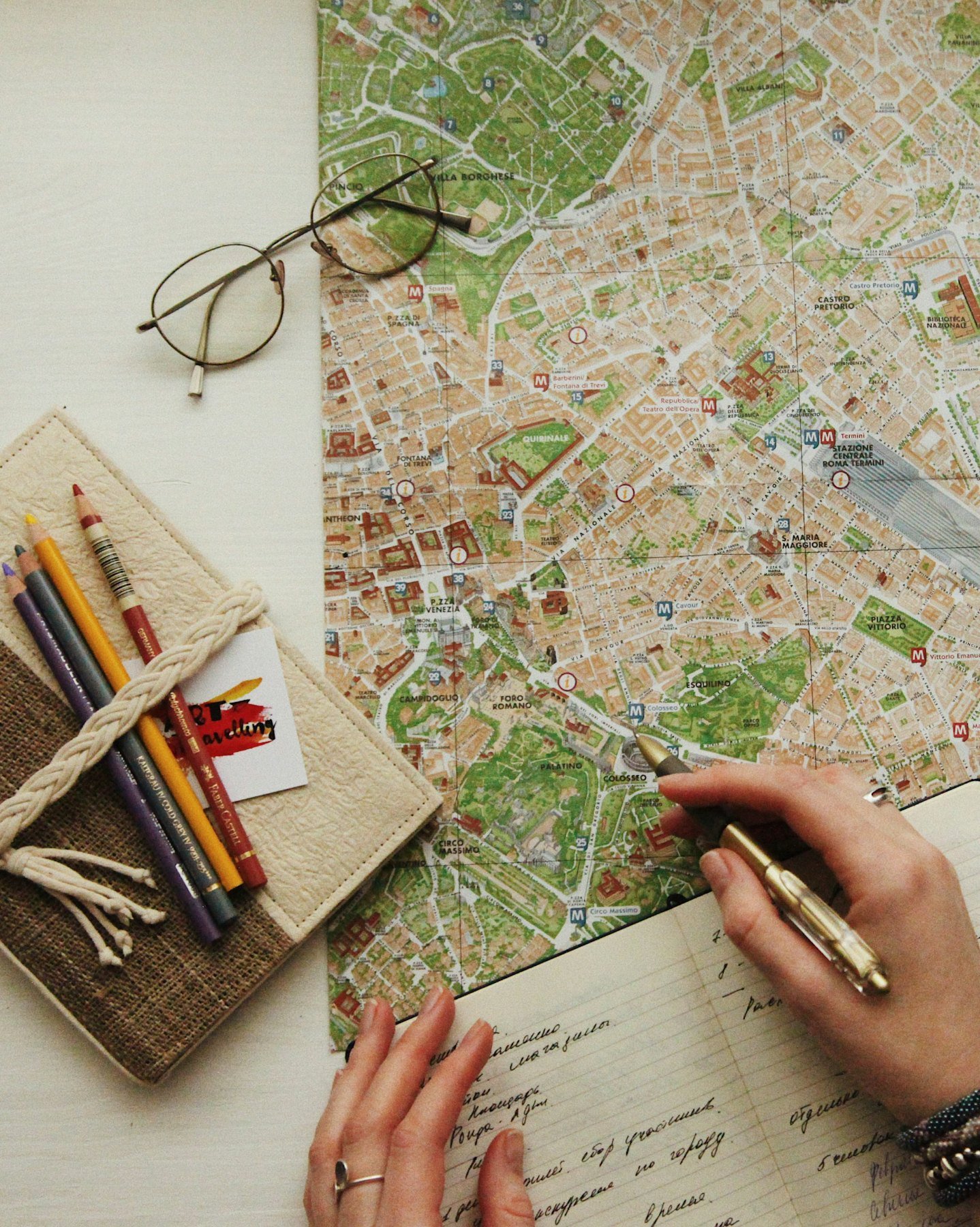
The “philosophy” of travel narrative
Hall made several important points during his talk. Travel writing is not about accomplishing extraordinary feats or covering thousands of kilometres, but about having your own “way of seeing” things and knowing how to convey it precisely to the reader.
How do you do that? The foundation is to always carry a diary and a pen with you, so that you can write down even the smallest details.
Slowness breaks down barriers
Travelling slowly, for example on horseback or on foot, makes it easier to connect with locals without being labelled as “the foreigner”.
He told us how, on a trip to Portugal, he set out without a mobile phone and with little knowledge of the language. The smartphone is a tool we rely on for GPS navigation, but it is a great obstacle to travel writing. Getting lost, making mistakes, asking locals for help and being curious take us out of our comfort zone and open us up to authentic observation.
True writing comes from the “beauty of the catastrophic”: when a trip goes completely wrong, the story that comes out of it is often brilliant and rich in authenticity, compared with an itinerary where everything goes smoothly.
Practical tools for the travel writer
One tool is the most valuable of all. He spoke repeatedly about the “power of the travel diary”: a source of free material that gains value over time. It records the evolution of the world; for instance, it can take you back to a village that no longer exists. You should keep one main file or notebook for all your trips, where you note down small details precisely and legibly, so that if the article is written weeks later, you can still decipher your own handwriting.
Among the examples mentioned in class was recording everyday gestures, such as the way a waiter pours wine or the type of bird spotted. These details make the experience accessible and vivid for readers, who will feel as if they were there with you.
Discipline is what guarantees expressive freedom
As with everything, constant practice is necessary to improve. As a daily discipline, he advised us to write 200 to 300 words regularly, but he also encouraged us to do quick creative writing exercises, such as listing, without a second thought and in very little time, five places we would like to visit and why. I don’t know about the other students, but for me it was a new and positive experience.
Career and publishing advice
Of course, anyone who wants to write must above all read a lot. His invitation was: “Read as much as you can.” It is important not to force ideas and to seek inspiration by reading widely, from many different points of view.
For those just starting out, it is advisable not to aim straight away for publishing giants (such as Penguin, which works mainly with big names), but to choose smaller publishers, able to offer direct, human support and real value along the writer’s path.
Equally important is knowing how to handle rejection. Pitching your ideas to newspapers and publishing houses takes a lot of time, and most of the time the answer will be “no”.
What should you avoid at all costs? Writers, especially younger ones, tend to compare themselves with other travel authors, and these destructive comparisons lead nowhere. Measure yourself only against yourself and look back: comparing what you wrote six months ago with what you write now will show you your own progress.
Gratitude and humility
Be grateful for small goals, such as the publication of a first article online, without burdening yourself with great expectations or impossible milestones.
What his teaching left me with
For the “call to read”, I have no problem: I read well above the average in any survey of reading habits… but of course it would be better to read more in English, so that I feel more at ease writing in it.
As for travel narrative, I already wanted to write about travel, but I had never thought about the “power of the diary”.
Moreover, Hall was very generous in answering our questions, as he faced students whose concerns were mostly about language. We write in English, but almost none of us are native speakers… so his advice, which I have made my own, is to write every day in my own language without thinking, going with the flow so as not to hesitate.
This masterclass was a great encouragement for me to be persistent, since I am one of those people who overthink in front of the blank page… Hearing Hall say “Just catch the pen and write” makes me want to dare. The quote I will make my own during this master’s: “Discipline is what guarantees expressive freedom.”
Stéphanie-Linda Maserin wrote this piece after the masterclass that travel writer Louis D. Hall gave at the School of Travel Journalism on 5 November 2026, as part of her training in the Master in Travel Journalism. Louis D. Hall is the author of In Green: Two Horses, Two Strangers, a Journey to the End of the Land; you can follow him on Instagram at @louisdhall.
Want to turn your journeys into stories that get published? Discover the Master in Travel Journalism and the Master in Gastronomic Journalism and Communication at the School of Travel Journalism.