
By Mónica Romero
“Costa da Morte” series · Part 8 of 10. A series by Mónica Romero, written as part of her final project for the Master in Travel Journalism at the School of Travel Journalism (2026).
Every dangerous coast ends up producing stories.
When, for generations, ships disappear, wreckage washes up on the beaches and the sea returns objects from places nobody knows, the line between history and legend begins to blur.
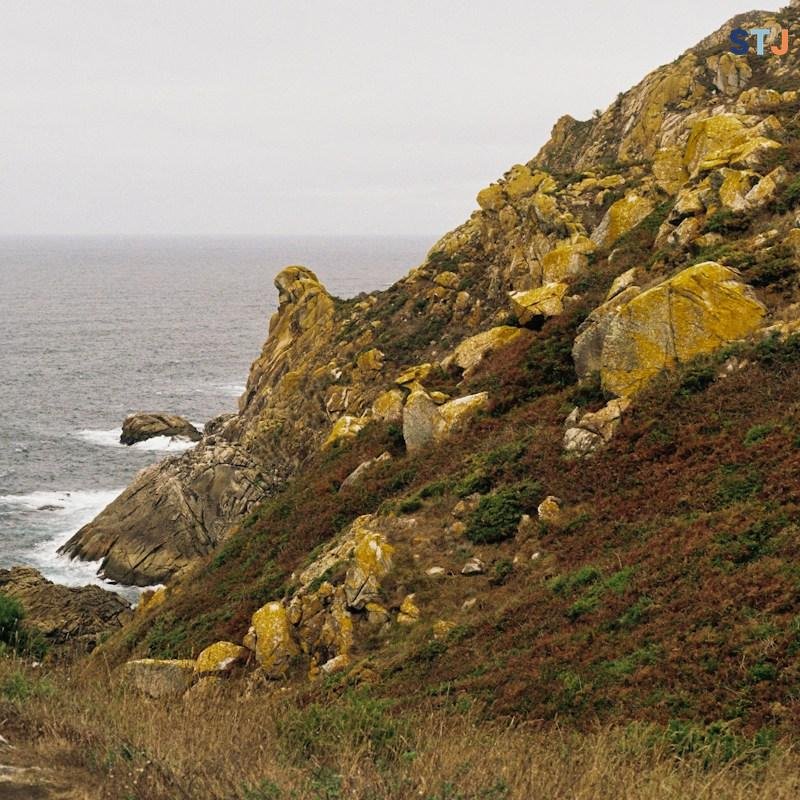
On Costa da Morte, that in-between territory is vast.
One of the most often repeated stories is that of the raqueiros.
According to the popular version, some coastal dwellers placed lights at strategic points — even lanterns tied to the horns of cows — to deceive ships at night. Sailors would take those lights for other vessels or safe harbours, come too close to land and end up wrecked.
Then the raqueiros would plunder the cargo.
It is a magnificent story.
Which is precisely why it has survived.
The problem is that historical research has found no solid evidence that any organised practice of causing shipwrecks ever existed. The black legend turned the salvaging of goods that reached the shore after real accidents into something very different: deliberately causing the disaster. Local research and publications have insisted on keeping the two apart.
The sea needed no help to sink ships.
The geography, the storms, navigation without modern positioning systems and the historical lack of signals were dangerous enough.
But Costa da Morte has other, much older legends.
To find them, you have to go to Muxía.
Beside the sanctuary of A Virxe da Barca lie gigantic granite boulders, around which one of the best-known traditions in Galicia grew up.
Christian legend tells that the Virgin arrived here in a stone boat to encourage the apostle James during his evangelising mission.
The boat is said to have turned into the enormous stones that still surround the sanctuary.
The Pedra de Abalar, the Pedra dos Cadrís and the Pedra do Temón represent different parts of that boat, depending on the version of the tradition. Some of them were also credited with ritual powers: passing nine times beneath Os Cadrís was associated with curing certain ailments, while Abalar could rock under the weight of those who climbed onto it.
The interesting thing is not deciding whether we believe it or not.
The interesting thing is understanding that those stones were already part of the symbolic landscape long before we arrived with a camera.
Something similar happens at Cabo Vilán.
There, rocks have been named A Caveira (the skull) or A Moa (the millstone) after the shapes they suggest. At O Roncudo, other stones keep names linked to shipwrecks and cargoes.
The landscape thus becomes an archive.
It needs no plaques.
Each generation learns where something happened and ends up weaving it into the place names.
Shipwrecks also generate their own folklore.
The Nil left stories of fabrics, machinery, champagne and objects recovered from its cargo.
The Banora filled the coast with oranges in 1965.
The City of Agra even left behind a bell that can still be seen in the church at Camelle.
And then there is the Prestige.
Here we are no longer talking about legend, but about contemporary memory. In Muxía, the sculpture A Ferida (The Wound) turned an enormous piece of fractured granite into a symbol of the disaster and of the volunteers’ work.
Perhaps that is why Costa da Morte is so fascinating.
Because its stories are not kept only in archives.
They are scattered across the land.
In a stone. In a cross. In a bell. In a cemetery facing the sea.
Some belong to history and others to the imagination.
And the best of them have been told for so long that it is hard to know exactly where one ends and the other begins.
This article is part of Mónica Romero’s final project for the Master in Travel Journalism at the School of Travel Journalism.
Mónica Romero wrote this piece as the final project of her training at the School of Travel Journalism. If it inspired you, take a look at our Master in Travel Journalism and our Master in Gastronomic Journalism and Communication, watch our students’ travel documentaries on YouTube and listen to their stories on our podcast on Spotify.
← Previous instalment: The Lighthouse Keeper’s Life: From Isolation to Automation
Next instalment (28 November): 12 Costa da Morte Viewpoints for Breathtaking Sunsets →
All parts of the “Costa da Morte” series
- 1. The “End of the World” Lighthouses of Costa da Morte: Where the Map Ends and the Atlantic Begins
- 2. A 3–5 Day Lighthouse Route Along Costa da Morte: Scenic Itinerary, Stops and Experiences
- 3. The Shipwrecks That Named Costa da Morte: 8 True Stories and What Remains of Them Today
- 4. Cabo Vilán: The Light Born of Fear and Storms
- 5. Fisterra: The Lighthouse at the End… and the Beginning of Many Lives
- 6. Touriñán at Sunset: The Ritual of the Last Light
- 7. The Lighthouse Keeper’s Life: From Isolation to Automation
- 8. Coastal Legends: Raqueiros, Stones with Memory and Other Tales Still Told (you are here)
- 9. 12 Costa da Morte Viewpoints for Breathtaking Sunsets
- 10. Photographing Lighthouses and Storms on Costa da Morte: Gear, Safety, Framing and Golden Hours