
By Florencia Fraga
“It’s as if time stood still,” said a German woman with whom we were sharing a privileged view of the Church of San Francisco from a pool measuring two metres by one.
There, five adults, a little girl and a baby were enjoying the only possible activity on that Sunday midday, when the dry, intense heat made itself felt. In almost perfect Spanish, she told us that many years earlier she had lived in Argentina: she had chosen the country for a study exchange and used that time to travel through much of it. Now she was back on holiday with her family.
One special reason for choosing the destination was to visit a friend from those student days, also German, who had decided to stay and live deep in the mountains after falling in love with a local man. To this day, she is still trying to solve the riddle of how her friend manages to live in a place where “time stands still”. It’s an impression that grows stronger once you leave Salta “La Linda” and travel along remote roads into the mountains.
Salta “La Linda” and the art of coquear
Our stop in Salta was brief, but that didn’t stop us doing our best to explore it and enjoy its streets. A local taxi driver advised us on the traditional art of coquear, chewing coca leaves into an acullico, the small wad tucked between gum and cheek, and with his convincing, expert patter he earned himself a tip. Two days after arriving, with our first packet of coca leaves in hand, my two friends and I set off on the road through northern Argentina. Travelling through these regions was something I had wanted to do for a long time, and at last it was happening.
A road trip through the north: Cachi, Cafayate and the Quebrada de Humahuaca
We drove 1,564 kilometres in total. We visited Cachi and slept in a cabin where we fought over the washing-up just to gaze at the vastness of the mountains through the big window. We carried on through the arid Quebrada de las Flechas to Cafayate and its lush vineyards. Getting from Cafayate to Purmamarca means taking Route 68, where we lost ourselves in the blend of colours: the reddish rocks, the green grass, the yellow of the dry land, the blue of the sky.
The Salinas Grandes salt flats overwhelmed us with their sheer size, while Tilcara and Humahuaca treated us to trails between gorges of orange rock, multicoloured hills and waterfalls. The trip ended in San Salvador de Jujuy, where the landscape is transformed by the humidity of the Jujuy yungas, the subtropical montane forest on the eastern slopes of the Andes, as you can see in Calilegua National Park.
The road to Iruya with Ignacio
Some moments of this great journey are firmly anchored in my mind. One of them is the road to Iruya with Ignacio: a village you reach along tracks above the clouds. We spent several hours driving through the mountains, listening to stories of the region told by our local guide. At times his thick northern accent, together with the roar of the 4×4’s engine, made it hard to follow the thread, but that didn’t stop us hanging on every story. Ignacio told us about local customs, about the essence of each village and what life was like there. His stories intertwined with the landscapes we discovered along the way and connected me even more with the experience of being there.
“Lo de Lidia”: a conversation that leaves its mark
Another experience that marked this trip came after walking the Quebrada de las Señoritas. That day the sky was completely clear and the temperature was perfect for the long paths between walls of rock. Once we had finished, we decided to have lunch in Uquía.
“Where are you visiting from?” asks the young woman who works at Lo de Lidia, a restaurant set up in the home of Lidia herself, where several certificates for making the best tamal in the north were proudly displayed.
“From Uruguay,” we reply.
“I bet you’re all nurses or doctors,” the young woman exclaims confidently.
“No, no,” we answer with shy smiles.
Her black eyes shone and her face took on an expression of pride and longing that moved me deeply. That moment left a mark on my soul. The fact that the young woman took it for granted that we had a higher education made me aware of our privileges. We are not nurses or doctors, and yet the three of us had the chance to choose between possible futures. That is not the reality for everyone, and this exchange, which could have been fleeting, revealed it to me completely. There is a particular energy throughout this part of Argentina: you sense it in the air and when you talk to people. And it makes your body vibrate differently.
Purmamarca, Viltipoco and the memory of the land
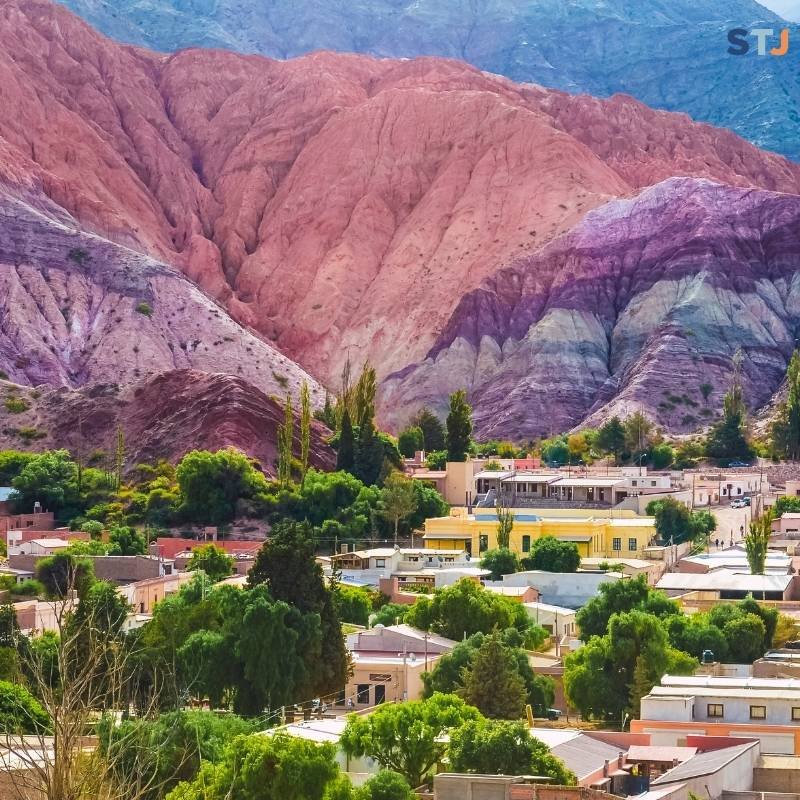
Walking the little streets of the villages around here, and above all Purmamarca, is like strolling through a craft lover’s paradise. All the musical and poetic richness blossoms in every peña, those gatherings dominated by folk rhythms such as the zamba, the chacarera or the malambo, while the aroma of freshly grilled tortillas wins you over. In fact, cultural expression has been a weapon of resistance in these regions, keeping alive the memory of Viltipoco, the Omaguaca chief from Purmamarca who united the peoples of the Quebrada and led the fight to remain on their land. Irene Marks expressed it in one of the poems in her book Antigales:
“…Buscan las piedras
la llaga abierta de tu indomable vena.
La encuentran y se incendian.
No fue de infierno esa luz.
En la ensangrentada rosa
de la roca encendida
en Purmamarca,
más allá del arrebol de todos los ocasos,
tu sangre está y estalla.”
(…The stones seek / the open wound of your untamed vein. / They find it and catch fire. / That light was not from hell. / In the bloodied rose / of the burning rock / in Purmamarca, / beyond the red glow of every sunset, / your blood is there, and it bursts.)
I remember coming across the monument to this chief and finding special meaning in the words engraved on it: “But the soul is not for sale; it will always remain, in the depths of time, which we want to recover.” Could it be, then, that time doesn’t really “stand still” here, but that in these latitudes time follows the rhythm of the soul? Slow time, time for presence and noticing, giving the mind room to interpret the answer the body has already sensed.
Pachamama and the rhythms of the soul
My body remembers the sensations of my stay in northern Argentina. I close my eyes and can feel the warm air on my face, the sun beating firmly on the crown of my head, my eyes dazzled by the glare of the sky and, at the same time, amazed by the brilliant orange of the Quebrada de las Señoritas. The thrill of walking on the two hundred and twelve square kilometres of the Salinas Grandes, which have been there for millions of years. The thrill of standing before a rainbow printed on the earth, the Hornocal, a range of hills more than four thousand metres high that made me aware of every breath I took. Savouring a northern empanada and cooling off with a cold beer after a long walk to the Garganta del Diablo.
As Don Atahualpa Yupanqui, the folk singer and poet whose music captured the slow pulse of the countryside, once put it: “For those who look without seeing, the land is just land.” The communities of northern Argentina, their people and their culture convey a deep love for and attachment to their land: the meaning of existence and the importance of being grateful to Pachamama, Mother Earth, for she is the one who gives us everything. The land provides people with the material for the bricks of their houses and with the space to grow their food and raise their animals. Every August, communities devote themselves to Pachamama with celebrations, but above all by contemplating her, honouring her and giving her offerings in thanks. For there is no life without the kindness of the earth.
In this part of the world, people have understood perfectly that nature’s rhythms are wise, and that respecting them is the way to live in nature and thanks to it. Northern Argentina sees and feels its land with the soul; it doesn’t just look at it. And I return to my country shaped by this way of being. That German woman’s comment still echoes in my mind, as it did throughout my journey, because I now understand that it isn’t that time “stands still” in these latitudes; it’s that time slips away from me in the whirl of big cities and in the rush that erodes my conscious presence.
Florencia Fraga wrote this piece as part of their training at the School of Travel Journalism. If it inspired you, take a look at our Master in Travel Journalism and our Master in Gastronomic Journalism and Communication, watch our students’ travel documentaries on YouTube and listen to their stories on our podcast on Spotify.
Interested in writing about travel that explores the extraordinary? Discover the Master in Travel Journalism and the Master in Gastronomic Journalism and Communication at the School of Travel Journalism.