
By Blanca Pereda
There is a way of disappearing that doesn’t involve moving house. It happens when your neighbourhood is still there, with the same streets and the same façades, but it no longer belongs to you, or to Pilar, or to Ignacio. When the greengrocer’s across the road closes because it can’t pay the rent. When the bookshop you’ve always gone to, the one where they know which book is right for you, has to leave because the building where they’ve worked for forty years has been sold. When you stop saying good morning to the neighbours you’ve known all your life, because now all you hear is the rattle of suitcase wheels and all you see are new faces every weekend. When you realise that, at some moment that went unnoticed, your city, your neighbourhood, your home turned into a tourist product.
Charts don’t have neighbours
For years I was familiar with all this. With the other side of it, in fact. I saw people whose eyes lit up when they realised they were in a position to ask for more, clicks that turned into bookings, graphs that kept rising. From an office with a view, it all made sense: supply and demand, the sharing economy, the free market. But graphs don’t have neighbours, and they don’t measure the alien feeling of being a stranger in your own city. The alarm went off late (or perhaps it was right in front of us and we ignored it) on an ordinary day, walking down the street. Three buildings in a row with similar signs:
“Tourist apartments. 24-hour check-in.” Where María’s family used to live, there is now a keypad on the door. Where the haberdasher’s was, a reception desk. Gentrification doesn’t arrive all at once. It comes flat by flat, neighbour by neighbour. And then you see it. The absence. Because streets packed with crowds shuffling along in flip-flops and shorts in the middle of November are exactly that: absence. Of locals, of identity, of belonging. The absence of reality.
The price of postcards
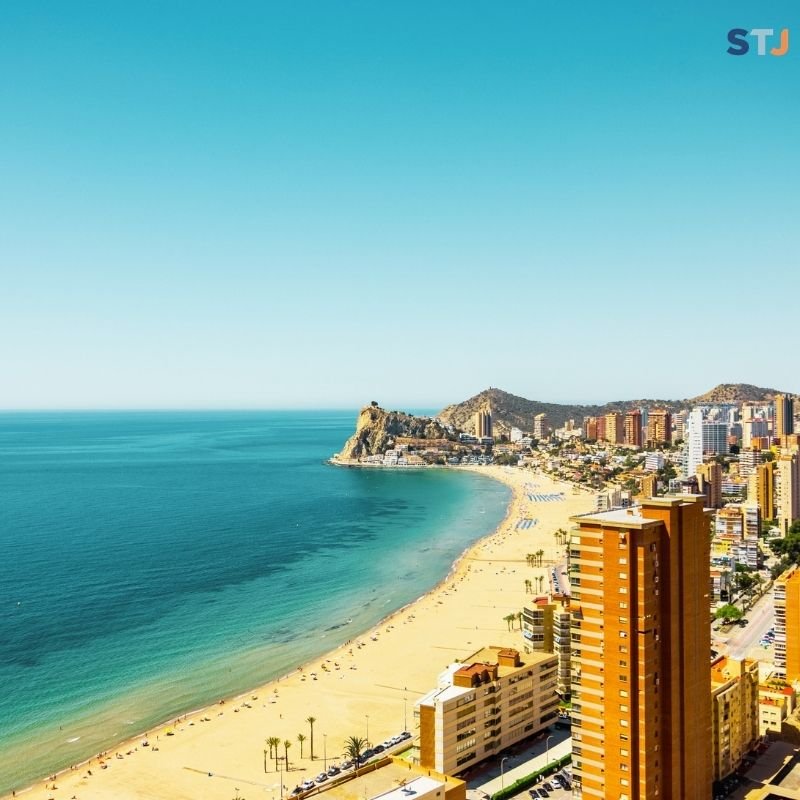
How much does it cost to live where other people want to go on holiday? On the Costa Blanca, as in so many other places, more and more. Rents have risen by almost 60% in recent years. As well as watching your city become an Instagram backdrop (and having to dodge tourists on your way to work as if you were on an obstacle course), your neighbourhood is now traded on Airbnb. Many of my friends, who could easily be yours, have left. One moved to a village inland. Another went back to her parents’. A third shares a flat with four other people, as we did in our twenties, except that he is now in his thirties with a permanent contract. Meanwhile, a building is sold to a foreign investment fund. Express refurbishments, tourist licences, a constant turnover of guests who will never learn that the rubbish goes out at night. The weariness of those who remain blends with the loss of identity of neighbourhoods reduced to a tourist stage set on which everyday life barely survives.
So, are the people who rent out flats the problem? Frankly, you can’t judge by the same yardstick someone who inherited their parents’ flat and lets it out to help pay the bills, and a giant that buys up apartments by the batch as if they were pears, or companies with hundreds of properties they have never seen and manage from a mobile app.
Invisible shared responsibility
If I’ve learnt anything, it’s that we are all part of the problem.
For years the platforms operated in a convenient legal vacuum, town halls looked the other way while their revenue rose, big investors bought everything they could while nobody regulated anything, and some owners let without a licence. And we residents were too slow to react. We got used to seeing our cities turn into theme parks. We resentfully accepted that shops would close to make way for short-lived trendy spots or bars selling stale paella and sangria of dubious origin for dinner. Sustainability isn’t only environmental. It’s social too. It means asking whether the tourism we want is compatible with people being able to go on living in their own neighbourhoods. Now measures are starting to arrive. Moratoriums. Zoning. Inspections. Some cities are suspending new licences. The regional government of Valencia is removing thousands of irregular holiday lets from the register. But the question remains: is it enough? Is it too late?
What might have been
The irony is that none of this had to be this way. Tourism could have been something else: exchange, mutual understanding, openness. That might have been possible if these measures had been in place from the start. They are hardly revolutionary; they are simply common sense. Some cities acted in time, while others, such as Venice or Dubrovnik, became living warnings that we have foolishly ignored: museum cities where residents are extras in their own homes. The Costa Blanca is somewhere in between. There is still local life, neighbourhoods holding out. There are still bakeries and old-fashioned bars, and brave people opening new businesses when everything seems to be against them. But with every moment that passes without effective action, the scales tip a little further towards the stage set, towards the scenery.
Packing our bags
I think about this every time I see someone desperately looking for somewhere to live because they’ve been pushed out of their home. Every time I walk past a shop with its shutters down. Every time I hear the story of someone leaving because they have no other choice. Visitors pack their bags on Sunday to go home. Will we have to pack ours to leave our own?
Blanca Pereda wrote this piece as part of their training at the School of Travel Journalism. If it inspired you, take a look at our Master in Travel Journalism and our Master in Gastronomic Journalism and Communication, watch our students’ travel documentaries on YouTube and listen to their stories on our podcast on Spotify.
Interested in writing about travel that explores the extraordinary? Discover the Master in Travel Journalism and the Master in Gastronomic Journalism and Communication at the School of Travel Journalism.