
By María Eugenia Martín
If decadence is embodied in Havana, Paris sounds like accordions, Lisbon is Europe’s nose piercing, Lima blurs into its drizzle and Buenos Aires dances the tango, then blue lives in Chefchaouen.
As far back as Ancient Greece, writers such as Herodotus, Aristotle and Homer asked themselves why we travel, and their answers wove together philosophical, historical, anthropological, ethical and political explanations, digging into thorny questions in an effort to understand human beings a little better. At other times the reason for a journey has been, and still is, much simpler: seeing the place that stuck with you after watching a film, visiting the city whose museum holds your favourite painting, fulfilling the wish to sit in the bar where a group of writers used to meet, wandering down the street where the hero of a novel lives, or getting the same photo in the same landscape as the influencer of the moment. In my case, after overhearing a conversation at the next table in a café, I wanted to see for myself whether there really was a town in my favourite colour. And so blue pushed me all the way to a Moroccan town in the Rif mountains, between Tangier and Fez, called Chaouen or Chefchaouen, which means “look at the horns”, because from there you can see the rocky peaks that surround it.
My first sight of Chefchaouen was of a town being born out of a mountain and trickling down the slope, spreading in blue threads that ran up and down. I had no idea how this North African town, flooded by a sea without water, would surprise me. I soon realised it would not be a monument, a mosque or a grand square; its beauty lay in the way it was composed as a whole, and it revealed itself little by little on blue walks. All I had to do was set off through the narrow streets and watch the cascade of blues twist and deepen around certain corners. Chefchaouen gathers every blue imaginable into a handful of corners: the indigo and cobalt of the ocean depths, the turquoise and aquamarine of Zanzibar’s beaches, the steely, stony blues of Patagonian ice, the sky blues and violets that herald the dawn, right down to the palest shades, almost white.
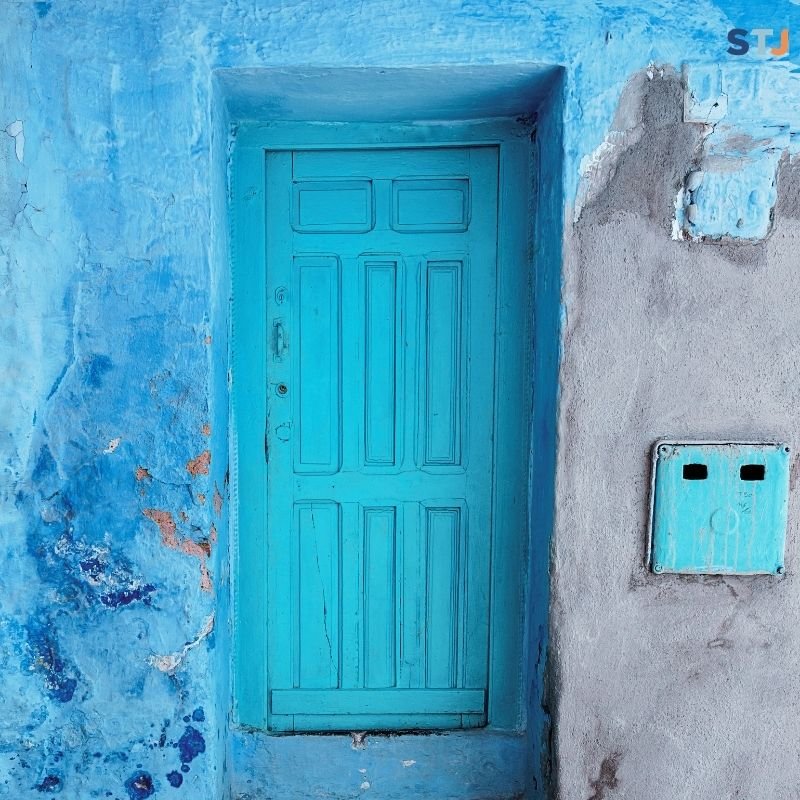
The town unfolds a hypnotic aesthetic for anyone who decides to visit. Had I been a painter, I would have walked its streets armed with brushes and a canvas under my arm, and let the pictures flow out of my hands on their own. Every spot is an endless source of inspiration. Sadly, I don’t have that gift. Instead, I was overcome by the elusive yet very physical feeling that the whole range of blues was passing through me, stirring different sensations, and amid those powerful, lyrical scenes I needed to capture the dreamlike link between reality and fantasy and express it somehow. Surrealist writing turned out to be a good vessel for whatever was bubbling in my subconscious without passing through the filter of reason, so I would sit down and write. The softer, powdery shades on some façades filled me with serenity. The glaucous and greyish tones, on the other hand, fell over me like a veil of fleeting sadness that turned into other emotions as I moved on to other hues. The sapphires, indigos and navies plunged me into an inner journey towards my own depths and dreams. I had never felt such an organic communion with a colour. Although I spent only two and a half days in the town, the omnipresent blue led me into an altered state of mind and convinced me that the whole world would now be shot through with it. It was almost an obsession. Walking into a restaurant, for the first few minutes I felt practically “assaulted” by other colours, so different from the monochrome outside. Stranger still was catching myself surprised that the cats dozing elegantly on steps and windowsills were not blue. Leaving the riad where I was staying, it even crossed my mind that swimming goggles would be more useful than sunglasses, convinced that I could dive into some nook of sea-coloured tones. I wasn’t losing my mind; I simply let places run through me, and Chefchaouen was soaking me in its powerful blue.
Chefchaouen fed my playful spirit in other ways too. As in other Moroccan cities, the medina is a labyrinth, and the tangle of its streets inevitably took me back to childhood, to games with hardly any rules where surprise is constant and your heart races because you don’t know what you’ll find around the next corner. Those improvised walks through the medina offered me a collection of wooden doors of every size and shape: some looked made for Lilliputians, others were grander, with Hand of Fatima door knockers. I had to resist the urge to knock and see who lived in those houses and have a chat. To ask them what they thought about their town, originally white, being blue, and whether they knew why people had started painting it that way. Whether it dated back to the arrival of the Jewish community, who used blue because it symbolised the sky and spirituality, whether it kept insects away or whether, quite simply, it kept things cool.
Amid the smell of freshly baked bread and spiced tagines drifting out of some window, I found the loveliest shop displays. The blue walls served as showcases, hung with fabrics, blankets, hammocks, babouche slippers, painted prints, rugs, lamps and boards of earrings and necklaces; there were soaps and other argan cosmetics in baskets and, lined up on the ground, little sacks of powdered pigment. I would have bought bags of powder in every colour without really knowing what for, just for the visual pleasure of looking at them now and then.
I remember a crossroads of alleys presided over by a grapevine whose trunk suggested it was very old. The roof woven by its tendrils gave pleasant shade, and I sat beside a tiled fountain where children and women were filling their jugs, letting the drops of water splash me. Just opposite, the street known as “Between Canals” rose in a staircase: it could have been the Moroccan version of a stairway to heaven. Red, yellow, orange and green flowerpots adorned the steps and walls, as in the patios of Córdoba. But here the pots burst out fiercely against the blue, and Chagall’s paintings came to mind, for the reverie stirred by images in which he handled blue masterfully and then boldly finished them off with other colours.
Plaza El Haouta, set back from the medina, was a haven of peace. Its central fountain was surrounded by watchful cats, whose permission you seemed to need before going near it. I wanted a photograph of the fountain’s roof tiles breaking up the blue, with the mountain “horns” peeking out in the background.
Night was falling and, on my way back to the riad, I stopped at a pool of light. The wall the faint glow came from was crammed with woollen scarves and hats. As I drew closer, I saw a boy inside who couldn’t have been twenty. I wanted to be part of that picture without intruding. “Salam,” I said, and carried on in French, because I had read it was a good alternative: “Votre magasin est très joli, monsieur.” “Et trop petit!” he replied with a smile. It was, indeed, the smallest shop imaginable, and also a corner brimming with charm. The boy sat inside his tiny stall under the breath of an oil lamp, buried among the coloured wools he knitted into his garments, and he talked without ever stopping. While I tried on a scarf striped in black, red, yellow and green, he told me how much he loved his craft. I couldn’t resist the melody coming from his transistor radio and asked who was singing. “Hamza Namira,” he said. “Marocain?” I wanted to know. “Non, égyptien.” Then I tried on a Parisian-style beret with brown and beige patterns. “Ce béret lui va très bien, madame,” he remarked, looking up from his work for a couple of seconds. I had no idea whether it suited me, as there was no mirror, so I trusted him and bought the beret. “Shukran,” I said gratefully, saying goodbye with the only other word I knew in Arabic, and shook his hand. I had forgotten how to say goodbye, and once again I had the recurring idea of learning Arabic some day, though its difficulty always puts me off. As I walked away I turned round; I couldn’t tear myself away from that stall and wanted to keep it in my memory like a postcard. I still have the beret, and whenever I wear it, the endearing boy comes back to me, knitting multicoloured scarves and hats by lamplight, defying the blue that reigned outside.
The next day I climbed up to the viewpoint near the Spanish Mosque, also known as the Bouzafar Mosque. “Spanish Mosque” sounded like an oxymoron to me, but the name turned out to be very fitting, as the building is an eclectic cross between a hermitage and a mosque. From up there, it looked as though the walls around Chefchaouen no longer served a defensive purpose but rather one of containment, to stop the blue from running away.
I would have liked to carry on up the mountain and go for a hike, but I knew I didn’t have enough time. Instead, the walk down along the Ras El Maa river gave me a scene of everyday life I could happily have stayed in for good. Women and girls were gathered at a communal washing place under a wooden roof, washing their clothes in the rushing water that tumbled over small waterfalls. I was absorbed by their bustle, recalling the stories my grandmothers had told me about going to wash clothes in the stream. One woman came over and put a flowery yellow headscarf on my head, its fringes and little coins dangling over my forehead. “Guapa, guapa,” she kept saying in Spanish, stroking my face and hair. They laughed, and I laughed with them. She gave me the scarf. I didn’t know how to repay her gift and instinctively rummaged in my bag, but found nothing I could give her. It wasn’t the first time something like this had happened to me, and I couldn’t help feeling overwhelmed and flattered in equal measure. I said goodbye without taking the scarf off. I had an ice-cold orange juice on a terrace by the stream, watching them take the oranges out of the water before squeezing them. Feeling very hippie, I asked the waiter to take a photo of me next to a clock set into a Gaudí-style wall. I crossed the river by a little stone bridge and lingered a long while among the meandering alleys, with no purpose other than to soak up the light of the magic hour at dusk.
I got back to the riad after dark. I went out onto the terrace: the blue had gone out. In its place, the hillside and the valley floor had filled with tiny lights twinkling like fireflies, and I lost all sense of time, just as I used to as a child in front of the lights of Christmas nativity scenes.
On my last morning, before taking a taxi to Tangier airport, I got up very early. In those first hours of the day it was a delight to be alone in the streets of Chefchaouen, with all the blue to myself. On my way to Outa el Hammam square, I stopped at a second-hand bookshop, Librairie El Kadi Ben Maymoun, carpeted with books scattered all over the floor. It saddened me that they weren’t on shelves, because some were real gems. I couldn’t tell what most of them were, as I couldn’t read their Arabic titles, but I bought one that was unmistakable from its cover drawing, The Little Prince, which joined my collection of Little Princes in different languages.
Outa el Hammam square lies at the foot of the town. There, the Great Mosque and the sand-coloured Kasbah offered a rest from the blue. I loved climbing the Kasbah tower and gazing out of its windows at the palm trees in the valley and the mountains on the horizon. I made the most of my last hour on one of the terraces of Outa el Hammam, sipping mint tea to the unhurried rhythm of the square and watching people stroll by. It reminded me of the villages of the Alpujarra in Granada.
As I savoured the hot tea, it became clear to me that colour was what had led me to the blue poetry of Chefchaouen. Among my memories I came across the colours of other landscapes and other scenes: the white of salt flats, the orange of dunes, the violet of lavender fields, the riot of colour in markets, the blush of the northern lights… And I wondered: how many more are out there, waiting for me with their colours?
María Eugenia Martín wrote this piece as part of their training at the School of Travel Journalism. If it inspired you, take a look at our Master in Travel Journalism and our Master in Gastronomic Journalism and Communication, watch our students’ travel documentaries on YouTube and listen to their stories on our podcast on Spotify.
Interested in writing about travel that explores the extraordinary? Discover the Master in Travel Journalism and the Master in Gastronomic Journalism and Communication at the School of Travel Journalism.