
By Torunn Irene Seldal
“This is it”, I uttered as I was looking at my yellow post-it sticks arranged on my desk – each with a written location name. “I am going back to Lofoten Islands”, I sighed as if my life depended on it, on a different mission this time. One of them was to investigate why women surfers and myself included are feeling so drawn to the coldwater waves in Unstad.
Of course, I know very well that one of the reasons we feel this magnetic pull towards Unstad, is because it is the prime location when it comes to
These women are not choosing an easy spot to improve their surfing power and consistency – especially skills. On top of powerful, big and messy surf there are strong tidal if you start comparing it to the currents and strong wind that can sweep you off your feet, then there popular surf locations in the rest of is the ice, snow, rain, storms and the thick neoprene, gloves and the country. I have studied this booties. Did I forget something? first-hand with a couple of buoys, and I can with certainty say that
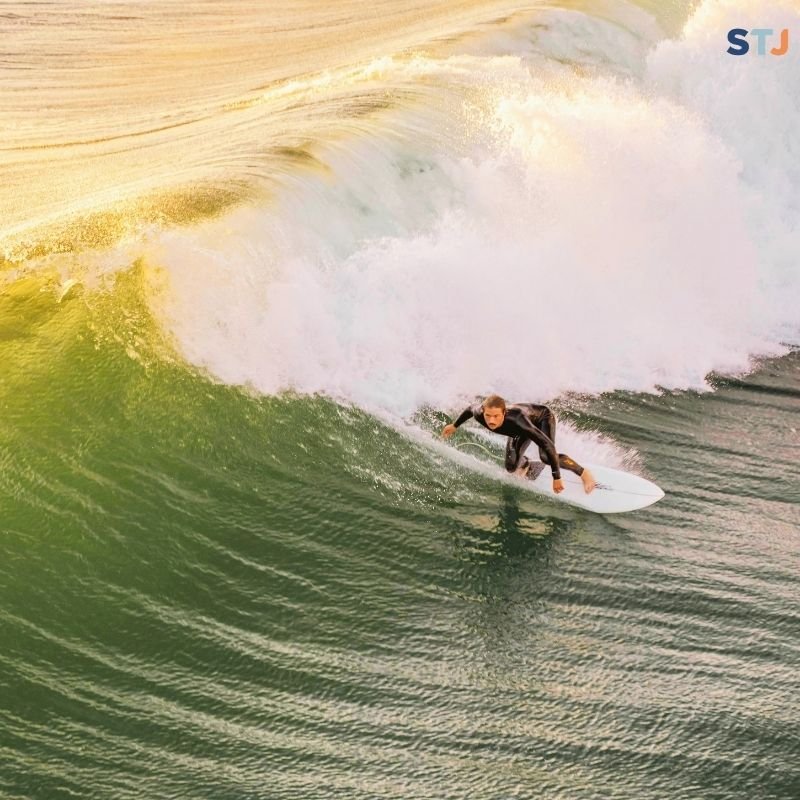
Yet, the number of women surfers in Unstad is increasing, only the observations are correct, the reflecting the global flare up of women entering the surf scene. breakers here are powerful. Though,
Surfing is a sport that has been male-dominating for centuries, then we already knew this from feeling thinking back to my surf science history class, there was talk about the waves by duck-diving or being surfing being a gender-equal recreational sport in ancient Hawaii. As smashed by them, but isn’t it nice to this has been dissolved for hundreds of years, women suffered to be have some data backing it up? blocked and prohibited from surfing to being marginalized with surf industries and media prioritizing their physical appearances or “bikini The last mission I was here for, was model” over their athletic abilities. to collect data for my post degree as an Oceanographer, so that’s why
Has this followed all the way to Unstad, 68° north from the arctic I feel the waves beneath this story circle, or does cold-water surfing strip away “the bikini model deserved some depth first. economy”? And those brutal conditions, wetsuits and so on determine who belongs and how?
Out of six of the seven women I interviewed (which I see daily are committing to the surf!), a recurring theme emerged: taking up space in a male-dominated sport. However, there seems to be an agreement of a different vibe in Unstad compared to other popular surf destinations around the world and in the rest of the country. Here, people are being very inclusive and are welcoming to newcomers.
“Almost everyone in this surf
If I see a woman surfer do something radical or scary in the surf, then community has moved here so then
I think I can do it too, but if a guy does it, I just think he is crazy”, she we end up shaping this surf culture said with a quiet laugh. together”, Tuva Børsheim said, local surfer since 2016.
Maybe this also inspires other women to continue pushing their performance in surfing and reclaiming their seat in the lineup that has She has been surfing overseas in always been there. many different countries and has experienced the macho surf culture
I´ve seen more women surfers in the lineup here now than when I first head-on. Where it has been very came here in 2020. Then it was only me and some guys or only guys difficult to get waves compared to plus Tuva”, Isabelle Johansson, Swedish surfer, said. She drove all the in Unstad. Here, she feels she has way from Stockholm to start her new surf adventure after surfing in more freedom and opportunities to
Costa Rica. catch waves because of less crowd.
Johansson thinks it is a bit sad that women do not always feel they “I think the reason for the growth of can take their seat in the line-up, but that with the growth of women women surfers in Unstad, is because surfers it has brought forward a more open community. Isabell of social media and that women explains that the women show a lot of resilience showing up in these surfers inspire other women surfers. harsh conditions, and that it is more the reward of a warm shower after the surf that can make the hassle all worth it.
“I feel like the lineup in Unstad isn’t as male dominated as some other places in the world. The other day when I surfed on my longboard, it was only women in the lineup”, Laura Elina, Finnish surfer said. She has been surfing here for over six years.
The localism and etiquettes don’t appear to be engraved in any Viking runestone, but when compared with popular surf destinations such as Hawaii, Australia and America, surfing was discovered a lot later in Unstad due to the technology of wetsuits to name a few. Maybe this was a good thing for the uprising of women surfers in these regions, because at this timeline the equity was already on a flair which may have given the Shield Maidens more freedom and space to contribute to shaping the surf community in Unstad.
There is more room to challenge yourself here with less crowd, but if it was 150 people out surfing then we might not have bothered to toughen up so much.”, Maud Nestgaard said, she was 22 years when she first came to Lofoten and think it is sometimes difficult to explain to surfers in other parts of the world what type of conditions she surfs in at home, so they can understand that she can actually handle challenging conditions.
“To give you an example, when I was in El Salvador, my friends there complained about offshore wind of 3mph, and I said, ” you have no idea, no one would have complained about that at home! ” There we have hailstones, changing of clothes in ice-cold wind, toes turning white, and you must make sure your underwear is easily available before you paddle out, because you don’t want to stand there freezing and look for it in the car” she said and laughed.
Women are treated differently in cold-water waves
Rebecca Olive, cultural studies researcher and a feminist has been doing several studies on women´s recreational surfing. She explains that women are gaining more confidence to seek more physically challenging experiences such as cold-water surfing, because women have been restricted or stopped from it in the past.
“I think there is something freeing about being in a wetsuit, not just swimmers. I’ve certainly noticed that there is a difference in how women are treated in cold water vs warm water places, maybe because it’s more difficult to immediately identify someone as a woman when they’re in a wetsuit? It’s hard to know”, she said.
I agree with Olive here, when it comes to surfing in a bikini, I feel free in the sense of feeling lighter body wise and because I can dip the whole body in sea water, not just my face. But when it comes to wearing a wetsuit I do feel freer to solely focus on improving my surfing, and I like that the black neoprene makes me feel a little “invisible” from the crowd and not being so self-conscious. I feel one is like wearing a pyjama at home and the other is like being on a fancy gala night wearing a dress.
Olive thinks the neoprene strips away the “surf girl” aesthetic, maybe even removing some pressure for us women when paddling out. I think she is spot on here, with everyone in the lineup looking like seals anyway. “But also, it changes how women are immediately obvious when wetsuits and all kinds of other neoprene are involved. They’re judged by strangers on their surfing before their gender.” Olive responded. From my interviews women repeatedly said there is an equal distribution of women and men in the lineup, but when there are more women in the lineup, some are feeling more loosened up and the focus is more on having fun.
“Women say there is a different feel for them, and they start to surf differently – less competitively and more focused on enjoying it,” some have told me. I don’t want to romanticise women or pretend that they’re angels from heaven. But it does mostly seem the collective experience of feeling marginalized often leads to a more inclusive approach when there are more women” she said.
A short history of women surfing in Unstad
“It wasn’t before 2012, that we could observe two to three women that surfed regularly in Unstad”, Line Breivik, managing director of Lofoten Surf Senter said.
The growth of women surfers had caught the local’s attention across Lofoten Islands, so in 2020 the local newspaper “Lofotposten” wrote two articles covering the flare-up.
“In 2011, there was arranged a surf competition at Unstad where women were encouraged to join but no one signed up, so Ellen Benjaminsen from Lofoten Beach Camp, Marion Franzten from Unstad Arctic Surf and me from Lofoten Surfsenter had to join, which wasn’t something we really wanted to, so this was the first competition with women surfers”, she said.
Breivik not only played a key role in the first successful women’s surf competition, but she also insisted that women receive equal pay and respect as the men during the 2019 Lofoten Open. This was the same year that World Surf League (WSL) installed the same rules, and in 2022 the WSL hosted competition in the same venue, so women would surf the same waves as men in all surf competitions such as the unforgivable wave “Pipeline”, in O’ahu, Hawaii. This was showcasing to the whole world that women are just as capable of surfing heavy and challenging waves.
Breivik´s actions set off a domino effect for future surf competitions across the country, leading to women finally being recognised and rewarded equally with men. Maybe this started something bigger, or maybe there was a benefit for women, that surfing started later in Unstad.
“More and more women come to the shop to either rent or buy equipment, so the interest seems to continue to grow”, she said with a big smile.
She also adds that it is 50/50 with men and women that are booking beginner lessons. Women surfing in the coldwater of Unstad bay has been increasingly prominent since the Lofoten Surf Senter opened in 2015. This demonstrates resilience and dedication in frigid conditions, but who stays and who goes seems to be up to Lofoten Islands.
“The weather conditions are clearly deciding who stays and who becomes part of the surf community. What we see from the first boom of women surfers, is that a lot of them moved partly because of the weather and partly because many wanted to live close to their family when they are getting kids”, Breivik said.
The influx of women to Unstad bay is evidently not being blocked, and it appears to be new faces occurring and familiar faces reoccurring, but one thing that might never change here, is the greeting that is received by the “Shield Maidens of Unstad”. Here women are celebrated, cherished, and seen.
Torunn Irene Seldal wrote this piece as part of the Final Master’s Project for the School of Travel Journalism.