
By Natalia Del Rivero
– To begin with, I’d like you to tell me a little about your story and introduce yourself: what’s your name and what made you study this career?
– My name is Guadalupe García de León del Paso. The first thing I did was train as an interpreter and translator, because when I finished secondary school the only option was hospitality management, and what interested me was cooking, not managing anything. So I spent many years working in translation. That led to general translations and later to translations related to food, but I also did a lot of graphic and editorial design. One day, when I saw how interesting the course had become at Anáhuac del Sur, because Culinarte from New York was there, I signed up. I left absolutely everything, I left my business partners and went off to study, and from that moment I started doing what I love and am so passionate about. As I said, at one point I was also doing translations to do with food, and that was wonderful for me because it was a niche I never expected to have. I worked with canola seed producers, who gave me the job of translating for them, which was also very interesting. And in that job – which I never expected, as a Mexican, and you’ll understand this perfectly – I would tell them: I want to send you something with tortillas, but I want you to fry the tortillas. So I sent them a recipe for chilaquiles, and then they asked me for another recipe with fried tortillas and I sent them flautas, which use the same ingredients, and they had no idea what I was talking about. So I had to start adding an introduction explaining the difference between one recipe and another, why they used the same ingredients and why the results were completely different. I also had to start sending them photos of the steps so they could understand the differences, because otherwise, poor things, they really had no idea. That was very interesting. About two years after finishing, I went to study for the certificate in Mexican cooking, and when I was already running my catering business they asked me to teach. I never in my life thought I would enjoy it, or that I would have the patience or the interest, and the truth is that I’ve now been teaching for almost 24 years and I still love it.
– And what inspired you to specialise in Mexican cooking?
– Oh, of course, because I love Mexican cooking. I love it. I’ve always felt it is very complete, that it has a lot to offer, and I firmly believe we have to spread the word about it.
– Which dish would you say is your favourite in Mexican cooking?
– You won’t believe this, but what I like most of all is fideo soup. For me, fideo soup in all its forms is just wow. Now, speaking more seriously, I think moles are wonderful, and I think they are actually very under-explored, because we know four or five moles, yet all over the country we have marvellous moles and adobos that represent us to the world in a very good way. And we make them intelligently, because if we make them too spicy nobody is going to eat them. That’s another thing we have to learn: chilli doesn’t have to be the dominant ingredient in a recipe, just one more element, one component.
– Speaking of ingredients, which ones appeal to you most, and why?
– Well, look, I find them very interesting because of the way they found their way into Mexican cooking and into every cuisine. That is the real art of cooking: knowing how to mix and combine, letting the ingredients shine without letting them overwhelm and trample the rest and steal their thunder. For me, that’s the foundation, isn’t it? A good balance, in which every component has its moment. That’s what we always have to achieve in our recipes. Recipes are born in families, and we have to give due credit to all those women – and men too – who have made Mexican cooking what it is today.
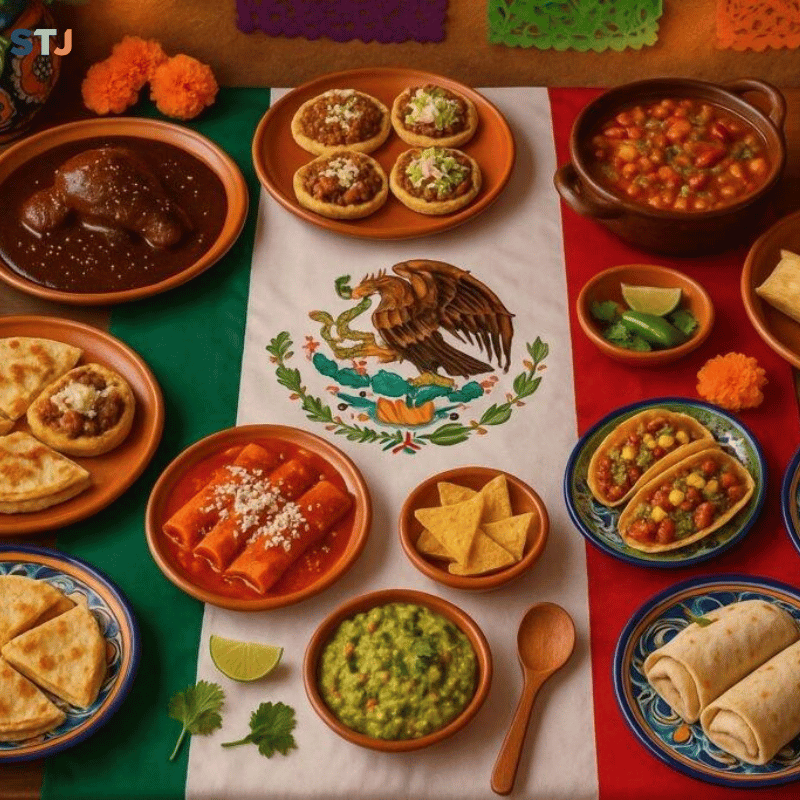
– Absolutely. And on the subject of our ancestors, is there a traditional technique you still use at home today?
– Yes, because I really like cooking from the ground up, starting from the very beginning. For example, I take my moles and chillies to the mills to be ground, or I do it myself with modern appliances – I’m not going to tell you I use a metate – but I like to do it from scratch. To teach Mexican cooking I had to learn to nixtamalise. At first I did it at home so I could learn how, so I could see the temperatures, how to put the grain in, and so on. So yes, I apply the principles of Mexican cooking: timing, respect, respecting the flavours, which I think is fundamental. I like people to tell me what they’re making. For example, something very classic, a chile en nogada, and it turns out they’ve used cashews and peanuts because they felt like it – that isn’t keeping to its origins, it’s something completely different, not a chile en nogada. That’s very important: that in our cooking, and in cuisines all over the world, we respect certain principles so that recipes stay authentic.
– Of course. And speaking of your role as an ambassador for Mexican cooking as a whole: I know you published a book with canola oil. Have you published anything else?
– I have four books. The first is called Bocadillos mexicanos de fiesta, published by Larousse, and I can proudly tell you that Larousse took it to the international fair in Paris in 2010 and it won first place in its category. Then I did another book with McCormick, about fish and seafood, with recipes from all over the world. The idea was to learn how to use herbs like the ones McCormick sells, which is also interesting because people need to learn that herbs aren’t all used in the same way. It’s a book I like very much, called Un mar de sabor. After that I did another book called Atún, with Atún Dolores. It’s a very beautiful, very complete book. And the last one I published is called Cuida tu corazón, which uses canola oil as a lighter oil; Larousse took it to a fair in Macao – I don’t remember the year – and it also won second place in its category of healthy-eating books. So I’m very proud of my life. And three years ago I was awarded the Ricardo Muñoz Zurita medal for spreading and promoting Mexican cooking, which also makes me very proud, because there must be about twenty of us who hold that medal.
– Congratulations on all these achievements. They really inspire me, and that’s why I wanted to interview you. Truly, congratulations.
– There’s something I didn’t tell you: my greatest dream was always to cook, and I did it from when I was very little. First with my father and then with my maternal grandmother, who were the ones who loved cooking, and I always loved it as a little girl – I had to be in the kitchen.
– Which ingredient do you consider indispensable in a kitchen for cooking Mexican food?
– Goodness, that’s very complicated, because it depends on which part of the country we’re in. Here in Mexico City we of course need maize to make tortillas, tamales and any preparation we like, because I think that is very important, and we need to know how to make the most of it. We have wonderful Mexican herbs, or herbs that adapted to Mexico and have become part of our cooking: for example, hoja santa, which is marvellous and isn’t from Mexico City, or coriander, which was brought from abroad but has become very important in our cooking. And above all, a real desire to cook – that’s another ingredient. Chilli, yes, but as I say, I don’t think its flavour should dominate.
This is only part of my interview with chef Guadalupe García de León del Paso. It was an interview packed with information and knowledge, and very easy to arrange once I got in touch with her: a great example of someone who presents cooking from its roots and with the importance it deserves. It was a very enriching experience that could easily fill a book with everything she has to share, beyond her four books – two of them award-winners – and her medal. I truly see her as a role model. I know I went over the word count, but she shared so much during the interview that it would have been impossible to sum it up in 1,000 words. This has definitely been my favourite interview and I would gladly do it again. Cooking is a passion, and she conveys it unmistakably – Mexican cooking above all.
Interested in writing about travel that explores the extraordinary? Discover the Master in Travel Journalism and the Master in Gastronomic Journalism and Communication at the School of Travel Journalism.